9.6 Billion Coming for Dinner – how can we feed them?

If you are reading this and you’re not hungry, be thankful.  If you are hungry, remember what it feels like, and get yourself a snack.  In either case it’s important that you then read this post.

There are expected to be about 9.6 billion people roaming the planet by 2050 –  35% above today’s 7.1 billion, growing 190,000 daily for the next 36 years.  Who’s going to feed them all?  This is a huge challenge – – we cannot do this on ramen alone.

A new initiative is exploring ways to fit everyone around that big dinner table in 2050, using solutions we can all live with.  It’s called FutureFood 2050.  More below, but it considers novel approaches such as 3-D food printing, leveraging the awesome power of the world’s women, and more.  

THE CHALLENGE
World Hunger

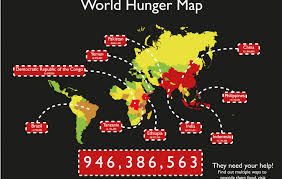
This issue starts with a large serving of irony:  according to worldhunger.org, about 900 million people regularly go to bed hungry – – about one in six people in developing countries.  Yet, we produce enough calories globally to feed everyone now.  (Daily per-capita food production in 2012:  about 2700 calories (FAO), more than the 2000-2500 recommended for adult women and men).

The problem, as we know, is partially one of distribution – the food may exist, but many people simply have no access.   Unfortunately there isn’t (not yet, anyway) a way to electronically transmit calories around the world.

Why is this so hard to fix?  We did figure out how to get creme filling inside a Twinkie, right?

Twinkies

Well, it’s just a little more complicated – – there are some major dynamics at work, including:
POVERTY.  Between 1-2 billion people live on $1.25/day or less, concentrated in Sub-Saharan Africa and South Asia.
CONFLICT/DICTATORSHIPS/CORRUPTION.  These isolate refugees, or divert needed aid, or both.
INFRASTRUCTURE. About half of the food grown in developing countries is wasted because of insufficient processing, packaging and storage capability.  And it’s often impossible to import due to lack of reliable transport.  Related to this is access to water; an estimated 800 million people don’t have access to clean water.
CLIMATE CHANGE.  Whether you call it Global Warming or not, extreme droughts, flooding and the like disrupt ability to grow crops efficiently.
ENVIRONMENTAL RESPONSIBILITY.  Industry faces increasing challenges in producing food in a sustainable, responsible way.  And there is a phenomenal amount of food wasted in developed countries.

THE PATH TO A SOLUTION WE CAN AGREE ON

Swaminathan

The most important step has been recognizing the problem.  Importantly, the UN, through its Food and Agriculture Organization (FAO), has conducted World Summits on Food Security to develop policy solutions to solve hunger.

But that’s at a policy level –  ultimately consumer acceptance, with willingness to compromise, is key to program adoption.  And that’s not always easy.  There have certainly been some dramatic food-centered communications over recent years.  But they’re often at either end of the ’science is always bad’ or ’science is the only solution’ spectrum.  In reality, most actions balance benefit with consequences; progress is made by objectively agreeing on serving the common good.

So how can we identify programs that we can all live with?  I think we can agree that this is a problem worth solving together.

The Institute of Food Technologists (IFT) has created FutureFood 2050 to take the discussion out of the conference rooms and to the people, to create an open dialogue and ultimately workable solutions. 

[IFT has 18,000 global members; they are often thought of as food scientists but their purview also includes most of the food supply chain.]

FutureFood 2050 will work over the next 18 months or so, featuring 75 conversations with the world’s leading independent-minded thought leaders, about how they think we can get to a healthier, safer and better-fed planet.  These opinion leaders will include policy makers, cultural influencers, scientists, engineers, avant-garde chefs, entrepreneurs, and more.

The first three interviews, covering 3-D food printing, leveraging the power of women, and an ‘Evergreen Revolution” (agricultural productivity without ecological harm) are already available on the website: www.futurefood2050.com.  Very interesting reading.

These interviews will then be distilled into a documentary by Scott Hamilton Kennedy, an Academy Award-nominated director, to be released in 2015.  As he said in an interview recently: “the hard part isn’t getting great content, it’s ‘how do you fit this amazing conversation into just 90 minutes’?”.

2050 seems a long time away, but world hunger is a massively complicated problem to solve, and it’s not too early to start.  Keep your eyes open as new interviews are conducted – – ultimately solutions may well come from the most unlikely places.

And once we solve that, we’ll work on getting the Cubs into the World Series.

SELFIES: Narcissism is now officially a trend (How can you tell?)

The youth of our society regularly assault the rest of us with a regular stream of silly fads, most of which mercifully fade from view in short order (think Cronuts, #anything, the phrase ‘YOLO’, and hopefully soon, Bieber).

However, a select few cross over into the magical land of Trends, which have more longevity, presumably because they offer something of (more) lasting value.

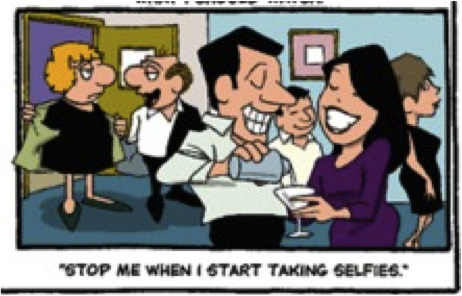
Last week’s Sunday comics provided an unexpected validation of the latest fad-to-trend transition: the Selfie.

Of course you know that selfies are photos taken of one’s self, in some unique situation, typically for the purpose of sharing (usually via social media) to demonstrate how fabulous your life is.   Recent selfies in the news have included our President, Ellen DeGeneres and Boston Red Sox slugger David Ortiz.  All have fabulous lives.

Last week, 3 comics (‘Doonesbury’, ‘Dustin’ and ‘The Lockhorns’) featured the Selfie.

Now, for this writer to extract deeper meaning from the comics is not news.

However, it is particularly instructive when you consider that the average age of the cartoonists (Garry Trudeau; Steve Kelley/Jeff Parker; Bunny Hoest/John Reiner) is 65!

DustinApril 6

As an activity that started with teens and spread via social media, one would hardly expect this totally narcissistic behavior to be recognized, let alone embraced by retirement-age journalists.

And yet, to quote Edna Mode: “…here we are”.

EdnaMode

In the case of selfies, this is one technology and social media-driven fad that has gone mainstream.   Who would have guessed?

So what, you say?

1)   Demographics, technology and social change are shifting so rapidly that generalizing about which groups will be trend adopters isn’t necessarily a good idea.

A recently published Pew Study finds that while older consumers are indeed less likely to be online than younger consumers, still, 59% of consumers 65+ are going online, and 82% of those are online regularly.
Think about that the next time someone assumes that xyz technology or app is ‘only going to be popular among younger consumers’.

2)   Don’t overlook the comics as a barometer of the national social conversation.

We have seen a little of what the future looks like. And apparently, it looks like ourselves at arm’s length.

SeniorSelfie

Outrage at New Corporate Average Calorie Count Mandate: What took so long?

Posted on

After over a year, the food industry has finally begun to voice frustration with the upcoming Corporate Average Calorie Count (CACC) requirements that were a little-noticed insertion in the recently implemented Affordable Care Act.

Like it or not, this law has been on the books for over a year – – why the sudden passive-aggressive reaction?

Like Big Auto’s Corporate Average Fuel Economy (CAFE) standards, CACC requires all US-based food and beverage manufacturers making over 20 products to average at or below 100 calories-per-serving for all processed products by 2019.   While CAFE uses a sales-weighted mean, CACC counts all products equally.  “We decided to use a simpler approach that everyone – consumers, manufacturers, retailers – – and Congress – – could understand”, said HHS Secretary Kathleen Sebelius (who knows a thing or two about the importance of simplicity). Sebelius-calories

Companies need to submit CACC plans by the end of 2014, with final compliance targeted by 2019.  Excluded are imported products, unprocessed foods, dairy, ‘ingredient’ foods like peanut butter or oil, alcoholic beverages and products sold through foodservice, vending and convenience channels (although vending machines are impacted by the same provision in ACA and have to post calorie counts by the end of 2014) .  Companies not meeting standards will face penalties of $1,000 per calorie above the target level, multiplied by each $1 million of revenue of that company. ACA-Vending

Food manufacturers are just now starting to realize the size of the challenge.  “CACC creates significant costs for manufacturers, a huge compliance burden, and most importantly, is likely to remove choice and impact taste for consumers,” said Lloyd Braun, CEO of Peterman Bakeries of Omaha, NE.  “If it’s difficult for a smaller producer like us, it could be almost impossible for the Krafts and Pepsis of the world”.

Indeed, meeting the standard will be tough.  We took a look at PepsiCo to see what they are facing.

According to its websites, PepsiCo sells 1327 products across its Pepsi, Frito-Lay and Quaker businesses (not counting Tropicana).  Its Corporate Average Calorie Count now stands at 118.2, with beverages actually close to the standard at 102.6, brought up by Frito-Lay at 137.9 and Quaker at 150.7 (click on chart).

PepsiCo-Calories

To meet the 100 calorie corporate goal, PepsiCo will likely need a combination of reformulation, elimination of higher-calorie offerings, and addition of lower-calorie offerings.  This could mean fewer products like Grandma’s Cookies (210 calories), Quaker Breakfast Cookies (175) and Starbucks Frappuccino (290) and more like Rice Cakes (35), Matador Jerky (75) and lots more AMP Sugar-free Energy Drinks (15).  Happily, Quaker’s Quisp cereal checks in at an even 100 calories and thus seems safe.

As difficult as this current Pepsi Challenge is, they at least have the benefit of a large number of products (and frankly, a couple of large subsidiaries) to work with.  The CACC mandate could be terminal for those companies specializing in more indulgent fare, such as frozen pizza (285), fettucine alfredo (415) and Garrett’s Gingerbread CaramelCrisp Popcorn (300).

Still, the angst is real: A source inside PepsiCo explained: “We thought we had done our part by helping reduce Americans’ calorie intake by 6.4 trillion calories as part of the 2010 Healthy Weight Commitment Foundation initiative – – we are now quite frustrated that the current Administration is piling on with these new requirements. So frankly, not much work has been done yet”.

Well, it’s time to stop whining and get to work.   ACA is not going away, and your country is depending on you.

US Census goes to NSA Fantasy Camp

This is a story of abuse of a bully pulpit in the online survey arena – – by none other than the US Government.

First, some context:  Recently I opted to answer one of those familiar online surveys, because a) being involved in the survey business I was curious and b) they asked nicely.  I would have also opted for c) a reward, but no one was offering.

However, after about the tenth or eleventh screen of increasingly inane questions (“how many times, on average per month, did you take a left turn in your primary vehicle over the last 6 months?”), I punched out and the surveyer was left with bupkis – nothing.  If they’d kept it to about 5 minutes I would have been fine with it.

In surveying, as they say, just because you CAN doesn’t mean you SHOULD.  This applies equally to network TV, use of cellphones and enhancement surgery.  There is a diminishing marginal return at work.  But I digress.

ACS_logo

The big kahuna of survey abuse came in the mail a few weeks ago – – the American Community Survey, cheerfully served up by your US Census Bureau.   This is a MANDATORY* survey that is constantly updated, and according to the website (accessible by clicking the graphic above), “generates data that help determine how more than $450 billion in federal and state funds are distributed each year.”  This includes typical data such as demographics, but then goes WAY beyond that.

*up to $5000 fine for noncompliance – – yee-hah!

ACS - Census - Screenshot

For the record, I have in the past been a big user of US Census data, and I’m a believer in its value for many purposes.

The reason this one is so objectionable is not only the intrusive information it asks, and not only the burden of time required to complete it, but also the $5000 hammer that awaits you if you refuse.  (There are apparently more extreme enforcement tactics, such as agents scoping out your house, but we shall stick to the meat of the matter).  It struck me as so out there that I actually considered contacting the ACLU to see if they can really do this.  The feeling subsided.

What The Survey Asks – –  check it out for yourself here.
– the survey starts out innocently enough – – ages, kids, ethnicity, etc
– then it dives into 2 sections that would make the NSA (or at least the IRS) blush:
1) HOUSING – – not just the expected house age, size, # of rooms – – this survey asks things like:
– exact types of computers, which of 6 types of internet service, monthly fuel expense, annual fuel expense, condo fees, monthly mortgage cost, real estate taxes, estimated resale value and other stuff including this gem:  “How much is the regular monthly payment on all second or junior mortgages and all home equity loans on THIS property?
2) PERSONAL INFO – – commuting time, what time the person leaves home for work and how long they are gone (hmmm…)
– also questions about income that made me swear I was doing a second tax return:  ‘Wages, salary, commissions, bonuses, or tips from all jobs. Report amount before deductions for taxes, bonds, dues, or other items.  “Interest, dividends, net rental income, royalty income, or income from estates and trusts. Report even small amounts credited to an account.  Etc. [Editors note:  dont forget the small amounts when dealing with the IRS.]   

It goes on.  The point of this rant is that the good people at Census have the ability to use the power of the US Government to make sure we have usable planning data.  Fair enough.  But they didn’t know when to stop.  This is an imposition of hours, not minutes, and the absolute need for some of this data is questionable at best (suppose it is known what computers are at home and when you’re not…).  And we are being asked much of the same info from another government agency.

The ultimate irony is that the NSA has probably figured out how to get this info without us even knowing it anyway (only partially kidding).  So why impose this pain for arguably marginally useful information?  Because they can, I suppose.

Perhaps, like ACA, the designers of this survey would have been well advised to try it out themselves before subjecting all of us civilians to it.

Final thought:  Get off my lawn.  OK, rant over.

Chicago IFT: Michael Jacobson, CSPI, the Food Babe and the curious impact of social media

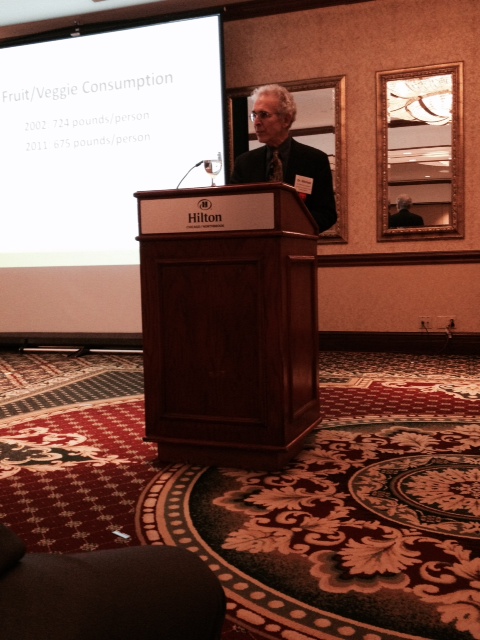
I had the privilege of attending a recent meeting of the Chicago Section IFT (Institute for Food Technologists).  The guest speaker was Dr. Michael Jacobson, Executive Chairman of the Center for Science in the Public Interest (CSPI), who spoke about America’s progress in becoming a healthier-eating nation.

Dr. Michael Jacobson

Dr. Michael Jacobson

Over the last 40 years or so, the CSPI has helped to reduce saturated fatssodium and sugar in our food supply, among other things.  While CSPI has often been a thorn in the side of Big Food in America, its efforts have resulted in meaningful change, usually brought about by government mandate (as opposed to corporate altruism).  And Jacobson is no party-line activist –  – he independently assesses the social benefits vs cost on any initiative, including things as controversial/PC as GMOs (he’s open-minded on this, in case you were wondering).

My key takeaway:  regardless of the advances in food science, our chances of becoming a healthier nation lie in the hands (and mouths) of the consumer.  The locus of influence in food and nutrition is becoming decidedly less institutional.

Food Scientists – heal!
Dr. Jacobson offered that while food scientists have culpability in having created most of the ‘Franken-foods’ that he reviles (“…a breakfast cereal that is nothing more than vitamin-enriched marshmallows…”), these scientists now play a key role in creating healthier alternatives that can be adopted by mainstream America.  

Two things occurred to me during Dr. Jacobson’s presentation, illustrating both the weakness and strength of the consumer:

1) You can build it but they will not necessarily come.  These healthier foods need to appeal to intended consumers for this to work, as was brought home by an attendee who commented that her school district’s new, more nutritional lunches, in addition to costing more, are also discarded much more often by the kids.

The problem is that consumers typically don’t want foods that make health claims.  Putting ‘reduced sodium’ on a package, for example, is almost like saying ‘don’t buy me’.

So the conundrum is:  how do you get people to eat healthier foods without them knowing it?  Not easy.

2) According to Dr. Jacobson, the rise in social media has accelerated the process overall, despite consumers’ sometimes misguided crusades.
Consumers, who previously had no voice, are now collectively applying pressure through social media.

Just this week, the so-called ‘Food Babe’ helped prompt the removal of azodicarbonamide from Subway bread, through a petition that is at 78,000 signatures and counting.  We have been unable to detect one shred of relevant credentials in the area of nutrition, food science, or science in general, about the Food Babe.  She apparently has an undergraduate degree in computer science.  But she cleans up well, is able to get access to influential people, and operates a successful blog.  And guess what – she’s helping dictate your food options!  Deal with it.

Vani Hari - the Food Babe

Vani Hari – the Food Babe

Earlier examples of removed ingredients include:
Kraft Singles removing an artificial preservative (sorbic acid)
General Mills’ Cheerios removing GMOs
And that’s just 2014.
Other recent examples are here, including Starbucks, Gatorade, Kraft Mac and Cheese, and Chick-Fil-A.  These are not inexpensive or simple changes to make, and speak to the power of the consumer.

Yes, the consumer is a fickle, capricious creature and quite often prone to acting immediately (or signing petitions) without checking facts.  But overall, the ability to project a collective voice is starting to make a difference in the food landscape – – and on balance, it appears to be for the better.

First Ever Battle of the Super Bowl Ad Reviewers!

Ever wonder why you never totally agree with Super Bowl ad reviewers?
Well, other than for a few good ads* they mostly don’t agree with each other either.  

Doberhuahua

The Armchair MBA has selflessly taken on what is certainly is a vast unfulfilled need and compiled a comparison of 9 disparate SB ad reviewers just for you!   Wow!   Almost as much fun as being a Broncos fan!

Just click on the chart below to see that while there is some consistency, in the end advertising is still an art and everyone’s got their opinion.  (You can click on the chart twice to make it even more readable.)

(*Generally universally liked:  Budweiser, Cheerios, Radio Shack, Microsoft – – although I’m not in the bag for all of them)

The reviewers:

Kellogg Graduate School of Management
Advertising Age
Wall Street Journal
Chicago Tribune
Entertainment Weekly
Variety
Slate
Yahoo Sports
New Yorker

I’ve provided my own opinion, to make it an even 10.

SuperBowl2014

Green/Yellow/Red ratings were my best interpretations of what the reviewers meant.   White means they didn’t review this particular ad –  – which in itself tells you something.  They are grouped based on my ratings, on an alphabetical basis by brand within ranking.

My evaluations are generally based on the Kellogg ADPLAN approach, which is becoming the standard:
Attention
Distinction
Positioning
Linkage
Amplification
Net Equity

However, I also incorporated a liberal dose of my visceral reaction during the game.

Quick commentary:  The Super Bowl is a unique marketing environment where stakes and expectations are high, and the bar for breakthrough is considerably higher than any other day.
Advertisers use the SB for much more than the eyeballs – – as a way to make a corporate statement, introduce something new, reposition themselves, set up other promotional activity, and many other things.
So these spots can be seen through many different lenses, which is why reviews often differ dramatically.

Having said that, sometimes an ad just sucks any way you look at it.

Not included in my ratings (but increasingly important) is how long of a tail these ads might have – – what their viral reach, impact and duration becomes.

Maybe next year.

Eataly vs Italy – a minimalist photojournalism essay

Eataly, Mario Batali’s mega-venture, just added a Chicago location in December 2013 (the other US location is in NYC).

According to Forbes, “Eataly Chicago is foodie destination with 23 eateries, one fine dining restaurant and roughly 10,000 products for sale. There are butchers, fish mongers and even a Nutella bar”.

I have not been there yet but am told by many sources that it’s an amazing experience, and I’m looking forward to going.

However, for those of you looking for a truly authentic Italian food experience without all the airfare (beyond, of course, the Italy Pavilion at Epcot), note that there may be some differences.

This is the meat case at Eataly Chicago.

EatalyChicago

And this is a typical meat case observed in Bologna, Italy during an October 2013 visit.

Italian meat case

Note that there are fewer faces looking back at you in the U.S. version.  For the purposes of marketing to generations of American consumers brought up on anthropomorphized animal characters, probably a good regional adaptation.

pig

Whither Apple? Can a brand be too strong?

Is there such a thing as too much brand strength?

This past week, Apple celebrated its 30th year in business and announced 1Q revenue and earnings above analysts’ estimates.  The reward?  Apple’s stock went down -8% in a single day.   The story was that iPhone unit sales were below expectations.
I suspect there’s more to it than that.

mac30

What’s going on?  Apparently Apple has so completely trained us to expect huge news, that merely growing a huge profitable business is seen as a negative, the ‘Microsofting’ of Apple, if you will.

Apple, of course, has brought this upon itself, introducing us to the Mac, iPod, iTunes, iPhone, iPad, and changing an entire industry.  As Apple’s legend continued to grow, this sort of pattern became expected, much like a sub-30 point game for Michael Jordan was greeted with a shrug.  The next cool thing?  It’ll come from Cupertino, of course.

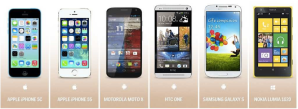
More recently, Apple’s track record has been less spectacular (perhaps not coincidentally following the passing of Steve Jobs).  Solid growth, but innovation more of the incremental sort, compounded by previously unimaginable screwups in product (Apple Maps) and marketing (being ‘out-cooled’ by Samsung!).  Competitors have started to catch up – Apple actually is following by increasing iPhone screen size.  In a recent Forrester Research study, Apple dropped from second to fourth in a consumer electronics brand customer satisfaction survey, behind Samsung, Microsoft and Sony.  What the what?!?!

Apple Comp

Finally, as one measure of expected future profitability, Apple’s P/E stands at around 12.7, down from 22 or so a few years ago.

What should we make of this?  Has Apple set the bar for itself too high and is now entering a death spiral (#Sony)?

1) To be sure, Apple’s experience demonstrates that ‘what have you done for me lately’ is alive and well for investors.

2) However, to paraphrase Mark Twain, the rumors of Apple’s demise are greatly exaggerated.
– What is less visible is that Apple has built an enormously deep reservoir of confidence and mystique over the years.  Apple still commands our attention, and has retained its exceptional image as an innovator and cultural driver, the result of its exceptional record of success, and absolutely consistent, disciplined branding work over the years.

Ever notice how sportscasters lead with how Tiger Woods is doing, even when he misses the cut (as happened this last weekend)?  We are all still looking to Apple for the next surprise.  This is what branding can do.  And you don’t need a high-profile marital flame-out for it to work, either.

I would venture that Apple is still the one technology company that all others measure themselves against.

Apple absolutely needs to continue to drive category innovation.   But when this happens (and it will happen), its deep-seated brand equity will help to re-energize its consumer base, driving greater sales and loyalty than might be possible with the same product from a different company.   Personally, I’m waiting for the Apple TV…

Top 10 2013 Mostly Accidental Marketing Lessons

This is the time of year where instead of being productive, people put together lists.
So here’s my look back at 10 events in 2013 that provided (purposely or not) great learning.

2013  Lesson 1:  Measure Twice, Cut Once.  Make that: Measure three times.
Healthcare.gov rollout
(honorable mention for Chicagoans:  Ventra public transit card rollout).
– So many lessons here.  It’s the lesson that keeps on giving.  Reminder: even if your brand isn’t one-sixth of the national economy you probably still want to test a new e-commerce site.  Test, test and then test again.

jon_stewart_obamacare

2013 Lesson 2: A brand CAN do a 180 in a Single Day 
Miley Cyrus
– And in this case it took about 5 minutes.  The recipe: take one tweens’ idol named Hannah Montana.  Remove most clothes, liberally add makeup, a big foam finger and nationally televised awards show; mix aggressively using the body and add a large dash of idiot grin.  Voila!  You’ve now transformed from Hannah Montana into what looks like the love child of Gene Simmons and Dita Von Teese, without the charm.
The winner:  probably Miley and her handlers, but hard to know yet.  The clear losers: Millions of formerly innocent Hannah fans.  Also, the general cultural level in the US.
So yes, it is possible to completely change your brand’s image in a day.  But it might involve twerking.

Hannah to Miley

2013 Lesson 3: There is such a thing as too much transparency
Lululemon
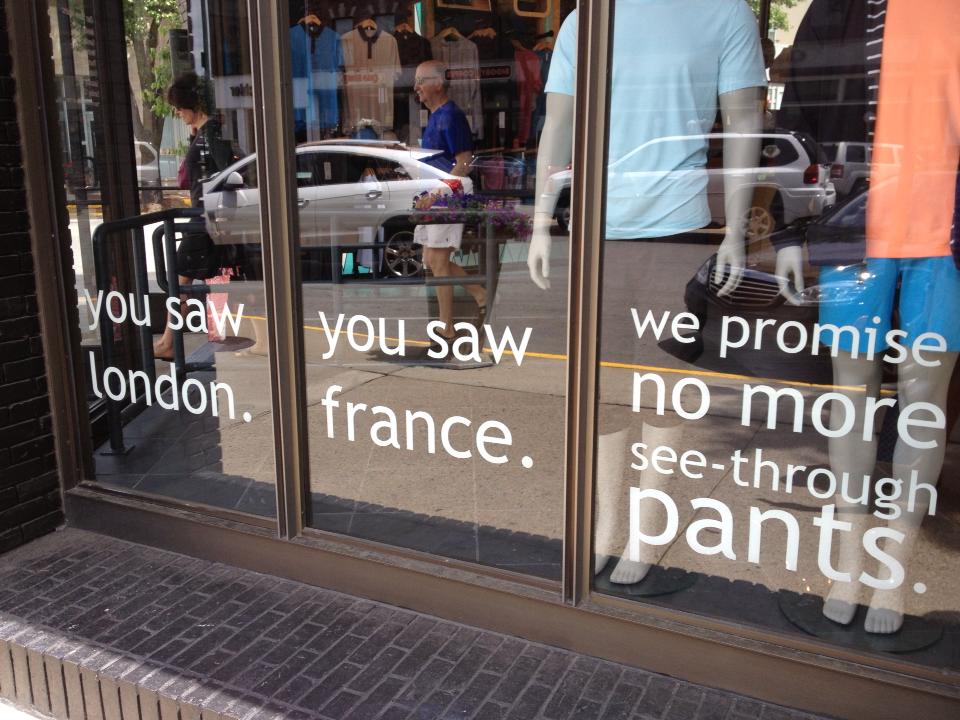
– Due to quality control snafus, Lululemon’s yoga pants delivered a little more than was supposed to meet the eye.  The media, always a model of sober restraint when it comes to high-minded topics like see-through clothing, did its best to spin this story as salaciously as possible.  Ultimately it went viral, resulting in loss of gobs of market value, as well as Lulu’s top management. At least they kept their sense of humor about it. (actually, there is a real lesson here: at the end of the day it’s about the product – and you can never take your eye off the ball).

Lululemon Store Window

2013 Lesson 4:  The early bird still catches the worm – – if he tweets about it.
Oreo cookies
– We now live in an era that enables, and requires, real-time marketing.  As has been reviewed ad nauseam (guilty!), Oreo slam-dunked it with a timely tweet during the Super Bowl blackout.  Meanwhile, given the opportunity of Marco Rubio’s magic cotton-mouth TV moment, the Poland Spring ad team not only didn’t stick the dive, they missed the pool entirely.

oreo-super-bowl-tweetMarco Rubio drink

2013 Lesson 5:  When life gives you lemons, make lemonade.  When your meatball supplier tries to slip you some horsemeat, clean house IMMEDIATELY.
IKEA
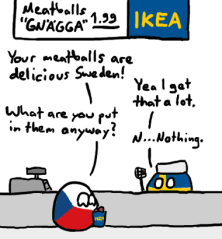
– When IKEA learned that some of its famous meatballs (150 million annually!) might contain traces of horsemeat, it immediately got rid of all meatballs in inventory, whether suspect or not.  Cost of write-off?  Probably pretty high.  Benefit to reputation by immediately taking action?  Priceless.  Sales of meatballs since then?  UP.

IKEA meatballs

2013 Lesson 6:  Hint: ‘Fail Fast’ is really just a euphemism for Test and Learn.  It doesn’t mean your goal is actually to fail fast.
JC Penney
– Here is a retailer that tried to do a 180 without twerking.  Or more importantly, without considering that its customers preferred periodic discounts.  Boom.
Easier to adapt to customer preferences than to try to force them to adapt to you.

jcpenneymadnessJCP quarterly

2013 Lesson 7:  There is No Such Thing as Bad PR (at least for Jeff Bezos)
Amazon
– Amazon’s eerie delivery drones cleverly debuted on ’60 Minutes’ the day before Cyber Monday.  Never mind that if you give it about 5 seconds’ thought, the barriers are significant (snow? wind? power lines? privacy issues? teen boys with slingshots?) – what it really shows is that in addition to any product you can think of, Amazon’s mission apparently also includes delivering PR to all homes.

Amazon drone

2013 Lesson 8:  If you go for the ‘wink-wink, joke’s on me’ approach, and people don’t get it, then ‘wink-wink, the joke’s on you’.
Honda/Michael Bolton Holiday campaign
– If you didn’t see them, these spots feature the man of the strained tenor and shorn mullet singing soulful holiday-esque tunes from atop a Honda, next to a Honda, in a Honda showroom, behind a piano, behind a guitar, all to the indecipherable reactions of surprised, baffled, younger presumed car shoppers.  It’s difficult to tell what the point is.  The obvious assumption is that this is a quid pro quo: the 60-year old Bolton (perfect for a younger target!) has a new album that needs promoting (true) and Honda needs some breakthrough quality in the holiday car ad environment that generally features obnoxiously gift-wrapped luxury cars (true again).
But what’s Bolton doing up there on that car?  Apparently, according to Adweek, this campaign is ‘poking fun at itself with melodramatic guitar solos and idiotic lyrical gems like “This special time of year, it’s filled with joy and cheer, for me and you and you and you, too’.”  Well, I know something about misplaced melodrama and idiot lyrics and I didn’t catch it.  If there’s a wink in there somewhere, it’s subtle enough as to be invisible.
So we’re left with a spot with bland cars, being promoted by bland music – – a perfect match, but I suspect probably not what they were going for.
The American public as a rule doesn’t respond well to ‘subtle.’   Witness, if you will, Ron Burgundy for Dodge – – a more effective celebrity hookup.

Bolton on car

2013 Lesson 9:  When in Rome, do as the Romans do.  When trying to break into Southern California, and your name contains the word ‘Fresh’, don’t pre-wrap the fruits and vegetables.
Tesco Fresh & Easy
– This one already has a coda. Big UK retailer Tesco created its Fresh & Easy chain in late 2007 to penetrate the Western US market with a fresh new smaller format store, famously after significant consumer research.  The experiment failed when consumers didn’t respond well to new formats, new food presentation, and in some cases, truly foreign concepts.  Ultimately F&E was sold to Yucaipa, which has added “competitive pricing, improved hours, fresher foods and assisted checkout” according to management.  Everything, it appears, has been changed except the name.
– The obvious lesson – – listen to your customers (see Lesson 6).

fresh and easy vegetables

2013 Lesson 10:  You can say Social Media and B2B Marketing in the same sentence
Maersk Shipping
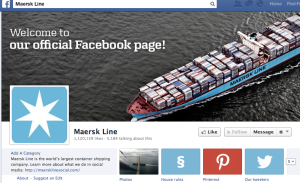
– Maybe it’s the exotic locations where its ships are shown.  Or maybe it’s just the fact that deep down we’re all little kids and are awed by really cool big boats.  Whatever the appeal, big freight shipper Maersk found a way to go from zero to one million+ in Facebook likes in about a year (good Forbes article here).  Of course, no one places container orders on a Facebook page, but for very little cost (repurposing archival company photos) this enhances the Maersk brand, distances it a bit from its competitors, and likely provides meaningful recruiting and morale benefits.

Maersk Facebook

Probably the big lesson for 2013 has been that while many old conventions are being challenged (e.g. static campaigns, role of social media), the key marketing fundamentals are still alive and well:  understanding your customers and their needs is the surest way to success (or at least avoiding being in next year’s write-up).

Happy New Year.

Why Dogs Aren’t Great Marketers

I’m back after a short blog sabbatical.  This post is in honor of Nigel’s 10th birthday.

Nigel

Sorry, Nigel, I love you but you suck as a marketer.  Sure, you have an unreal sense of smell – – you can smell me silently unpeeling a banana from another floor of the house so you might get a little piece of the action.  And you’ve told me many times that this or that ad campaign really stinks.  So far so good.

But, and I hate to break this to you, buddy, you’re color-blind.  You couldn’t tell a green biscuit from a red one from a brown one.  (That’s why I never present you with more than one at a time – – with no way to tell them apart, you’d starve before you made a choice).

Anyway, by being color-blind  you miss a key differentiator that can make or break a product – – COLOR.

Humans, on the other hand, are attentive to differences in color, and that makes a huge difference.
– color not only calls attention to a single product in a crowded field, it is a strong mnemonic reminder to aid in brand recall, and can even convey desirable qualities about a brand.  In short, color can mean a LOT, even if in itself it has no bearing on product performance.

This is before you were born, but there was a time where products in a category all looked alike.

OwensCorning2
– before 1956, all fiberglass insulation was yellow – but then Owens-Corning dyed theirs pink to differentiate from the competition, in 1964 hired the Pink Panther, and the rest, as they say, is history.  They redefined what this category looks like and BECAME DIFFERENT (sorry for yelling.  I’m not mad).  More than 50 years later, they’re still leveraging the color Pink.   Along the way they got trademark protection for pink in this category.  On the other hand, Pepto-Bismol, another pink icon, was unsuccessful in protecting pink for the antacid category.

– If you did have full color sensitivity, Nigel, stopped ‘grooming’ yourself and picked your head up and looked around, you’d see lots of examples of where color has helped differentiate products.
– green in tractors (John Deere), teal in luxury jewelry (Tiffany), brown in package delivery (Brown, er, UPS, – – even if they’ve now moved on)

john-deere-tractor-1UPS Tiffany1


I’ve noticed a few myself.

MegaRed Krill Oil – -in a sea of sameness in fish oils (all honey-colored capsules), maker Schiff came out with a variation (krill) and underscored that difference by not only coloring their product and package red, but extending it to the name itself.  I’m not sure if it’s any different from a functional standpoint, but it definitely has made a mark in this crowded field by being different.

MegaRedFish oil pills

Christian Louboutin Shoes – – ok, you may be a little closer to this (literally) than me, but designer Christian Louboutin has staked a position in the market by coloring the soles of his namesake high heels bright red.  Apparently this made enough of a difference that he was in court with Yves St Laurent regarding whether this design can be protected.  Regardless of the outcome, red soles in this category have been permanently associated with Louboutin, and have drawn significant attention to his brand in a crowded field.

Louboutin shoes

And differentiation, my friend, is what it’s all about.  Don’t ever forget to think about color next time you’re taking potshots at this or that product when we’re shopping at PetSmart.