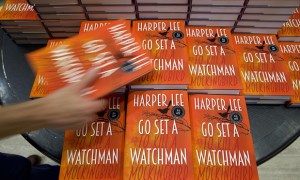
A strange thing happened during the recent launch of ‘Go Set A Watchman’, the new(ly discovered) first novel by Harper Lee, author of the classic ‘To Kill A Mockingbird’:
Publisher HarperCollins advance printed more than 2 million hardcover books
Presses were globally coordinated to simultaneously deliver versions in multiple languages
Extremely tight security was used, including shrink-wrap, security cameras, and secured shipments by truck to retail locations
Barnes & Noble was in the news
A new book shrouded in mystique, focused on retail distribution sounds more like a 1980s release than 2015. Especially for a book that was written before TKAM, which no one had yet read! Why the throwback approach?
HarperCollins very shrewdly realized that it had an opportunity of huge proportions, which could be optimized by understanding the audience and delivering what they would want.
A brand, named Harper Lee, with enormous equity from over 50 years of visibility
A built-in audience of several generations who first enjoyed ‘To Kill A Mockingbird’ in book form
A heavily covered back-story concerning the surprise discovery of the secret manuscript and inquiry into the mental state of the author
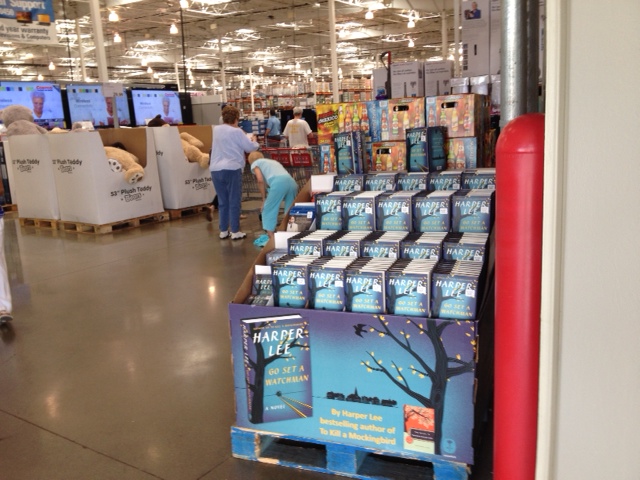
Display Shipper at Costco
As of now, the book has already been reprinted several times and is the fastest-selling book in HarperCollins history – remarkable in this digital-centric era. The fact that ‘Go Set A Watchman’ has gotten generally mediocre reviews is almost beside the point.
HarperCollins scored a big success by understanding the audience, the environment, and having the courage to act accordingly and decisively.
Recently two new books came out from notable authors:
‘Go Set A Watchman’ by Harper Lee (author of the all-time classic ‘To Kill a Mockingbird‘, published in 1960)
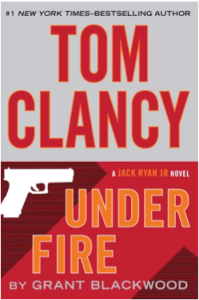
‘Under Fire’ from Tom Clancy (who first published ‘The Hunt for Red October’ in 1984, and went on to sell over 100 million espionage and military thriller books).
Both are regarded as brilliant writers, with one key difference: Ms. Lee is still alive, and Mr. Clancy is not.
Apparently able to write from beyond the grave, Mr. Clancy’s name prominently adorns new books in the market, which at closer inspection are actually written by others (Grant Blackwood this time, Mark Greaney previously).
(in a bit of confusing overkill, a sub-brand third name is on the cover: “A Jack Ryan Jr. Novel”)
My initial gut response: Betrayal! They’re selling me Clancy and delivering Blackwood! Marketing malfeasance of the highest order! Isn’t Clancy’s writing the reason people bought the books? Isn’t he the brand? If not, what is the brand when it comes to books?
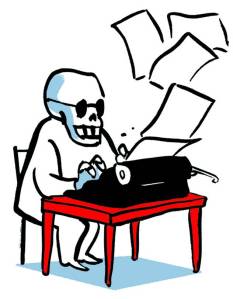
ILLUSTRATION: NISHANT CHOKSI
Joe Queenan takes a swing at this very topic in a recent Wall Street Journal piece (mentioning a few other dead-but-still-publishing authors), and this quote starts to get to it: “…it is the vision of Tom Clancy and V.C. Andrews and Robert Ludlum that makes their work so remarkable and unique, not the plots, characters, prose or leitmotifs. The actual writing is secondary.”
Apparently these posthumous publications still sell quite well. People have something in mind when they hear the names Clancy, Ludlum, and even Franklin W. Dixon (Hardy Boys) and Ian Fleming (James Bond).
In the same way a brand’s essence is the expectation it creates for what will be delivered, these authors set an expectation that is the core of these books’ attraction. And apparently the essence of these authors’ brands was their imaginations – the unique areas in which they chose to set their storytelling, and the imaginative approaches to the storyline – – and not necessarily the specific unique quality of their prose.
Indeed, Ludlum trademarked plot lines and partially wrote books before he died, which have been ghost-written as new material afterward, presumably with his blessing from beyond.
Forbes covered this topic a few years ago and has some additional interesting examples.
When you think about it, we readily accept the same phenomenon as it occurs for other brands in entertainment, where no one expects (or wants) to run into the name on the marquee:
Count Basie Orchestra for big band jazz
Disney for wholesome family entertainment
Liz Claiborne, Yves St. Laurent and Perry Ellis for fashion
So upon reflection, it seems OK in certain situations to evoke a person’s name that has over time consistently come to represent a type and quality of deliverable, and in effect has earned its right to be a brand. That is what a brand is. Even if it can leave you feeling a bit misled.
But this can only go so far.
I will not go to see Itzhak Perlman if played by someone else, watch a Usain Bolt-branded ghost-athlete, or read newly published Shakespeare by a ghostwriter.
A pair of recent customer service experiences (one very good, one not so good) inspired this post. (If you’re in a hurry, my POV is at the end.) If you stick around, I’ve included some juicy case studies.
These experiences made me wonder – what is the essence of good customer service? Do those famous over-the-top examples make good financial sense?
I’m no customer service professor, and this subject has been covered countless times, but I do have my opinion (and this is my blog /bully pulpit) – but customer satisfaction does not seem directly related to dollar value.
Customer Service has always been a point of distinction for those making The Customer Is Always Right truly a focus of their strategy
Nordstrom, LL Bean and others have long been traditional standard-bearers for ‘no questions asked’ service
However, abuse has caused even highly-regarded companies to adjust their policies
Social Media has amplified the impact of customer service, both good and bad
Missteps are more visible and make companies vulnerable to public shaming or boycotts, or minimally distraction, regardless of a complaint’s merits
For a great set of examples of service gone bad, check out this article. If you want to focus on one, I personally found the Amy’s Bakery example (#2) delicious to read.:
Good deeds are similarly great opportunities for spreading positive stories – circulated via social media, they often create value much greater than paid advertising.
Here are a few great examples. Check out the Netflix live chat example (#3) on the Helpscout link – – very fun.
Two recent personal experiences shaped my opinions of companies.
My carry-on bag’s handle failed after hundreds of trips. The brand is High Sierra. I contacted them online and explained my issue, with photos (as they requested). My goal was to find a repair shop. I had mentioned that I ideally would like a fix by the weekend as I was traveling on Monday morning. It was Thursday.
On Saturday morning I received, by FedEx, a large box containing a replacement handle, with a few extra zipper pulls thrown in (which came in handy). A few minutes and I had the handle replaced and was good to go. At zero cost. Fantastic!
The brand is High Sierra. High Sierra. High Sierra. They are now owned by Samsonite. Kudos to Samsonite for allowing this business unit to take care of customers in a highly personal and attentive way. High Sierra.
I have 2 other bags from High Sierra and you can bet that they get right of first refusal on the fourth.
A recent Avis rental came with no washer fluid, which I bought later for $3.84. In returning the car I requested that this amount be taken off my bill. In similar situations with other companies the response was usually immediately taking one of my rental days off the bill and getting me on my way.
In the case of Avis, it eventually required the attention of 4 Avis people. The agent receiving cars didn’t have authority; the front desk clerk didn’t have authority; the manager had authority but couldn’t make a system input; finally the 4th employee was able to input the solution. Total time for a $4 issue? 20 minutes.
And the solution? A $10 voucher, which means they didn’t actually refund anything.
Worse, this delay caused me to miss an opportunity for an earlier flight.
So, what is the secret to customer service?
BE CUSTOMER CENTRIC. Simple as that.
Let the customer know they have been heard – this alone is more important than any dollar amount of a solution.
Treat the customer like a human. Stay off the scripts if possible. You don’t have to pretend to be Captain Kirk (see Netflix example above) but a personal touch is incredibly effective.
(By the way, insider tip: as a customer, treating any customer service person or clerk or waiter or sales person etc like a human being almost always yields positive experiences).
Demonstrate that the customer is priority #1, company is priority #2. Avis was clearly all about Avis.
Delays in response exacerbate frustration. Speedy response shows that you are listening and can nip negative feelings in the bud.
Going above and beyond has significant upsides – you want to be on the ‘best customer service’ blog post, not the ‘disaster stories’. And a few well-placed good deeds can get a ton of mileage (see links above).
I would have been satisfied with a recommendation for a good repair shop for my bag, and High Sierra (High Sierra. High Sierra.) went above and beyond, to my delight. As a result, they have the opportunity for word-of-mouth recommendations from unexpected places, including people like me. (High Sierra!)
And Avis? They worked to win a little battle, and lost a round in the war. They will get less consideration from me next time around. Try Harder? Good idea.
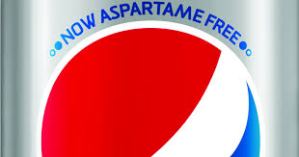
PepsiCo just announced that it will be taking the artificial sweetener aspartame out of Diet Pepsi and replacing with another artificial sweetener, sucralose (known more commonly as Splenda®), combined with another sweetener named acesulfame-K (‘Ace-K’), which is a lower cost ’sweetener helper’.
The stated reason is to respond to consumer objection to aspartame, as stated by a Pepsi Sr. VP: “Aspartame is the number one reason consumers are dropping diet soda.”
The more likely reason is that Diet Pepsi volume is down over 5% in the last year, part of a long-term slide, and nothing so far has worked to reverse the trend.
But this change is unlikely to make a material difference, for a few key reasons.
First, let me risk public embarrassment to try to establish my bona fides. I marketed aspartame (Equal® Sweetener) for 6 years, and sucralose (Splenda) for another 5. Did a lot of consumer research during those years.
Left: failing the dorky marketer test. Right: at a trade show, excitedly pitching sweeteners
Here’s why I don’t think this will make a difference:
1) Consumers generally don’t know what’s in their diet soda to begin with. When asked open-endedly about ingredients in diet sodas, they have a vague notion that they contain artificial sweeteners, but the sweetener is not often mentioned by name. When prompted, they will recognize aspartame. But while consumers may theatrically claim that they avoid aspartame when they’re in a focus group, in reality very few actually check labels.
2) Consumers are generally full of it when it comes to stated preferences. They will tell you all day long that they want less fat, less sugar, less salt, etc – – but in reality they will rarely change ingrained habits if there’s even the slightest risk of compromise (such as taste or cost).
3) Non-users or lapsed users have a handy reason for why they don’t use the product. Aspartame has enough negative PR that it is an easy, politically correct and inarguable reason as to why surveyed consumers aren’t using the product. But the true answer is a more complicated mix of dynamics including macro consumption trends, emergence of new alternatives, and changing demographics (‘modern’ diet sodas were first introduced, and gained loyal followings, in the early 1980s).
4) Changing out one artificial sweetener for another just reminds consumers that diet sodas generally contain artificial sweeteners. Not a great plan to bring in new users.
6) Most importantly, consumers like their products the way they are. ANY CHANGE in a loyal user’s product formulation will arouse suspicion. A product as iconic as Diet Pepsi owes its unique taste to the specific combination of sweeteners in its formula. It is impossible to improve the taste of Diet Pepsi, because its ideal is defined by its current taste. So any change will alienate current users, who are currently drinking it even knowing in the back of their minds that it contains an artificial sweetener.
Ironically, this is the same category where New Coke infamously demonstrated what happens when you change the formulation of a well-loved product. It will be interesting to see whether this ‘New Diet Pepsi’ fares any better.
Below is an introductory spot for New Coke in 1985. In retrospect, a product and spokesperson that ultimately followed similar paths, albeit on different timing.
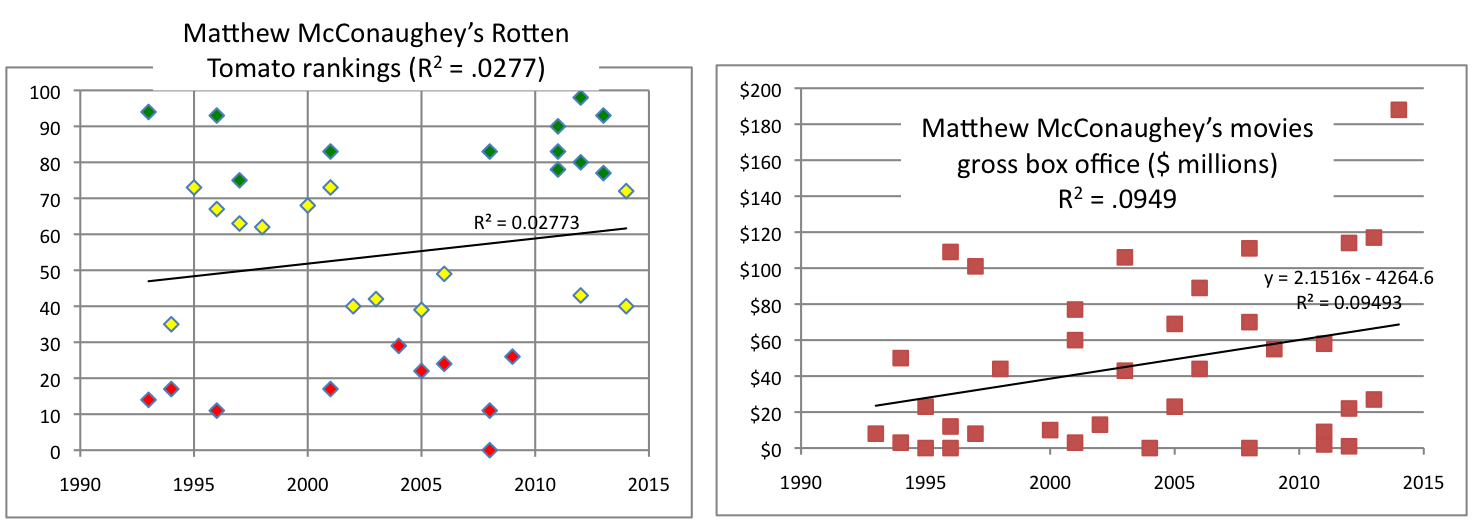
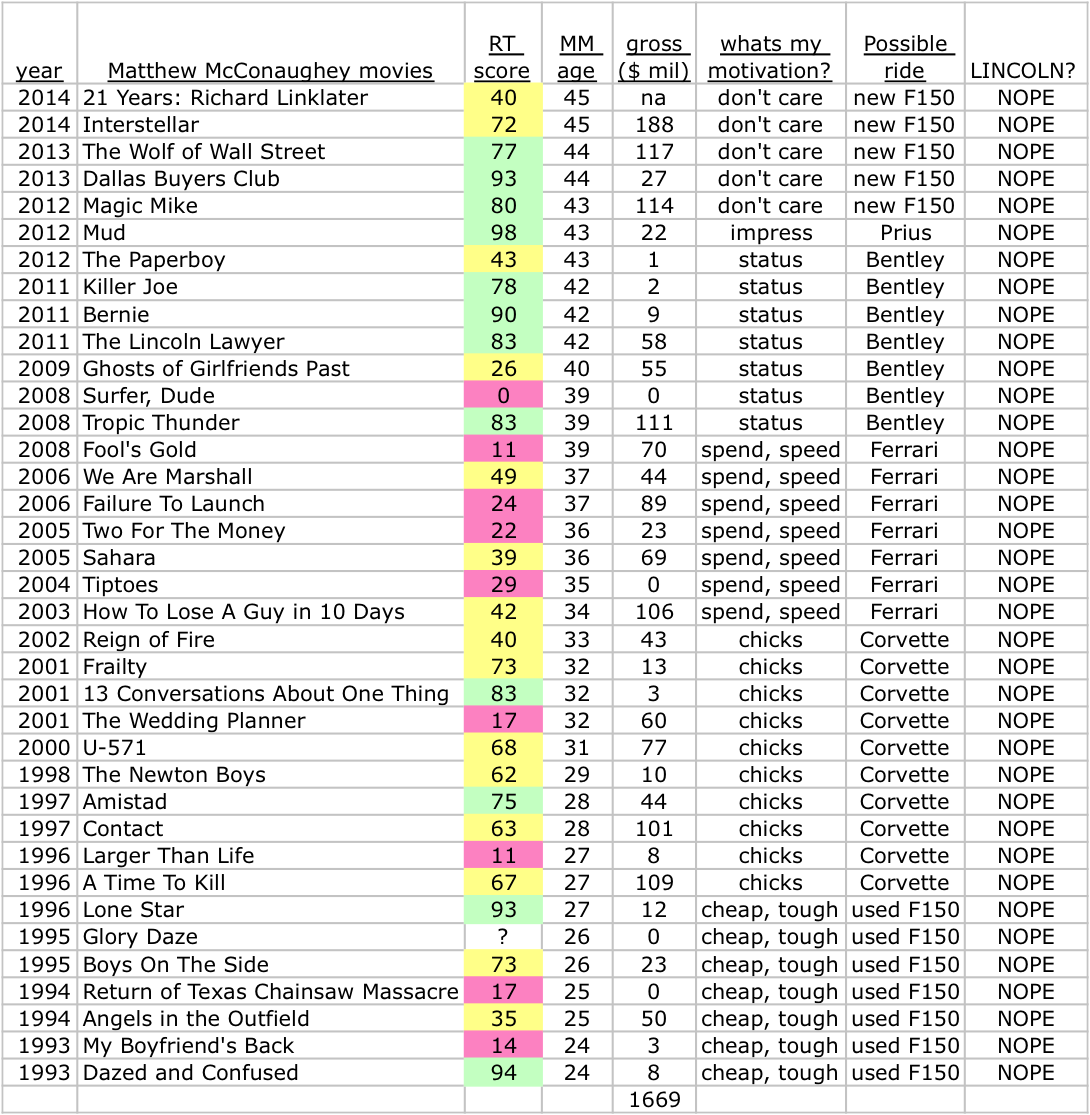
You’ve seen the ads where Mr. McConaughey very seriously mumbles gravitas-laden lines like “I’ve been driving Lincolns before anyone ever paid me to drive one”. https://www.youtube.com/watch?v=u4lklnkk8SU Yeah, he’s purty. Yeah, he has demonstrated decent range, from the decidedly non-Shakespearean Return of the Texas Chainsaw Massacre to Texas Buyers Club and beyond. 3 dozen or so movies over the last 2 decades, with a combined box office gross of $1.7 billion or so. Not too shabby. Mr. McConaughey seems to have gotten into real money by his late 20s (see chart below).
Mr. McConaughey’s celebrity seems the sole driver behind these spots, as evidenced by the fact that it is high on style, but the dialogue is itself mostly random. Not a single explicit or implied benefit in the bunch. So what is celebrity and why do advertisers use it? A quick review of what a celebrity can bring to the table:
Breakthrough. Put a loose cannon or a recognizable pretty face on the tube, and people may look up from Heroes Charge and pay attention. Very helpful in a noisy world.
Endorsement. If Celebrity So-and-so chooses Product X, it must be good, because they can afford the best. This works if it is logical that Celebrity So-and-so actually would use the product.
Coolness by association. If a product is associated with a cool person, if things roll right some of that cool rubs off on the product itself.
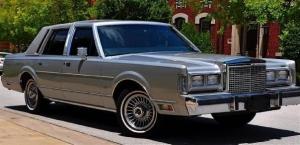
EXHIBITS 1 AND 2 – These 2 charts demonstrate that over his career, Mr. McConaughey’s movies’ gross revenues rose faster than his movie ratings did (as demonstrated by comparing slope of the trend lines, which is one well-established quantification of celebrity – data taken from table below). So he definitely has it. But I’m still not buying a Lincoln from Mr. McConaughey, celebrity though he may be. This particular campaign, to me, falls down mostly on #2 – endorsement. I have done a statistical analysis of Mr. McConaughey’s career and can demonstrate that there is no time in his career where he would have chosen to drive a Lincoln because he “just liked it”. In other words, I don’t believe him. EXHIBIT 3 – let’s just get this out of the way. Before MM started making money, he was a kid barely into his 20s in rural south Texas, and this 1988 model is the sort of used Lincoln he may have had to consider. Case closed. There were plenty of Camaros, TransAms and F150s to go around. EXHIBIT 4 – shows career movies, Rotten Tomatoes rankings (up or down vote of what % of critics liked it), as well as what he may have been thinking as his star (and paycheck) rose, he aged out of his twenties and eventually 30s, and what sort of vehicle he may have considered. Net – Mr. McConaughey is by most measures a true celebrity, and he has earned it through quality and quantity of performance (though not always at the same time). But no one will be able to convince me that he willfully drove a Lincoln when he had all sorts of other options available — which is what his commercials are trying to get us to do with the Lincoln MKC.
It’s time to demonstrate (again) that when it comes to advertising, no one agrees on anything. Raise your hand if you’re shocked.
The Armchair MBA repeated last year’s stunt in comparing the ratings of 10 prominent2015 Super Bowl ad reviewers, summarized in the handy chart below, along with my personal ratings. (Green/yellow/red coding, alphabetized within my ratings)
While no Doberhuahua this year, there was plenty of dreck and schmaltz to take its place, but a few very good spots as well. Unfortunately many spots were so-so – – either they rewarded our attention with a muddled message or weak branding, or they were copy-by-committee logical with no heart or pizzazz (Hello, GoDaddy. Hello, Weathertech).
Mostly universally admired: P&G Always “Like a Girl”, Avocados from Mexico, Dove Men+Care, Mophie, Budweiser/Puppy (I declined highest marks on the last two)
Most universally unloved: Nationwide’s “Boy” (runaway loser), Nissan, Lexus
Most schizophrenic (scored best on some lists, worst on others): McDonald’s “Pay with Lovin’”, SquareSpace/Jeff Bridges, Loctite “Positive Feelings”, Toyota Camry/Amy Purdy, Carnival Cruise Lines, Victoria’s Secret (had to watch this again to make sure I knew how I felt)
A few observations:
– Personally not a fan of high-concept feel-good spots like McDonald’s or Coca-Cola or Jeep, or for that matter, the very cute/manipulative Bud puppy ads. Fun for the agency, probably test well for likability, but hard to see how see how it drives action or enhances the core brand equity.
– Love spots like Fiat 500 SUV – simple message (we made the base 500 bigger), using an analogy that’s easy to understand and relevant to the main point (if a bit naughty)
– Would love to be a fly on the wall during the approval process of the Nationwide’s “Boy” spot (spoiler alert: it’s about a charming boy who turns out to be dead. More chips & dip, please).
– For fun, check out some of the breathless, we-take-ourselves-kind-of-seriously reviews comments like “Powerful message but tough ad to watch”, “Disturbingly brilliant and impactful”, “emotionally powerful and good storytelling”, blah blah blah – you can see some here (as well as a CMO’s explanation about why his ad was NOT supposed to sell product. Hmmm…).
To see the summary, click on the chart below. Click twice for maximum size/readability.
My evaluations are generally based on the Kellogg ADPLAN approach: Attention – Distinction – Positioning – Linkage – Amplification – Net Equity – – along with some personal gut feel.
We know that the Super Bowl is a special stage, and different rules certainly apply. In addition, there are social media linkages and previews that can dramatically amplify the impact of ads. So it is somewhat unfair to judge an execution in isolation.
On the other hand, we don’t claim to be fair. And as observed last year, sometimes an ad just sucks.
A new ad from McDonald’s focuses on an underleveraged asset – – local stores’ place in their communities – – reflecting a potentially effective component of its plan going forward. McDonald’s faces huge headwinds in the form of stalled sales and softness* among younger consumers who seem to favor more contemporary fast feeders like Chipotle that deliver things McDonald’s isn’t good at: local sourcing, transparency, nutrition, etc. (in addition to more tasty food).
Ask any 2 people about what McD’s should do and you’re likely to get 3 or 4 opinions: reinvent the menu to appeal to younger consumers, make everything natural, offer more customization, trim the menu to the core items, invent a sub-brand, etc.
Marquee subjects range from the catastrophic (weather tragedies) to the personal (new babies). This is delivered alongside Love-centric advertising and unapologetic paeans to things like the venerable Big Mac, and efforts to increase transparency and show authenticity of ingredients (you can hear Ms. Wahl’s explanation of the transformation here).
The marquee ad (‘Signs’) was fairly controversial, with many panning it as being manipulative and even disingenuous because of McDonald’s visible role in the ongoing minimum wage debate (‘Fight for Fifteen’) and its appearance as a huge mega-billion dollar company that doesn’t care.
While the ’Signs’ spot is not perfect and is not a little mawkish, and certainly will not turn McDonald’s around, I think it is reflective of good strategic thinking.
Why? Because rather than trying to reinvent itself to reach a fickle audience (at the risk of alienating loyal customers), McDonald’s is identifying what its core strengths are and building its strategy around them.
McDonald’s role for decades has been reliably providing familiar (if not exciting) food at a good value in a clean environment. However, for many people McD’s has also been a reliable gathering place to meet, talk, and in many cases conduct business. Stop by a store on a weekday morning and you’ll get the picture. For these people, McDonald’s isn’t a soulless corporate behemoth that underpays, it’s a familiar nearby restaurant where you can always get $1 coffee, wi-fi, and time with your friends (or get stuff done) for a few hours. It’s local, it’s part of your routine and part of your life.
In this way, McDonald’s delivers a local connection that few of its competitors do. So they’re wisely making a point of it.
Sure, they also need to offer more transparency and things like Cuties for Happy Meals, AND continue to work on speed, service and cleanliness, AND some of the customers pictured above will not likely be patrons forever, AND they have a LONG way to go to reclaim relevance, but they cannot turn this oil tanker around overnight and positioning as local stores rather than a huge multinational seems to be a step in the right direction to stabilize things now.
On the other hand, I’m not so sure that forcibly selling a generic Love message is the answer. Last time that seemed to work was for Coca-Cola 40 years ago. Actually, not sure it even worked – and in viewing it now, frankly, many of those fresh-faced singers look like aliens.
Say ‘SAP implementation’ to someone who has been through one and you are likely to get a look conveying some combination of pain, pity, terror and dread (and perhaps schadenfreude).
Enterprise Resource Planning (ERP) giant SAP recently announced an approach and suite of applications called ‘Simple’.
For a company with a reputation of being anything BUT simple, this casting-against-type positioning could be tricky business; successful transformation will not be immediate.
And one look at their recent 2-page WSJ ad indicates they may not yet be fully embracing this ‘Simple’ concept.
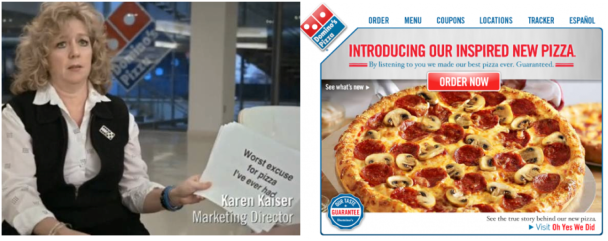
But ERP software is not pizza – – with pizza, a $10 or $15 mistake and you’re on to someone else.
Do a search for ‘SAP Implementation’ and it’s obvious that the stakes are quite a bit higher – – not only $100 million or more, but years of organizational churn and resources, as well as lost opportunity if/when things go awry. You can’t say ‘we know we’ve messed these up in the past, but going forward we’ll be awesome – trust us’.
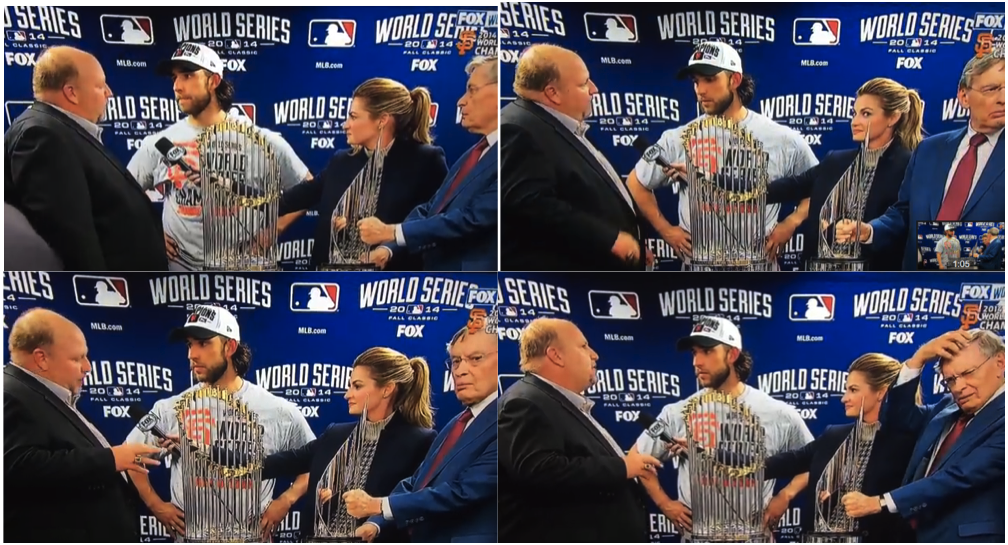
By now you’ve seen Chevy Sales Executive Rikk Wilde’s cringe-worthy presentation of the World Series MVP Award to the SF Giants’ Madison Bumgarner, as reporter Erin Andrews and Commissioner Bud Selig both looked to be trying to flag down a cab.
Not surprisingly, this clip immediately lit up the Twitterverse and generated a remarkable amount of media attention (and references to Chris Farley, with whom Mr. Wilde was frequently compared).
But perhaps unexpectedly, rather than distancing itself, GM took advantage of it with a wink and a smile, embracing Mr. Wilde’s performance and his instant classic utterance “Technology and Stuff”. Within a few days of the event, there was a full-page ad in USA Today playfully referencing the World Series MVP ceremony.
Chevy Tweet
USA Today Full-page ad
So of course, The Armchair MBA has decided to spoil the moment by trying to extract object lessons from this episode.
And there are clear lessons from L’affaire Wilde that today’s marketers need to keep in mind:
1) Expect the unexpected. Speed is key, so be ready.
Today’s media saturation and 24/7 coverage means that an opportunity could present itself at any time
Marketers need to be vigilant and have a response team on call
Senior management needs to give marketing teams autonomy to act quickly
2) Serendipity can be your friend – be open to improvisation to marketing plans.
Even the best plans need to be able to stretch sometimes to take advantage of marketplace events
The Chevy Colorado pickup had just (Oct. 3) been named in a large airbag recall, which was limiting sales
The publicity surrounding Mr. Wilde’s presentation drew new attention to the Colorado, and the recall went from front burner to a secondary issue, at least temporarily
3) Consumers like authenticity and the little guy. And they hate to be manipulated.
Wilde’s memorable performance, while not pretty, was also clearly not slick corporate-speak, and therefore broke through the clutter, arguably much better than if a senior executive, or GM CEO Mary Barra herself, had presented the award
We will use ‘little guy’ in the figurative sense. Mr. Wilde, by virtue of his stammering, sweating performance, reminded us that we’re all human, and if faced with a global TV audience, might be a little nervous ourselves. So in an unplanned way, this helped connect the audience to the product.
This was 100% authentic. If it turned out that it was at all scripted, it would have backfired on GM in a huge way
(As a side point, apparently Mr. Wilde was selected to give the award mostly because he was a long-time Royals fan and his management thought it would be a thrill for him — even though he was obviously not a media trained spokesperson. Good for you, Chevy!)
4) Consumers like humility and a sense of humor
“Technology and Stuff” was a perfect way for GM to gently poke fun at itself
In contrast, denying or attempting to spin would have been futile
5) Branding is very powerful for people too
Unless you, as new parents, know with 100% certainty that your precious child is headed for a career path involving heavy metal bands or the adult film industry, for heaven’s sake, do NOT name him Rikk Wilde.
A cursory scan of the ad shows a few obvious errors:
CEO Earl Mosegi’s promise includes: “…will not lose their shirt off there back” (sic)
Featured product claim: “Women shirt now available”
Key contact called “Sale Representative”
It gets worse.
Ad contains a QR code that is inactive
Ad implies a Facebook page (but no URL) which if you find it, not only doesn’t reference the ad, it features products not remotely like a dress shirt. Seems to be targeted at kids. And it hasn’t been updated since July 2014.
But wait – there’s more!
The website itself is remarkably incomplete but also quite entertaining.
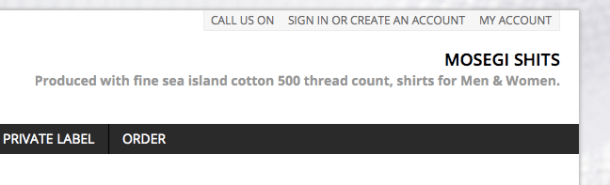
Of 8 main tabs, only 3 have content. There is no contact info.
The all-important ‘ORDER’ page contains just a static image – – there is no ordering mechanism for all the consumers who have seen the ad to take action online!
The ad shows a minimum order of 12 shirts; the website lists minimum orders of both 100 and 300 shirts. Clearly this is a wholesaler trying a direct consumer appeal.
Most remarkably, an unfortunate keystroke error removed a key letter from the word ‘shirt’, resulting in an entirely new word, which shows up on the home page as well as every single header.
This brings up a few key questions:
Is the entity who placed this ad a) the playboy son of a Turkish billionaire setting up shop online? b) an unemployed Russian hacker? c) a Nigerian scammer? or d) a third-grader?
How does an ad that has a bargain-basement pitch, contains so many obvious errors and leads to an online dead-end, get approved by the Journal’s advertising department? (guess: maybe $387k has something to do with it?)
This is a campaign that seems to have been thrown together with not much thought other than a price point and a photo.
These people really need to get their shirt together.
One thing this ad is excellent at is demonstrating, by omission, some obvious basics of an integrated campaign:
Start with a compelling message/offer (arguably they are ok here)
Infuse every element of your marketing mix with the same consistent message, offer and look
Make it easy for customers to take action
For crying out loud, have someone who knows the language check for accuracy. (The Armchair MBA is particularly pained at this last point, as its companion business, Peregrine Advisors, specializes in helping clients avoid online gaffes).
The Armchair MBA works hard to scour the globe for stories worthy of your attention. This one fell into our lap.
 A strange thing happened during the recent launch of ‘Go Set A Watchman’, the new(ly discovered) first novel by Harper Lee, author of the classic ‘To Kill A Mockingbird’:










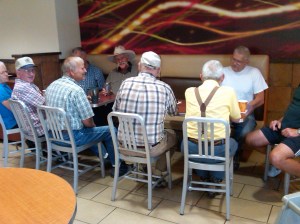 For these people, McDonald’s isn’t a soulless corporate behemoth that underpays, it’s a familiar nearby restaurant where you can always get $1 coffee, wi-fi, and time with your friends (or get stuff done) for a few hours. It’s local, it’s part of your routine and part of your life.




 The Armchair MBA