Category Archives: Marketing and Media

What an Epic Fail Integrated Marketing Campaign Looks Like

Monday’s Wall Street Journal delivered a rather amazing example of how NOT to promote a product, along with the news and pithy commentary.

Most marketers know that messaging can be maximized if deployed consistently across vehicles.  This is apparently more difficult than it seems.

Page A7 of today’s WSJ featured a full-page color ad for €5.99/$7.99 dress shirts, from a manufacturer somewhat oddly named ‘Mosegi & Haberdashery’.

Mosegi Ad 2

It is important to keep in mind that a full-page color ad carries a price tag of $386,865.98.

A cursory scan of the ad shows a few obvious errors:

  • CEO Earl Mosegi’s promise includes: “…will not lose their shirt off there back” (sic)
  • Featured product claim: “Women shirt now available”
  • Key contact called “Sale Representative”

Mosegi_Quote

It gets worse.

  • Ad contains a QR code that is inactive
  • Ad implies a Facebook page (but no URL) which if you find it, not only doesn’t reference the ad, it features products not remotely like a dress shirt. Seems to be targeted at kids.  And it hasn’t been updated since July 2014.

Mosegi_Cartoon

But wait – there’s more!

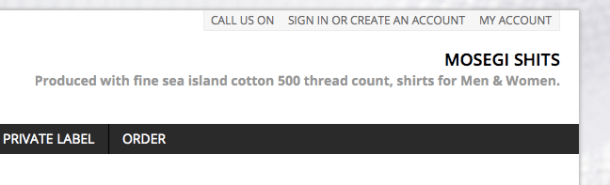
  • The website itself is remarkably incomplete but also quite entertaining.
    • Of 8 main tabs, only 3 have content. There is no contact info.
    • The all-important ‘ORDER’ page contains just a static image – – there is no ordering mechanism for all the consumers who have seen the ad to take action online!
    • The ad shows a minimum order of 12 shirts; the website lists minimum orders of both 100 and 300 shirts. Clearly this is a wholesaler trying a direct consumer appeal.
    • Most remarkably, an unfortunate keystroke error removed a key letter from the word ‘shirt’, resulting in an entirely new word, which shows up on the home page as well as every single header.

Screen Shot 2014-10-27 at 5.07.52 PM

This brings up a few key questions:

  • Is the entity who placed this ad a) the playboy son of a Turkish billionaire setting up shop online? b) an unemployed Russian hacker? c) a Nigerian scammer? or d) a third-grader?
  • How does an ad that has a bargain-basement pitch, contains so many obvious errors and leads to an online dead-end, get approved by the Journal’s advertising department? (guess: maybe $387k has something to do with it?)
  • Is this our official notification that QR codes are truly dead?
  • Does a re-integrator exist?

Marvin

This is a campaign that seems to have been thrown together with not much thought other than a price point and a photo.

These people really need to get their shirt together.

One thing this ad is excellent at is demonstrating, by omission, some obvious basics of an integrated campaign:

  • Start with a compelling message/offer (arguably they are ok here)
  • Infuse every element of your marketing mix with the same consistent message, offer and look
  • Make it easy for customers to take action
  • For crying out loud, have someone who knows the language check for accuracy.   (The Armchair MBA is particularly pained at this last point, as its companion business, Peregrine Advisors, specializes in helping clients avoid online gaffes).

The Armchair MBA works hard to scour the globe for stories worthy of your attention. This one fell into our lap.

As the saying goes, better lucky than good.

…and Botswana makes it 100 Countries!

In a shameless act of self-promotion, this announces that as of today, The Armchair MBA has now reached 100 countries served!    A sort of crazy milestone considering its quite humble and uninformed beginnings, some 70 posts and 2 1/2 years ago.

100 Countries


But beyond cocktail party braggadocio, what does this say about the state of blogging?  Or, who cares?

First, some info.
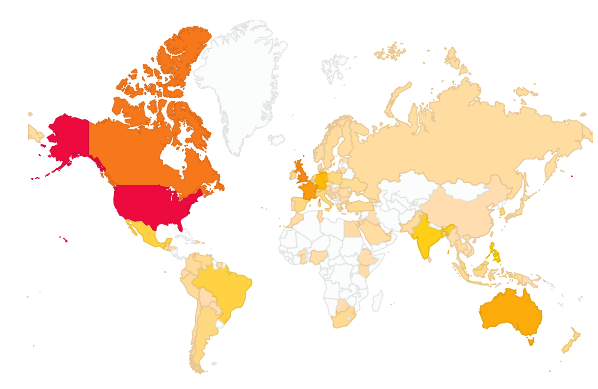
Below is a map of where my readers have come from. Darker colors indicate more readers.
– Clearly a bias toward English-speaking countries but plenty from elsewhere.
– While the US is by far the strongest reader source, average daily readership comprises about 5 or 6 countries, which shift daily.
– Notable in their presence:  China (a single rogue reader!), Botswana (which got me over the 100 hump today) and Papua New Guinea (only because I can’t not think about the combination of loincloths and laptops).
– Totally expected absences:  Cuba, Russian satellites, Iran, N. Korea, and most of Africa.  Is there media repression?  Of course.

While I have a strong base of followers (thank you!), most readership is not subscribed and comes from 2 sources:  LinkedIn (on one page or another) and online search results.  The latter group accounts for the majority of non-English country visitors.

Screen Shot 2014-10-09 at 3.14.30 PM

 Lessons learned?
– The global pull of The Armchair MBA has been surprising.  Part of the reason is that topics often have global relevance; one more support point for the theory that borders are increasingly irrelevant as it relates to business news/learning/sharing.
Posts have long tails – – there is a bump in initial readership but even the oldest posts get recurring views.  The internet is a great accumulator.   Full disclosure:  I recently experimented by taking a SEO approach and including all African nations in text form — it has resulted in some visits from Africa, but to the point below, it is slow.  But it is possible to proactively solicit traffic.
Propagation is steady but slow – – but even if initial readership is modest, much value is still retained as a post transitions from ‘news’ to ‘reference’TAMBA-credential
Having a blog like this pays nothing, but it does have its benefits:
Provides an outlet for my voice and is encouragement to continue to explore, think and opine
– Occasionally merits a media credential, enabling privileged access to trade shows/seminars and continued learning for myself and for my clients
Solicits feedback and additional points of view, often from some surprising sources
– And, every once in a blue moon, provides validation in the form of a ‘Like’.  Sort of like Facebook, only with much more work (including checking my sources).

Thanks for reading.  And thank you, Botswana.


We Tested it On You, So It’s Probably OK for Your Pet

I had the pleasure of attending a brand new trade show – Petfood 2.0 – in Chicago recently.

Petfood2.0logo

Not surprisingly, this show is still getting its furry legs under it – – a very manageable group of 35 disparate exhibitors made for a quick and interesting, if not yet cohesive, experience.

Overall, though, a larger theme presented itself:
Following thousands of years of dogs serving man, the tables have turned.
Man now serves dog.

Exhibit 1:  Hemp for Pets.

Now available from our friends at HempMeds, is a line of products made from hemp to benefit your pets.  aNew™ Pet Nutrition‘s products provide essential fatty acids (EFA – – Omega-3 and -6) and are made from a blend of hemp seed oil and raw hemp stalk oil (which is rich in cannabidiol – CBD).  EFAs, as we know, are highly beneficial – – just don’t ask the industry to agree on what the top benefits are.

pet_oil250

This innovation in pet health could not have been possible without the committed testing of hemp products by millions of Americans in the 1960s and 1970s.  So while the outcome of all that testing is up for discussion, your cat or dog is possibly benefiting now from what you did in college then.

OK, that’s not accurate.

While hemp is illegal to grow in the US, it is perfectly legal to import any part of the hemp plant in all 50 states.
And while the prospect of Fifi or Rover lying on his or her back contemplating the ceiling tiles for hours on end and giggling is intriguing, these products contain virtually no THC – the active ingredient that makes marijuana psychoactive.

Although it would be interesting to see if Nigel would behave any differently with the munchies.  Doubtful.

Hempmeds

Exhibit 2:   Functional ingredients for pets – – it worked on Man, so it’s probably safe for Rover.

We long ago realized that we could do better than feeding our pets Ol’ Roy (WalMart).  Thus emerged added value feed (e.g. Iams, Eukanuba, Science Diet, etc), offering different formulas for large breeds, older pets, etc. as well as some medical needs.

Meanwhile, human foods and beverages have increasingly been stuffed with a dizzying array of functional ingredients, many of which have no empirical basis in efficacy.  But we humans have shown that we’re willing to buy them anyway.  What did Charles Revson say about hope?

Based on this massively-scaled test market on mankind, it apparently has been deemed that animal-kind is now ready to safely ingest all sorts of functional ingredients that may or may not actually ever benefit them.

Petfood2.0

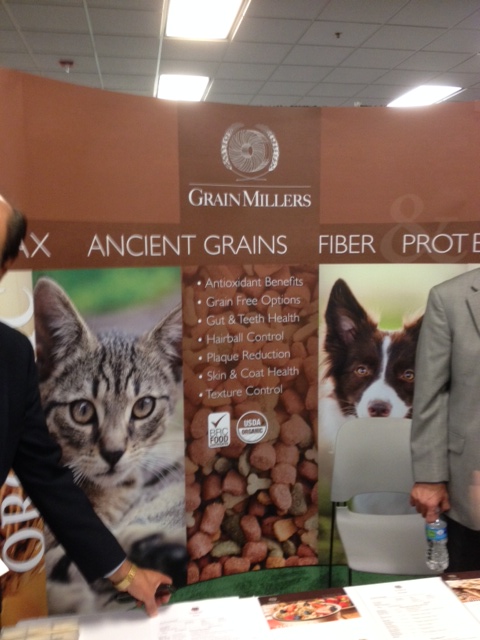
Incorporating things like ancient grains, fiber, medium-chain triglycerides, probiotics and ionic trace minerals, your pet can now get benefits heretofore only considered for the human species (notwithstanding hairballs and a healthy coat).

One company, PetNaturals of Vermont, offers products to address the following areas:
– Agility, Antioxidant, Bladder Support, Breath, Calming, Daily Multivitamin, Digestion, Hip & Joint, Immunity, Slim-down, Urine pH balance (really – to avoid yellow spots on the lawn), Periodontal health, Fecal function, and Skin/Coat health.

You dog and cat owners will probably recognize some of the benefit areas in the products below.

photo 1

We live in a world where the things we eat promise magical powers to fix whatever marketers insist needs fixing.  And regardless of the effectiveness, manufacturers have made a tidy business catering to hope.

Now, due to the significant sacrifice, expense and effort expended in testing on humans, our pets will soon be able to have their diets enhanced, and your wallet may end up just a little lighter.  So when your pet looks up as if to say ‘Thanks, Man’, now you know what’s going through that little brain.

I have no doubt that many of these ingredients can provide real benefits to some of the 150 million dogs and cats out there.

Except I’m not believing anything that promises intelligence to an Irish Setter.

Captex

Comcast Hacks its Own Email Service! On Purpose! Really!

UPDATE TO THIS POST – – SOLUTION FOUND!  and not from Comcast.

A helpful reader sent me the following recommendation, pasted below in its poetic entirety.

go here: http://xfinity.comcast.net/adinformation/
sign-in
Opt Out
Turn Off

Done and done! So easy…stop bitchin’!

———————————————————-

He was right – – it did work, very quickly.  Why couldn’t Comcast send this solution?

Original post  (below):

———————————————————-

How does Comcast spell customer?        Apparently, ‘H-O-S-T-A-G-E’.

In a bizarre marketing gambit to generate revenue through its Xfinity email service, Comcast has not only demonstrated that it values advertisers over customers, it has shown that it has mistaken customer captivity for loyalty.

When you have customers in a market where there are available alternatives, you need to do 2 things: a) keep them happy with superior service; and b) try to avoid giving them a reason to switch.

Here’s what I recently experienced:

SmallXfinityAdLargeXfinityAd

  • Without warning, a square advertising banner appeared on the upper left of my screen, covering key email commands (select, delete, refresh, etc). Comcast thus made it impossible to use its own email.  This ad never went away.
  • A mouse-over converted this box into a larger, even more annoying video ad, in effect acting as a palace guard, to ensure that customers couldn’t even try to get to the controls and read their emails.   Footprint of ads shown below.

XfinityOverlap

  • Disabling this ‘feature’ required an email to Comcast, and resulted in a 6-step, byzantine preferences-changing process that ‘may take up to 30 days to take effect’ (see below). What? Complicated process + 30 days to opt out?  Do you want me to switch?

comcast note


– Comcast calls this program ‘Segmented Advertising’, and provides an explanation that it tailors ads to based on customers’ preferences. (Not exactly a new concept, but what if our preference is to just get our email?)

ComcastSegmented

The upside-down-ness of this program is hard to believe, and is proof that at Comcast there is some kind of crazy monkey at the steering wheel.

A hacker working for a competitor would be hard-pressed to create a more annoying disruption for Comcast users – and they’ve done it for themselves.

Let’s break this down:

  • The ONLY reason anyone visits an email page is to use email
  • Disrupting email utility therefore eliminates the reason to use Xfinity email
  • An opt-out approach FORCES ALL CUSTOMERS through the exercise of disabling (creating ill will), and forces customers to immediately try out an alternative (Apple Mail and gmail for me).
  • Taking up to 30 days to take effect provides a great trial period for competitive email services
  • And to complete the cycle, fewer users of Xfinity email of course reduces reach and effectiveness of the offending ads

I’ve blacklisted the companies whose ads continuously and annoyingly popped up. For the record, they are:

  • Blain’s Farm & Fleet
  • Walter E Smithe Furniture
  • Howard Jewelry and Loan – The Pawn that Pays
  • Grossinger Auto Dealers
  • McGrath Audi of Glenview/McGrath Acura of Morton Grove
  • Golf Mill Ford
  • Evanston Subaru in Skokie
  • Highland Park Ford Lincoln Superstore
  • Peter Francis Geraci – bankruptcy attorneys
  • Luna Carpets
  • Ambiance Window Fashions

Since I’m not in the market for a car, home furnishings, farm equipment, bankruptcy help or pawn services, I will survive.

Finally, I’m writing this post/rant to share my experience (I was perfectly happy a week ago, mind you) and hope you share it with someone you love.  Especially if they work for Xfinity.

Again, the lesson, said a little differently:  in a world with ready options, don’t piss off your customers.

-0-0-0-0-0-0-0-0-0-0-0-0-0-0-0-0-0-0-0-0-0-0-0-0-0-0-0-0-0-0-0-0-0-0-0-0-0-

For those who are interested, below are screen shots of the process required to eliminate these ads (which hasn’t taken effect for me yet).

OptOut1 2 OptOut3 4 OptOut5 OptOut6

WalMart Sets Nutrition Back 50 Years With These Spots

I don’t remember where I was when I saw the first of these spots, but it smacked me upside the head like a pouch of pasteurized cheese food product.

In the sausage-making process wherein retailers devise merchandising schemes and then pressure manufacturers to fund them, WalMart seems to have inadvertently sewn together a nutritional monster of an advertisement (two, actually).

The tagline on the spots: “Get a Smarter Start to School” couldn’t be more off the mark.

These ads take us back to a time when nutrition is an afterthought at best, and where the convenience of instant food is paramount.  
Sorry, but quick + non-nutritious ≠ smart.

UnhealthyWalMart

The setup:

A typical impossibly lovely and fit TV family is gathering before dinner and Mom asks what they want.  Of course the young kids, being kids, throw the long ball by asking for their favorite processed foods:  Hot Pockets and Chef Boyardee.  The husband, being, well, a guy, goes to his mental bacon file and all he can come up with is…Bacon Mac and Cheese.
Mom, the savvy and conscientious gatekeeper, decides she can easily avoid hassle and effort by immediately capitulating; three package openings, three microwave beeps and a token salad later, dinner is served.  Mom is hero.

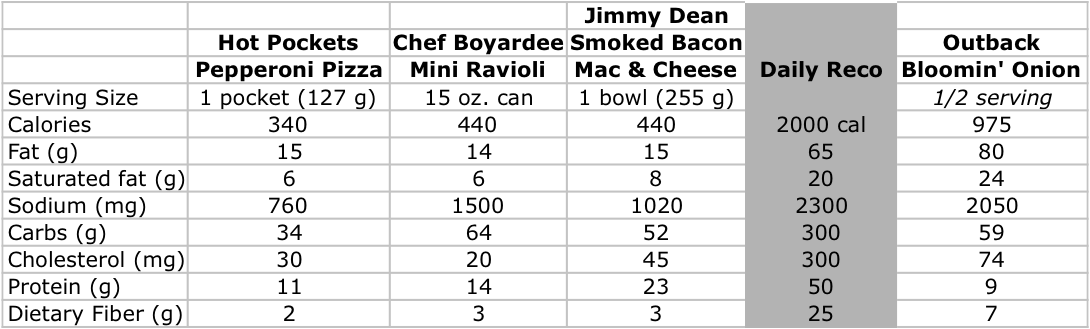
No problem, right?  Well, let’s assess the nutritional damage (Daily limits according to Netrition.com).

WalMartDinnerNutritionals

(We’ve assumed the young lady would eat one Hot Pocket, the young man would eat one can of Mini Ravioli and Dad would eat until interrupted by dessert).

In terms of calories, these are not horrible (but also don’t include other things served with dinner).  In the case of protein, they perform well (particularly Dad’s, because bacon).  On the other hand they provide a fairly heavy dose of saturated fat, carbs and sodium.  And not much fiber.  So nutritionally, this isn’t particularly ‘smart’, and in restaurant terms, steers more toward Bloomin’ Onion than Chez Panisse.  It is definitely not a model for a balanced, nutritious meal.

More insidious is the positioning of convenience above everything, where instant food, regardless of its merits, is the solution to ‘what’s for dinner’.  The entire family seems to have completely slept through years of nutritional messaging, PSAs and school programs, and I’m guessing Michelle Obama would not endorse this spot.
The audience gets a great reinforcement of instant food as good habit, and a great opportunity to model simple, nutritious eating is missed.  Not good.

There is a breakfast companion ad in this campaign, where the featured items are Froot Loops, Frosted Flakes and Jimmy Dean’s Pancakes and Sausage (on a stick).  No additional comments necessary, except if the same family is bookending its day with WalMart’s meal suggestions, that puts a LOT of pressure on lunch.

On the other hand, it’s probably not easy to match program participants to be nutritionally balanced.  And at the end of the day, business is business.

Check out this Kraft Mac & Cheese ad from the 1950s, and hang in there for the hot dog meal suggestion.

We have some significant weight/health issues in this country, and I wish we could do better.

Little League Whiffs on a Golden Opportunity

For most people in Chicago, and many across the U.S., this year’s Little League World Series rivaled any other sport in excitement and inspiration. This was in no small measure due to a few unexpected subplots.

Yet Little League, with a chance to embrace a unique opportunity to broaden its appeal, missed a golden opportunity in its TV marketing effort.

For those who didn’t follow the LLWS (which ended yesterday), two story lines completely dominated the coverage, and for good reason:

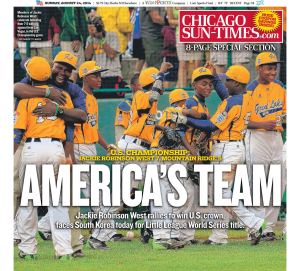
chi-jackie-robinson-west-fans-20140823-004 jrwcoverDJButler

1) A team of kids from Chicago’s South Side, Jackie Robinson West, overcame significant odds to reach (and win!) the U.S. Little League Championship game (falling short in the World title game to a very strong South Korean team). These kids, all African-American, are generally from less privileged backgrounds, yet showed how far a person can go, through preparation, determination, poise and pluck. It was a joy to watch these kids play, and they truly united the city of Chicago across all socioeconomic and demographic strata, a particularly welcome shift from Chicago’s more typical tragic stories of violence.  They are true role models for everyone, not least those for whom organized sports may be less accessible.

Mo'Ne 2) Mo’ne Davis, from Philadelphia’s Taney Dragons team, became the first girl to pitch a complete game shut-out in the LLWS, with pitches over 70 mph. For opposing batters, that would equal a major league pitch of over 90 mph (due to the shorter distance to the plate). Mo’ne’s heroics helped her team to third place overall, and created significant publicity for her, including the cover of Sports Illustrated.  For girls everywhere, Mo’ne is a fantastic role model.

These two stories elevated Little League to a meaningful place in cultural significance, with stories about opportunity, teamwork, dedication and perhaps above all, inclusion.

Unfortunately, during the broadcast Little League, in a continuation of its ‘I am Little League’ campaign, showed a PSA that completely missed an opportunity.  The faces in the otherwise well-done spots were for the most part straight out of Norman Rockwell circa 1950: charming kids but not a person of color, and certainly not a girl, in sight.  (I saw this spot but was unable to locate it online.)   

Here’s a fairly typical PSA from earlier in 2014; based on this past week, ‘I am Little League’ is now quite inaccurate:

In a world where organized sports for kids are increasingly specialized and expensive, there are too few examples of kids participating for the sheer love of the game (as opposed to a stepping stone to a pro career), or examples of girls competing effectively with boys on equal terms.  

This year’s LLWS was a tremendous chance to say “We’re Little League – – we don’t care where you’re from – – if you want to play, we want you!”.

So perhaps this year’s LLWC was two big steps forward, and one back, but at least it’s headed in the right direction.  Now if you’ll excuse me, I need to make plans to attend Chicago’s parade Wednesday for the Jackie Robinson West team.

Microsoft’s Epic S*** Sandwich RIF Letter

Posted on

Elop

We’ve all seen letters/press releases announcing reductions in force  – – usually brief, sometimes using euphemisms – – and many of us have been impacted by them.  Not fun.

We’ve also been schooled that when you have something unpleasant to say (say, in a private performance review), surround it with a positive lead-in and a positive ending – the so-called S*** Sandwich.

We have now seen what happens when a senior executive (seemingly without adult supervision) attempts to use said Sandwich approach on a massive scale, publicly, with consequences that impact an enormous number of people.  And it ain’t pretty.

Yesterday, Stephen Elop, inherited when MS bought Nokia and now running Microsoft’s Devices Group, sent a letter to MS employees announcing a huge reduction in force (12,500 employees).  He drops this bomb after 10 paragraphs of corporate-speak (bread #1), and then devotes all of 2 sentences to huge staff reduction, one of which is reserved to cover the human impact.  He then goes on to describe other steps being taken to achieve the corporate goals (bread #2).

You can read the entire letter below.  By doing a quick scan, you can see that there is a single number in the entire 1000+ word missive:  12,500.  And you can bet that that number is the one takeaway shared by all MS employees.

This letter is not a secret: it is posted on Microsoft’s own site:  http://www.microsoft.com/en-us/news/press/2014/jul14/07-17announcement2.aspx

This has the feel of someone who is trying to sneak in some bad news without the other person noticing: “Hey, how ya doing?  Like the new haircut.  Cool about LeBron coming back to Cleveland.  Sad news about Johnny Winter.  I ran over your dog.  Hey, I think the Cubs can make a comeback in July”.

Anyone who has gone through the trauma of being involuntarily detached from their livelihood knows that it is always shocking and usually devastating.  It needs to be treated with sensitivity, with regard for the dignity of those affected.

It is nice to know that this RIF is in the service of the very detailed strategic corporate goals outlined in Mr. Elop’s letter.

So for those of you who are affected:  my sympathies, both in the event and in the way it has been positioned
To Mr. Elop:  Easy for you to say

Below is the entire text:

-0-0-0-0-0-0-0-0-0-0-0-0-0-0-0-0-0-0-0-0-0-0-0-0-0-0-0-0-0-0-0-0-0-0-0-0-0-

Hello there,

Microsoft’s strategy is focused on productivity and our desire to help people “do more.” As the Microsoft Devices Group, our role is to light up this strategy for people. We are the team creating the hardware that showcases the finest of Microsoft’s digital work and digital life experiences, and we will be the confluence of the best of Microsoft’s applications, operating systems and cloud services.

To align with Microsoft’s strategy, we plan to focus our efforts. Given the wide range of device experiences, we must concentrate on the areas where we can add the most value. The roots of this company and our future are in productivity and helping people get things done. Our fundamental focus – for phones, Surface, for meetings with devices like PPI, Xbox hardware and new areas of innovation — is to build on that strength. While our direction in the majority of our teams is largely unchanging, we have had an opportunity to plan carefully about the alignment of phones within Microsoft as the transferring Nokia team continues with its integration process.

It is particularly important to recognize that the role of phones within Microsoft is different than it was within Nokia. Whereas the hardware business of phones within Nokia was an end unto itself, within Microsoft all our devices are intended to embody the finest of Microsoft’s digital work and digital life experiences, while accruing value to Microsoft’s overall strategy. Our device strategy must reflect Microsoft’s strategy and must be accomplished within an appropriate financial envelope. Therefore, we plan to make some changes.

We will be particularly focused on making the market for Windows Phone. In the near term, we plan to drive Windows Phone volume by targeting the more affordable smartphone segments, which are the fastest growing segments of the market, with Lumia. In addition to the portfolio already planned, we plan to deliver additional lower-cost Lumia devices by shifting select future Nokia X designs and products to Windows Phone devices. We expect to make this shift immediately while continuing to sell and support existing Nokia X products.

To win in the higher price segments, we will focus on delivering great breakthrough products in alignment with major milestones ahead from both the Windows team and the Applications and Services Group. We will ensure that the very best experiences and scenarios from across the company will be showcased on our products. We plan to take advantage of innovation from the Windows team, like Universal Windows Apps, to continue to enrich the Windows application ecosystem. And in the very lowest price ranges, we plan to run our first phones business for maximum efficiency with a smaller team.

We expect these changes to have an impact to our team structure. With our focus, we plan to consolidate the former Smart Devices and Mobile Phones business units into one phone business unit that is responsible for all of our phone efforts. Under the plan, the phone business unit will be led by Jo Harlow with key members from both the Smart Devices and Mobile Phones teams in the management team. This team will be responsible for the success of our Lumia products, the transition of select future Nokia X products to Lumia and for the ongoing operation of the first phone business.

As part of the effort, we plan to select the appropriate business model approach for our sales markets while continuing to offer our products in all markets with a strong focus on maintaining business continuity. We will determine each market approach based on local market dynamics, our ability to profitably deliver local variants, current Lumia momentum and the strategic importance of the market to Microsoft. This will all be balanced with our overall capability to invest.

Our phone engineering efforts are expected to be concentrated in Salo, Finland (for future, high-end Lumia products) and Tampere, Finland (for more affordable devices). We plan to develop the supporting technologies in both locations. We plan to ramp down engineering work in Oulu. While we plan to reduce the engineering in Beijing and San Diego, both sites will continue to have supporting roles, including affordable devices in Beijing and supporting specific US requirements in San Diego. Espoo and Lund are planned to continue to be focused on application software development.

We plan to right-size our manufacturing operations to align to the new strategy and take advantage of integration opportunities. We expect to focus phone production mainly in Hanoi, with some production to continue in Beijing and Dongguan. We plan to shift other Microsoft manufacturing and repair operations to Manaus and Reynosa respectively, and start a phased exit from Komaron, Hungary.

In short, we will focus on driving Lumia volume in the areas where we are already successful today in order to make the market for Windows Phone. With more speed, we will build on our success in the affordable smartphone space with new products offering more differentiation. We’ll focus on acquiring new customers in the markets where Microsoft’s services and products are most concentrated. And, we’ll continue building momentum around applications.

We plan that this would result in an estimated reduction of 12,500 factory direct and professional employees over the next year. These decisions are difficult for the team, and we plan to support departing team members with severance benefits.

More broadly across the Devices team, we will continue our efforts to bring iconic tablets to market in ways that complement our OEM partners, power the next generation of meetings & collaboration devices and thoughtfully expand Windows with new interaction models. With a set of changes already implemented earlier this year in these teams, this means there will be limited change for the Surface, Xbox hardware, PPI/meetings or next generation teams.

We recognize these planned changes are broad and have very difficult implications for many of our team members. We will work to provide as much clarity and information as possible. Today and over the coming weeks leaders across the organization will hold town halls, host information sharing sessions and provide more details on the intranet.

The team transferring from Nokia and the teams that have been part of Microsoft have each experienced a number of remarkable changes these last few years. We operate in a competitive industry that moves rapidly, and change is necessary. As difficult as some of our changes are today, this direction deliberately aligns our work with the cross company efforts that Satya has described in his recent emails. Collectively, the clarity, focus and alignment across the company, and the opportunity to deliver the results of that work into the hands of people, will allow us to increase our success in the future.

Regards,

Stephen

-0-0-0-0-0-0-0-0-0-0-0-0-0-0-0-0-0-0-0-0-0-0-0-0-0-0-0-0-0-0-0-0-0-0-0-

Jobs Cut

Direct Mail’s Identity Crisis

Posted on

We’ve all noticed that as emails have multiplied, the complexion of our snail mail has changed.

It seems that Direct Mail is an industry in dramatic transition.

Not only are marketers more able to individually profile and target consumers, but technology is starting to make it possible to eliminate most junk snail mail altogether.
– Consider PaperKarma, which automatically unsubscribes you from junk mail.
– Or more dramatically, the late, great disrupter Outbox, which went for the whole bundle in working through the USPS to allow consumers to digitize all of their postal mail so that individuals could get rid of junk mail, keep important things organized and never have to go out to their mailbox again. Despite strong market response, the USPS squashed Outbox.  See their very interesting story here.)

And yet, there are plenty of signs that there’s a lot more work to be done.

Consider the following examples:

1) Restoration Hardwareas posted last year, RH again sent its grandiose collection of ‘Source Books’ — only instead of 7 lbs, we got 15 lbs in the form of 12 separate catalogs with over 3000 pages.    We didn’t request this catalog, nor did we buy anything from RH in the last year (nor did we actually open the last shipment).

Restoration1

– The apparent environmental plunder generated predictable outrage, including a clever Tumblr called ‘Deforestation Hardware’.

Seems like an enormous waste to print and ship.  Yet RH claims that by sending once per year on heavy stock, they actually print fewer pages than many competitors, and encourage online shopping, which is a growing % of their business.  At the same time, the shipping label claims ‘UPS CARBON NEUTRAL SHIPMENT’, whatever that means.  You can find their whole array of disclaimers here.

Personally, I doubt that many consumers keep these things on the coffee table for a month, let alone a year, and the optics are a PR disaster.  It seems more like an ego play by the boss, Gary Friedman.  I’m just glad I didn’t run into my mailman the day he had to deliver these to the neighborhood.

Lesson:  As online shopping continues to morph, the role of ancillary vehicles (like direct mail) will continue to morph as well – – in this case, moving from an immediate revenue-generation prompt to (theoretically) serving as a visual brand reminder, much as broadcast media has traditionally done.

2)  Effective Targeting,  Or Not.   In the same week I received the RH catalog/doorstop, I also received glossy pitches for, in ascending order of preciousness:
a) Audi A8  (starts at $77k; optionable to $120k).  Nice car, but nope.

audia8

b) Around the World by Private Jet (sent by a company called TCS Expeditions and sets you back about $180k per couple for 25 days or so).  Apparently there are lots of these types of tours available; you can save $80k by going as a single!  Nope again.

WorldTravel

c) The jet itself.  Specifically the new Falcon 8X from Dassault.  Yes, I actually got a sales pitch for one of these.  About $58 million.  Nope yet again, even if the garage were bigger.

FalconJet

Somewhere someone has decided that I’m a good target for these extravagances.  I am not, nor is there much in my background to suggest that I am.

So I can’t understand why in this age of micro-targeting, Big Data and 1:1 marketing, that I’m being targeted.

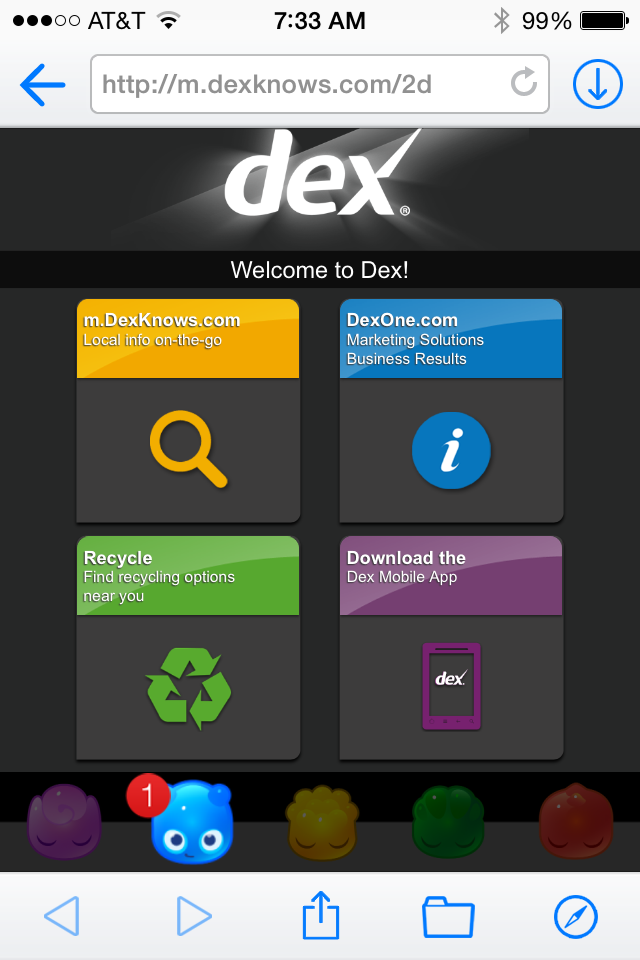
3) DEX.  Like Gene Simmons, the Yellow Pages just won’t go away.  The days where YP was a household staple are long gone; they are now obsolete the second they land with a pathetic thud on your driveway.

Ironically, there is a QR code on the front of the book, which like a snake eating its own tail, leads you to the Dex app (below), as if to hammer home the printed version’s obsolescence.  And in case you needed a further reminder, there is a recycling link to help you dispose of the printed directory you just received.

Dex App

Clearly all of this cannot go on forever.  There are not enough dollars, hours, or trees to sustain this wasteful direct mail.

Lesson: at some point, the ability to get high-quality, appropriately targeted mailings might make a huge difference in an email-cluttered world.  But we’re not there yet.

Top 5 Observations! – National Restaurant Show (Part 2)

Posted on

This is part 2 of coverage of the 2014 National Restaurant Association show – too much great stuff to fit into one post.

Screen Shot 2014-05-23 at 3.32.59 PM

I’ve ranked my top 10 observations; this post features my Top 5.

(If you missed my previous post, you can see #6-10 here).

Again, all links are live so please click through with abandon.

OBSERVATION #5.  School Lunch is a Battleground.

Remember when school lunch was a PBJ, apple and Twinkie in a paper bag or Superman lunchbox? How many ways would that not work now?

Two trends are making school lunch planning fiendishly difficult.

A) FLOTUS Michelle Obama’s Healthy, Hunger-Free Kids Act of 2010 sets limits for sodium, fat, sugar and calories, among other things.
– What’s happened is that compliant healthy meals are often too skimpy (or not tasty), kids are not eating them, and some schools are dropping out because they are losing money (even with subsidies).

Check out these funny-yet-sad tweets from kids complaining about their lunch offering:

Screen Shot 2014-05-23 at 3.22.14 PM

B) Separately, allergens (like nuts) are becoming more of a center of the plate issue.

The result of all this is that there were numerous products specifically positioned as not only allergen-free, but also satisfying the school lunch nutritional requirements.

Home Free, Skeeter and Funley’s are on the market touting such mouth-watering claims as ‘Nut Free’, ‘School Compliant’ and ‘Gluten Free’ and other ‘free-from’ things.   Which is a shame, because beneath those claims they all tasted really good – a message that seemed somehow forced into 2nd place.

Cookies

Separately, organizations like Wholesome Tummies are offering alternative programs providing ‘fresh, nutritious and exciting foods’.

There were a lot of school nutritionists asking lots of questions.  And ultimately the market will decide.


OBSERVATION #4.  Liquor-flavored meat.

With these two manly ingredients, how could you lose? There were quite a few examples of meat flavored with some sort of macho alcohol. We’ve seen things like Jack Daniel’s barbecue sauce for years, but these examples had the flavor infused into the meat.

A few examples:
Family Brands has just introduced meat products infused with Ole Smoky White Lightnin’ Tennessee Moonshine. You can get pulled pork, sausage and other products flavored with with regular, apple pie or other moonshines. They taste great, but don’t overdo it – – you may get Dukes of Hazzard flashbacks.

OleSmoky

– Over at Zoe’s Meats, they’re offering Ghost Pepper Salami with tequila

– And my friends at Kronos Foods were sampling their brand-new Beer Can Chicken, which I can testify is better than anything I get from my smoker.  Perhaps one reason is that they use PBA (Premium Brown Ale), while I use PBR.

OBSERVATION #3.  Food Trucks Mainstreamed.

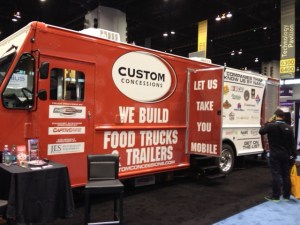
Food trucks have long been thought by some of as being on the funky fringe of foodservice, operating from recycled ice cream trucks. Well, this year served notice that food trucks are now driving right down the middle of the road.
FoodTruck

FoodTruckInt

Several companies offered custom foodservice trucks, built to spec and coming in at around $150,000. These are impressive, well-equipped, heavy duty vehicles specially built to bring the finest cuisines right to your doorstep.

At that point, whether you go for kimchi, po’ boy, pupusas or paletas is entirely up to you.


OBSERVATION #2 – RUNNER-UP:  Kallpod.  ‘What’, you say?

How many times have you had an otherwise great meal spoiled by:
– waiting for a refill on your drink
– waiting for your check
– otherwise having your server disappear into the ether never to be seen again

Well, this tech innovation gets super-high marks because it focuses on diner satisfaction.   What a concept.

The best analogy for Kallpod is the ‘Call Attendant’ button in an airplane – – only in this case it’s on your restaurant table and it’s wirelessly connected to a special Dick Tracy-like device that your server wears.

Kallpod

The concept is simple: you hit a button (refill, check please, etc) and your server gets a small vibration/shock and message like ‘check, table #8’. How great is that?  Awesome, although possibly less so if you’re a server, I suppose.

Reminds me a little of the Burger King Subservient Chicken that was compelled to respond to commands from strangers (shown in redemption video here):

http://adage.com/article/news/burger-king-s-subservient-chicken-video/292953/

So Kallpod offers something for everyone:

– Diners get quicker, better service and for a select few, the opportunity to indulge hidden sadistic tendencies
– Operators convert more drink requests, and can turn tables more quickly
– Servers get the opportunity to see their guests more, and for a select few, the opportunity to indulge hidden masochistic tendencies.

Kidding aside, this is a palm-to-forehead great idea, well executed.


And the winning #1 observation at this year’s NRA is:  SCHMACON!  

Yes, Schmacon. It’s not a trend or even a fad, it’s the sort of cosmic occurrence that we unfortunately see all too infrequently in our short time here on this mortal coil.

Schmacon2

My first minutes at NRA, at 9am, took me directly into the olfactory territory that the modest Schmacon booth was invisibly marking.

Schmacon is ‘smoked and cured glazed beef slices’ , but think of it as beef bacon, which by one account tastes like ‘crispy glazed pastrami’ (thanks Kevin Pang). By all accounts it is delicious, as demonstrated by the growing line for samples (of which I had two, for research purposes).

In addition, it is lower in calories, fat and sodium than traditional bacon.  A bit ironically, it is not pork but neither is it kosher.  But who are we to quibble about a technicality?

Schmacon is from Schmaltz Products in the Chicago area – a company with a funny name, but serious deli DNA.

Schmacon was a Food & Beverage 2014 award-winner.  I took home Schmacon literature and a scratch ‘n sniff button to remind me of my experience.  It’s mostly just for foodservice now, but you can taste it for yourself when it hits retail shelves later in the year.

———–

So that’s it for the Top 10.  I do have some Honorable Mentions directly below:

Ice Beer.  Basically a beer slurpee, complete with alcohol.

IceBeer


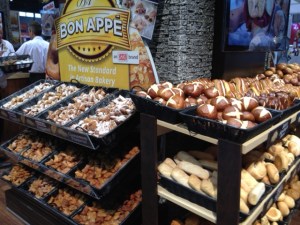
Nutella Poppers.  Like little chocolate beignets – awesome (and proof that carbs are alive and well)
Carbs!


Neat meat replacements.  Mixes made from nuts, beans, grains and other ingredients.  Really tasty with great texture.

Neat

Poppies Dough.  Terrific products (but I’d be lying if I didn’t say I had a little Seinfeld moment…)

Poppies


Top 10 NRA Show Observations (Part 1)

Posted on

Once again, I’ve taken one for the team and walked the floor at the National Restaurant Association show (yes, that NRA; sorry Mr. Nugent).

NRA

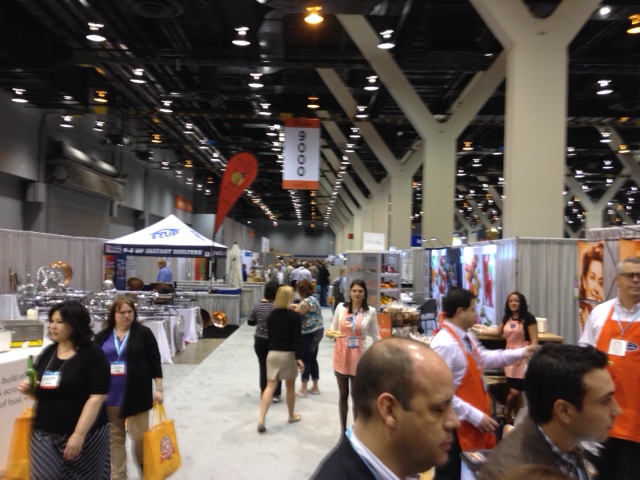
Show Floor – 2014 NRA – McCormick Place

In addition to things I reported on last year, there are some exciting new offerings.

Because there’s so much cool stuff, I’ve separated my Top 10 list into #6-10 (today’s post) and Top 5 (coming soon).  So here we go.

[NOTE:  as always, all links and photos are live: click on them to learn more]

Observation 10.  Tea!  Tea!  More Tea!  – as you may recall, tea was originally introduced at the 3000 B.C. NRA show (held outdoors in Wrigley Field).

The news this year is that every time you turned around you bumped into another tea purveyor trying to look old and mystical and yet hip at the same time. (sort of like Cher? Keith Richards?)  Dozens of them. Perhaps it’s an echo effect from Starbucks’s Teavana venture.  Or maybe they’ve been there all along and I’m just noticing.  At any rate, hot or cold, flavored or straight, Oprah’s Chai Latte or not, prepare to be offered tea more and more often.

DavidsonTea


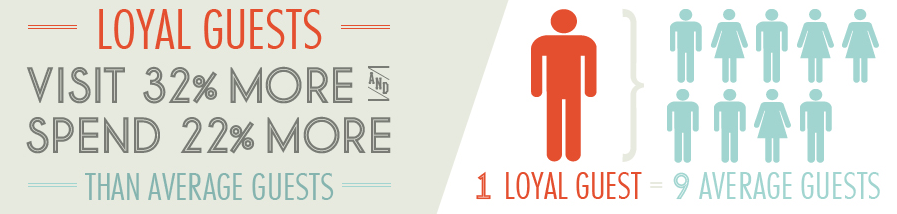
Observation 9.  Greater Sales through Big Data.    Have you heard this term before:  ‘big data’?  Of course you have.  Not to be confused with ‘Satisfying Customers through Big Data‘ (more on that later).  The restaurant business is increasingly swimming in POS data, and LOTS of companies are trying to use it to help restaurants pry every last dollar from your wallet.

Essentially it comes down to driving traffic, increasing loyalty, up-selling, and above all, getting you to buy more high-margin beverages.  You out there, experimenting with different restaurants and learning about different food cultures?  Well, STOP IT!  Do you want to be just average, or do you want to be LOYAL?  Yes, a restaurant-centric, not consumer-centric way of looking at things.

Screen Shot 2014-05-20 at 9.56.30 PM

One loyalty company called Paytronix allows operators to send geofenced messages (it is what it sounds like), lets them pay for food with their phones, and more.  Just when we thought our ability to actually communicate with each other couldn’t get any worse, there are now even more distractions available.

Paytronix also models guest behavior to project potential high-value customers and nurture them. Which of course sounds familiar, since the casinos have been doing it for years.  Except you will never be comped drinks and a hotel room in a restaurant.

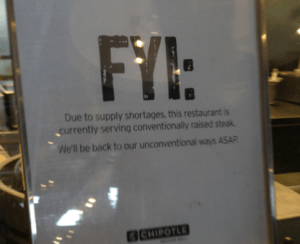
Observation 8.  Responsible/Local Sourcing – Whether it’s produce, protein or grains, where food comes from is increasingly getting attention.  However, it’s one thing to say it, quite another to do it on a meaningful scale.  As Chipotle found out recently when they faced a shortage of ‘responsibly raised beef’, reducing your supply options means the margin for error shrinks as well.

HydroponicsScreen Shot 2014-05-22 at 5.10.14 PM


Observation 7.  Mobile to help back office.  Could there be a less sexy title?  Doubtful.  The point here is rather than ‘mobile’ being a buzzword but not really ready for primetime, Mobile is starting to be leveraged in a way totally relevant to the frenetic nature of hospitality.

One startup, Partender, has developed a mobile app to get real-time inventory updates for the bar area.  In the bar business, making money is a lot about tightly controlling inventory to keep service levels high, while making as much cash available for the important stuff: hiring trick bartenders like Tom Cruise.

Seriously, I saw this app at work and it is slick, intuitive, and totally appropriate for the use.  When inventory is sitting on the shelves, it’s hard to input with a fixed desktop or laptop.  Mobile is increasingly adding real value where it makes sense..

Screen Shot 2014-05-22 at 5.15.48 PM

Observation 6.  Plant-Based Dinnerware – compostable products have been around a while; this year there were more products that were plant-based.  Specifically, companies like World Centric and Vegware offer tableware, utensils, napkins, hot/cold cups, to-go packages and more made from things like sugar cane, wheat straw, and corn.  As volume increases, costs will come down and you’ll see more of this approach.

energy-savings

…But wait – – Now you can also get utensils that you can not only eat with, but that you can EAT.  Foodie Spoon offers a selection of different serving shapes (spoons, cones, shapes) that you can put stuff on, and then eat the whole thing.  Think of a mini-me taco.

FoodieSpoon
So next time you’re at a party and a waiter offers you an elegant canapé on a spoon, amaze your friends and chomp the whole thing down.  (But maybe check first.)

THAT’S IT FOR OBSERVATIONS 6-10.   COMING SOON:  THE TOP 5, which promises to be even more exciting.

In the meantime, a few bonus experiences from the show:

Silpat Girl

Silpat Girl

Espresso Cheese!

Espresso Cheese!

Stay tuned!