Re-posting an article originally published on LinkedIn.

The more you learn about this rescue, the more amazing you realize it was.
https://www.linkedin.com/pulse/6-things-thailand-can-teach-us-crisis-management-dave-tuchler/
Re-posting an article originally published on LinkedIn.
The more you learn about this rescue, the more amazing you realize it was.
https://www.linkedin.com/pulse/6-things-thailand-can-teach-us-crisis-management-dave-tuchler/
Sometimes, as marketers, we take ourselves WAY too seriously. Having a little fun can be a great way to break from the pack and enhance your brand identity.

Overly serious messaging with the tonal equivalent of sucking a lemon can get a message across but can also miss a great opportunity to connect with the audience and to break through in a crowded environment.
I’m not talking about Bud Light ha-ha slapstick funny – there’s lots of that out there (and a lot of it is not particularly funny).
I’m talking about funny that connects to someone as a person. There’s a difference.
Exhibit A – Sprinkler Supply Store
I ordered replacement gaskets online from a sprinkler supply company. They arrived and all worked out. End of transaction.
…but no one could hear the rest of the announcement over the clamorous applause. Bells were rung. Balloons were dropped. “It’s Raining Men” blared from every speaker.
Simply put, adding you to our Sprinkler Supply Store family was cause for immediate celebration, everyone is thrilled you’re now a customer. Thank you!”
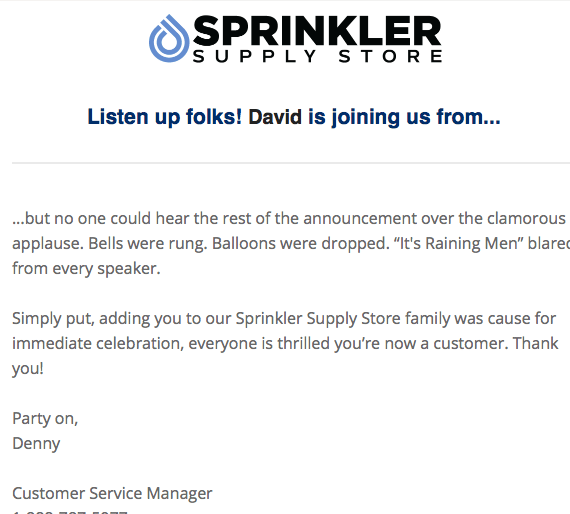
Exhibit B – UberConference – World’s Best Hold Music!
If you’re waiting for other people to join your UberConference call, you will hear music about…being on hold. First time I heard it, I laughed out loud.
Here’s a company that essentially force-feeds hold music saying “hey, we rely on hold music and even WE think it sucks!” In other words, they get it.
 “I’m On Hold” was written and performed by Alex Cornell, an UberConference exec. Sample lyrics: “Well, I’ve been sitting here all day/I’ve been sitting in this waiting room/And I’ve been waiting on my friends/Yes, waiting on this conference call – all alone/And I’m on hold, well yes, I’m on hold/I hope it’s not all day”.
Check out the YouTube video below, and check out the comments. That’s a great connection.
Exhibit C – Sheetz (a 600-unit, 65-year old mid-Atlantic convenience/gas chain)
Convenience stores connected to gas stations are many, varied, and mostly interchangeable. Not this one.
Exhibit D – Buick Enclave
I am not a Buick guy, but I did a double-take with a current spot.
Base version
https://www.youtube.com/watch?v=UA-I-cN9mh8
‘Dog Walker’ version



https://www.youtube.com/watch?v=mYoq2epAXG8
Exhibit E – Southwest Airlines safety announcements
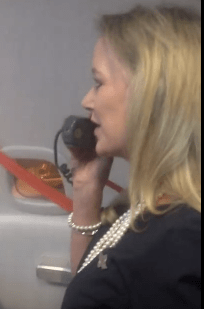

https://www.youtube.com/watch?v=07LFBydGjaM
Great marketing messaging creates a connection with the viewer – – to demonstrate that the advertiser understands who their target consumers are, and what they feel and need – – and that this empathy presumably translates to a belief that they can better meet your needs.
Humor, in addition to helping break through the clutter, is a very good way to create that direct connection, and maybe help bring that prospect a little closer to being a customer.
Of course, there are some situations where humor is just not appropriate – – serious life issues, mean-spirited, sexist or condescending humor, things that appeal to only a miniscule narcissistic sub-segment of society (copywriters), and stuff that’s just not funny.

So remember that, like hot sauce, while it can spice things up, not everyone likes humor the way you do, it doesn’t go with everything, and if used too aggressively, it can ruin what you were trying to improve.
Do You Know Your Most Valuable Customers? Do they know that you love them?

It’s 10 times harder to get a new customer than to keep an existing one. Loyal customers are more profitable and have the highest Lifetime Customer Value. They love your company already. They have already been acquired, qualified and taken through the funnel – – you have them where you want them!
So why, with today’s sophisticated customer management systems, are loyal repeat customers too often just an afterthought? Or missed entirely?
In today’s post we will try to demonstrate that marketers must make extra effort to identify and appreciate these great customers.
Customer Relationship Management (CRM) data-based systems have given marketers the illusion that they not only know everything about their customers, but that their email outreach perfectly motivates everyone. This is not always the case. They don’t always get it right. Customer targeting algorithms written too narrowly can miss the bigger picture.
Case in point: my very own Mom.

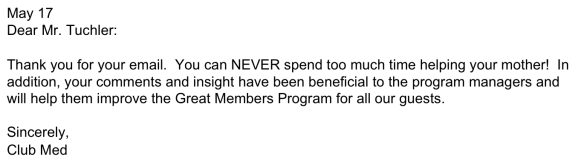
In the case of Club Med, the algorithm failed. They were focused on the last 3 years only. And they completely missed the fact that she’s a long-time customer who brings a group. Mom turns out to be a mere Turquoise! A rookie in their eyes!


———


————-

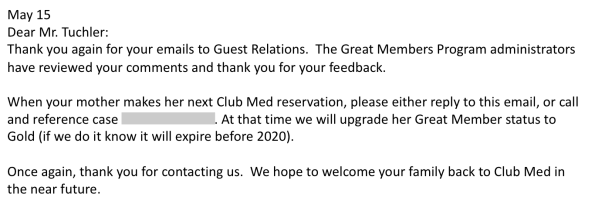
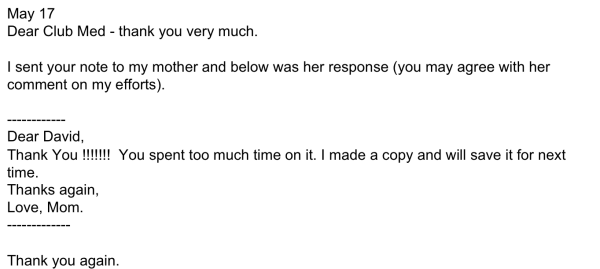
Club Med of course doesn’t want to ignore their best customers. It’s just that their system isn’t set up to recognize them all the time. To their credit, they handled my email rant with grace – – and came through in the end.
——–
So figure out who your best customers are and take care of them!
Right after you take care of your mother.
This is our monthly installment of ‘Delayed Grasp of the Obvious’.
Just before Facebook Week last week I volunteered a point of view that was posted in Kevin Coupe’s excellent retail blog MorningNewsBeat.com, questioning that as FB doesn’t charge, how can it compensate users for breach of their private data? (the letter is shown below).
Fair enough question and we saw Zuckerberg, Sandberg & Co. take some baby steps last week after the Congressional rotisserie.


But I made a huge error when I said “Facebook is free already”. Palm to forehead.
Facebook is not free. Nothing is free.
As has been famously stated and variously attributed, ‘There ain’t no such thing as a free lunch”. Meaning, there’s always a hidden or implied cost or quid pro quo with anything positioned as ‘free’.
In Facebook, you don’t pay cash, you pay with something much more dear: YOU.
In fact, Facebook, and all other ‘free’ sites, are not benevolent social facilitators, they are essentially match.com-like dating sites that try to hook up advertisers with hot to trot consumers. Except you don’t volunteer things like ‘long walks on the beach’. All you do is go about your daily life, posting and clicking, and your profile is created in the background, with data you didn’t even know was being collected.
Basic stuff, but really brought home by the latest Facebook issues, which look to become a watershed moment in privacy practices.
As a marketer doing anything online, understand that your future efforts to connect with consumers is going to have to deal with increasing amounts of skepticism, where consumers make a more informed decision about whether hitting that last click-bait article, or signing up for something that looks free.
– and increasing privacy laws will likely mean greater disclosure and more overt opt-in requirements.
As a consumer, realize that online you are first a commodity, not some company’s friend, and you need to take exceptional care of YOU.
The days of ‘free’ services are waning. And this is not just another conspiracy theory.

April 6, 2018
I liked this email about the Facebook situation from MNB reader David Tuchler:
So here’s the thing: any normal business that screwed up or compromised its customers’ privacy or violated any other customer rights would be compelled to offer some sort of make-good (morally if not legally). If the laundry scorches your shirt, they cover the cost of the shirt or give you a credit. Even Equifax offered a identity protection service, even if it was sort of a ‘honestly, you can trust me again’ thing. The point is that the injured party is somehow compensated.
Facebook is different – it does not collect revenue from its consumer users. So even with millions of its users’ confidential data breached and a market cap of $464 Billion (that’s over $200 per user or $6000 per affected user), does Facebook have a responsibility to somehow make things right? And how would that even happen? In-kind gestures (we’ll extend your subscription another 3 months) doesn’t necessarily work here – – not only because FB is free already, but I don’t want any more FB – – I actually want less.
This is one of those areas where the law hasn’t kept up with the fast-moving nature of online activity (sort of analogous to the online sales avoid sales tax loophole). To the extent these social media companies have no avenue to make things right, I would have to agree with the European direction of requiring more strict and obvious safeguards and opt-in mechanisms so that risks are made clear and users can make a more rational judgment on whether to join or not.
-0-0-0-0-0-0-0-0-0-0-0-0-0-0-0-0-0-0-
As you may have heard, social networking giant Facebook today quietly announced the test marketing of an updated version, called Facebook Real, with the stated objective of improving the Facebook user experience.

Facebook has always taken some flak about its negative effects, so this seems a worthwhile goal. But cynics as we are, The Armchair MBA feels Facebook Real is just a misdirection play to divert attention from the ongoing Cambridge Analytica scandal (CEO Zuckerberg is scheduled to testify before the US Congress in the near future).
In any case, this is an example of how a seemingly innocuous reason-for-being (exploit the constant human needs of attention and affirmation to create an online community and attract eyeballs) can instead have the opposite effect (while also creating an international political scandal).
In today’s online world, nothing is 100% predictable. Or even 50%.
——
Since its founding in 2004, Facebook in 2017 has reached over 2 billion active users and a market value of over half a trillion dollars (although the recent scandal chopped about $50 billion – !! – off its market cap).
Along the way, however, the effect of never-ending positive posts from friends combined with lack of personal interaction has drawn increasing criticism for its negative psychological effects – – leading to a press release in December 2017 from Facebook’s own researchers admitting that sometimes people “felt worse” after spending time online.

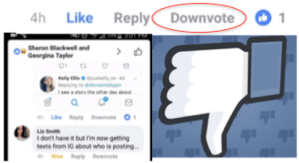
Facebook has itself experimented with a ‘dislike button’ (which they call a ‘downvote button’) to give users some measure of control. But this hasn’t gone anywhere.
https://www.thedailybeast.com/facebook-is-testing-a-dislike-button-called-downvote-with-select-users
How will Facebook Real be different?
Facebook Real is a different way to help some users better cope with a continuous stream of positive posts, while still staying connected.
It is well known that the carefully curated posts of acquaintances’ positive experiences – – an accomplishment, a great vacation, a financial windfall, a celebrity sighting, etc. — are in reality your friends’ personal Highlight Reels. No one has a life as fabulous as any single person on Facebook, let alone everyone combined.
Indeed, as the Facebook researchers noted, “reading about others online might lead to negative social comparison” – – in other words, feelings of relative inferiority.
Facebook Real takes a different approach that is elegant in its simplicity. It essentially attempts to make feeds more representative of real life, including the ups as well as the downs – – and relies on Facebook’s seemingly endless personal data trove, combined with some remarkable algorithmic programming.

In the test, every 2 or 3 actual positive posts from a person will be supplemented by one ‘fake’ post that is designed to reflect the realities of life. These ‘reality’ posts will be woven into the feed naturally, based on what Facebook knows about you.
For example, if Person A posts ‘my daughter is on the honor roll’ followed by ‘my husband just achieved his karate green belt’, or ‘got first row tickets to the Final Four’, it will be followed by a random post that Facebook has created but which is based on the person’s actual life.
If Facebook’s data shows that this person has, say, experienced a drop in credit score, a mortgage default, a threatening blackmail note from a spurned co-worker, a pet that failed obedience training, or a child that was recently bailed out of prison, this will be skillfully used to create a real-looking post sent from that person. The ‘sender’ will not be aware of this ‘faux post’.

The result will theoretically provide a break from the incessant stream of positives and show that everyone actually deals with real life, leading to a more interested, engaged and stable universe of Facebook users.
The downside is of course that Facebook Real relies on leveraging ever-increasing and ever-intrusive data on its users, which is not consistent with current attitudinal trends.
Look for more information on Facebook Real in coming weeks, and please contact The Armchair MBA if you suspect you may be in the test group. We’ll (anonymously, of course), provide an update in a future post.
I just finished a lengthy (20 min.) survey regarding a recent vacation, only to have my input erased due to technical issues. Getting a lot of this lately.
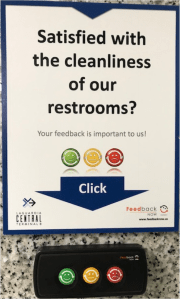
Not elbow-friendly buttons
Marketers have become entranced by the ability to survey consumers at very low cost. This is a seeming game-changing alternative to custom studies that can easily get into 4 or 5 figures or more. Technology has made it possible to survey via email, phone and even in restrooms!
What’s not to like?
Well, as a consumer, I’ll tell you what’s not to like. We are getting surveyed to death. Ironically, more surveys might be leading to lower quality insights.

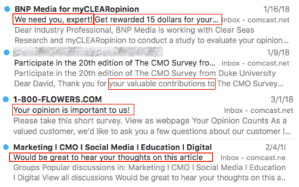
If, like The Armchair MBA, you use your inbox as a de facto filing tool, search for ‘survey’ or ‘what do you think’ or ‘your opinion’ and see what you get.
The answer is: lots. In addition to follow-up questions on every Amazon purchase, flight segment, taxi, Uber or car rental you take, everyone is getting into the act.
The dangers of over-surveying are:
All of these things can result in worse, rather than better, information.
So here are a few things you can do to maximize the usefulness of your surveys.

 4. Promise to share results of the survey. This is the researcher’s click-bait, especially if it’s something of high interest. Related, give the respondent some level of belief that the results will actually result in something good being done.
5. Flatter the potential respondent. ‘We’d like your expert opinion’, etc. As long as Pride is still one of the Seven Deadly Sins, this will have some effect.
And finally, tip #6 – – don’t put a push-button survey machine in a restroom.

A week ago the impossible happened – a Super Bowl that was WAY more exciting than the ads.
Still, duty calls – – it’s taken a week to fully process the advertising train wreck but the result is worth the wait.


The Armchair MBA carefully analyzed the reviews of 10 respected entities (plus a timid peep from Harvard Business School), summarily ignored them and can now announce the REAL best and worst ads of 2018.

Super Bowl spots, in particular, need to stand out in a hyper-charged environment, create water cooler (social) chat to extend the brand, and ultimately move the brand forward.
Clicking on this chart will blow it up so you can see where everyone came out.
Included at no extra charge – charming, witty, pithy bons mots! It’s so worth it!

We generally subscribe to the ADPLAN evaluation system set up by the Kellogg Graduate School of Management (Attention, Distinction, Positioning, Linkage, Amplification and Net Equity).

First, a few general observations:
Selected Best Ads


Selected Stinkers


Maybe like the E*Trade commercial says, I’m just getting old.
Online shopping’s biggest barrier is sometimes called the ‘final mile’ – – and like a long bridge that has an unfinished gap, an otherwise great online retailer fails if it can’t get the goods all the way to your front door.

The same applies to traditional media, where either the message, or the call-to-action, or both, can be bungled.
This ancient reminder for marketers is to remember to keep the audience in mind when crafting your message. It’s not what you say, it’s what they hear.
I am referring today to very old-school media — radio and outdoor. To be effective, they need to make the message or benefit simple and clear, and effectively tell the listener or viewer how they can take action. Too many advertisers fail this simple test.
Let’s look at a few examples.
Radio – – if nothing else, it MUST say where you can go for more information!
Too many radio forget you can’t see what they’re saying or write things down – – you can only listen and hope you got it right. “Hey, I’m driving, I’m texting and don’t have a freaking free hand right now!” Radio doesn’t have a pause or rewind function.


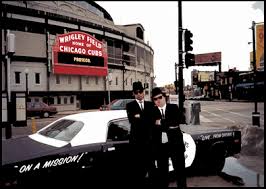
Net, just remember that your listener doesn’t know you, can’t write stuff down, and so make it as easy as possible to take away a key benefit and how to reach you.
Outdoor – – this is where even more heinous communication crimes occur. Particularly on expressways, where presumably the intended viewer is driving fast, hopefully paying attention to the road, but probably also still texting.
In any case, there are only a few fleeting seconds to grab their attention. So make it simple, make the type big, and get out of they way.
The following examples either have an unidentifiable offering, are unreadable, have impossible to read contact info, or a combination of the above.
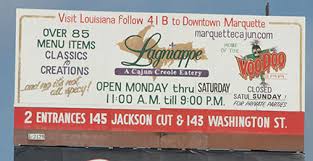
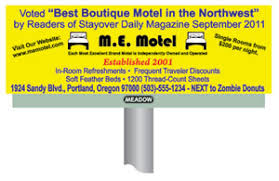


If you are contemplating outdoor, do a flashcard test to see if a colleague can get the point in a few seconds.
And – – watch your spelling!


This is the final post of 2017. Next year The Armchair MBA will offer a series of tips on how to spot scurrilous email scams, based on a carefully curated collection of several hundred emails with bad intentions!
Happy New Year!
Don’t you hate it when you want your money back and have no leverage? Explanation of this (and ‘Hand’) follows.
This is about companies who put barriers in place to enable them to hold onto your money until they wear you out. A war of attrition. Things like unreachable customer service, phone personnel with no names who cannot be recontacted, endless phone wait times, etc. We’ve all been there. Some of you are probably on hold with someone right now!
My goal is always to have a ‘So What’ in my posts but other than stopping transacting altogether, I am not sure how to preemptively protect against this! So I’m open to suggestions.
So that’s your challenge, dear readers. For the good of humanity, help us find a solution.
The basic model has been around: exploit human nature.


It used to go something like this: you get a gift card and the issuer gets the revenue and records future redemption as a liability. You put it in the kitchen ‘everything’ drawer next to your frequent shopper cards from 1995, never redeem it, company books revenue with no expense. Nice! Called ‘breakage’ in accounting, commonly known as ‘slippage’ in consumer goods. Coupons are issued, people don’t bother redeeming, etc.
This new version is more insidious and aggravating. As George Costanza might say, we have no hand! And they know it!
Here’s how it works (examples below):
Case study 1: Booked AirBNB for about $1600 for a week; they (and owner) got payment in advance. Upon arrival, property has significant water leaks, which are being repaired, rendering it uninhabitable. AirBNB is contacted, situation explained, they offer $400 refund afterward and refuse to discuss the matter further. Boo, AirBNB!
Case study 2: Rented car with GPS. GPS didn’t work. Took over an hour and several emails just to get back the $30. Boo, Fox Car Rental!
Case study 3: Moved across the country. $17k total bill, which required payment in full ahead of time (apparently this is standard operating procedure, which is itself worthy of a separate conversation). Move happened 3 days late, which created additional expense for friends who flew in to help with the move, and which technically qualified as a ‘late delivery’ by the mover. Several items broken. After huge effort and many hours and emails, result was a check for $20 we got in the mail. Zero hand in this one. Double Boo, North American Van Lines!
Case study 4: WSJ inexplicably stops being delivered one Friday. Go to handy online notification area but service is down. Chat is not manned yet (it’s before 8). Phone line also not available. Paper doesn’t come on Saturday either, make several online entreaties to both email and chat. Now start getting 2 (identical) papers on Monday. Issue finally settled on Tuesday. Boo, WSJ!
I could go on. I’m sure we all could.
In fairness, these infuriating episodes are balanced by the transparency and customer satisfaction focus of many excellent online retailers, who understand something about customer satisfaction and loyalty.
In all of the cited cases the supplier messed up, but the burden was on the consumer to spend the significant effort to (maybe) get a satisfactory reimbursement. There is no Online People’s Court to help resolve these issues. I personally resent having to spend precious time just to claim what is mine in the first place!
Sure, over the long haul corporate reputations can be harmed, penalizing bad behavior. But I don’t want to wait for the long haul.
How can we fix this?
While there are scholarly arguments on both sides of ‘how much service is too much service’ (yeah, HBR, I’m looking at you), The Armchair MBA suggests that in going above and beyond in solving a customer issue, the customer may end up more satisfied than if they didn’t have a problem in the first place!

The end result is that you can basically turn that customer frown upside-down, and perhaps even translate that into loyalty – – but it takes effort and commitment.
Net – sometimes it’s the effort – – listening, promptly replying, admitting guilt when appropriate, empathizing with the customer, and making it right – – that makes the difference. Customers appreciate that you care, even if they don’t get all they want.
A few personal stories illustrate the point.
1) Delta – NOT ready when I was
Recently I was a casualty of the Delta Airlines meltdown, where storms early in the week caused cancellations all week due to Delta’s inability to adjust.

The impact on me was that I had to rent a car and endure a nasty overnight drive from Providence to Raleigh NC (there were no other flights available).
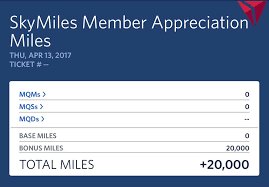
How did Delta handle it?
Prior to this episode I was not committed to Delta one way or the other. But this mea culpa demonstration (without me asking), especially compared to how United dealt with its own PR issue at around the same time, has me leaning positively toward Delta.
2) 360fly, Inc. makes what is essentially a baseball-sized 360° GoPro. I ordered one for work, but it was delivered without one of the camera mounts I had ordered. After a few weeks I brought this to their attention.

Their response: they immediately apologized for the error, sent me the missing mount, and sent me an additional mount as compensation for my inconvenience.
My impression of them went from ‘small company, not particularly well-organized’ to ‘small company, maybe not so well organized but heart in the right place and committed to the customer’. This translates to my discussing them positively (including this post).
3) 1-800 Flowers. I’ve used these guys for years, with mixed results. When I had flowers and a balloon sent to my mother recently, the balloon, while in the photo of the item, wasn’t delivered. (the inclusion of a balloon was an inside joke).

I sent a gentle email and the immediate result was:
– an apology from the head of customer service, assuring me that the photo would be adjusted so as to not be misleading
– an apology from someone way higher in the food chain
– an immediate reduction in the bill in the amount of the balloon (even though I hadn’t paid for a balloon separately)
– a generous coupon for next purchase
– a balloon appeared on my mother’s door THAT SAME DAY! WOW!*
*when this happened, it was hard to believe – – what a great demonstration of making it right! Turns out hard to believe was accurate. 1-800-Flowers did not in fact send a balloon to my mom- – someone else coincidentally did at the same time. But still, they did a great job.
I’m sure everyone has an experience where they were ready to go to battle with a company, only to have the company respond with such aggressive goodwill that the complainer was turned into a fan.
The secret, in addition to what’s mentioned above?
To be able to solve a customer issue over and above their expectations, you must screw up once in a while.
Excellence on a regular basis sets an expectation.
On the other hand, periodic screw-ups with excellent resolution makes a more compelling impression.
 The Armchair MBA