Ever wonder why you never totally agree with Super Bowl ad reviewers?
Well, other than for a few good ads* they mostly don’t agree with each other either.
The Armchair MBA has selflessly taken on what is certainly is a vast unfulfilled need and compiled a comparison of 9 disparate SB ad reviewersjust for you! Wow! Almost as much fun as being a Broncos fan!
Just click on the chart below to see that while there is some consistency, in the end advertising is still an art and everyone’s got their opinion. (You can click on the chart twice to make it even more readable.)
(*Generally universally liked: Budweiser, Cheerios, Radio Shack, Microsoft – – although I’m not in the bag for all of them)
I’ve provided my own opinion, to make it an even 10.
Green/Yellow/Red ratings were my best interpretations of what the reviewers meant. White means they didn’t review this particular ad – – which in itself tells you something. They are grouped based on my ratings, on an alphabetical basis by brand within ranking.
My evaluations are generally based on the Kellogg ADPLAN approach, which is becoming the standard:
– Attention
– Distinction
– Positioning
– Linkage
– Amplification
– Net Equity
However, I also incorporated a liberal dose of my visceral reaction during the game.
Quick commentary: The Super Bowl is a unique marketing environment where stakes and expectations are high, and the bar for breakthrough is considerably higher than any other day.
Advertisers use the SB for much more than the eyeballs – – as a way to make a corporate statement, introduce something new, reposition themselves, set up other promotional activity, and many other things.
So these spots can be seen through many different lenses, which is why reviews often differ dramatically.
Having said that, sometimes an ad just sucks any way you look at it.
Not included in my ratings (but increasingly important) is how long of a tail these ads might have – – what their viral reach, impact and duration becomes.
Eataly, Mario Batali’s mega-venture, just added a Chicago location in December 2013 (the other US location is in NYC).
According to Forbes, “Eataly Chicago is foodie destination with 23 eateries, one fine dining restaurant and roughly 10,000 products for sale. There are butchers, fish mongers and even a Nutella bar”.
I have not been there yet but am told by many sources that it’s an amazing experience, and I’m looking forward to going.
However, for those of you looking for a truly authentic Italian food experience without all the airfare (beyond, of course, the Italy Pavilion at Epcot), note that there may be some differences.
This is the meat case at Eataly Chicago.
And this is a typical meat case observed in Bologna, Italy during an October 2013 visit.
Note that there are fewer faces looking back at you in the U.S. version. For the purposes of marketing to generations of American consumers brought up on anthropomorphized animal characters, probably a good regional adaptation.
This past week, Apple celebrated its 30th year in business and announced 1Q revenue and earnings above analysts’ estimates. The reward? Apple’s stock went down -8% in a single day. The story was that iPhone unit sales were below expectations.
I suspect there’s more to it than that.
What’s going on? Apparently Apple has so completely trained us to expect huge news, that merely growing a huge profitable business is seen as a negative, the ‘Microsofting’ of Apple, if you will.
Apple, of course, has brought this upon itself, introducing us to the Mac, iPod, iTunes, iPhone, iPad, and changing an entire industry. As Apple’s legend continued to grow, this sort of pattern became expected, much like a sub-30 point game for Michael Jordan was greeted with a shrug. The next cool thing? It’ll come from Cupertino, of course.
More recently, Apple’s track record has been less spectacular (perhaps not coincidentally following the passing of Steve Jobs). Solid growth, but innovation more of the incremental sort, compounded by previously unimaginable screwups in product (Apple Maps) and marketing (being ‘out-cooled’ by Samsung!). Competitors have started to catch up – Apple actually is following by increasing iPhone screen size. In a recent Forrester Research study, Apple dropped from second to fourth in a consumer electronics brand customer satisfaction survey, behind Samsung, Microsoft and Sony. What the what?!?!
Finally, as one measure of expected future profitability, Apple’s P/E stands at around 12.7, down from 22 or so a few years ago.
What should we make of this? Has Apple set the bar for itself too high and is now entering a death spiral (#Sony)?
1) To be sure, Apple’s experience demonstrates that ‘what have you done for me lately’ is alive and well for investors.
2) However, to paraphrase Mark Twain, the rumors of Apple’s demise are greatly exaggerated.
– What is less visible is that Apple has built an enormously deep reservoir of confidence and mystique over the years. Apple still commands our attention, and has retained its exceptional image as an innovator and cultural driver, the result of its exceptional record of success, and absolutely consistent, disciplined branding work over the years.
Ever notice how sportscasters lead with how Tiger Woods is doing, even when he misses the cut (as happened this last weekend)? We are all still looking to Apple for the next surprise. This is what branding can do. And you don’t need a high-profile marital flame-out for it to work, either.
I would venture that Apple is still the one technology company that all others measure themselves against.
Apple absolutely needs to continue to drive category innovation. But when this happens (and it will happen), its deep-seated brand equity will help to re-energize its consumer base, driving greater sales and loyalty than might be possible with the same product from a different company. Personally, I’m waiting for the Apple TV…
This is the time of year where instead of being productive, people put together lists.
So here’s my look back at 10 events in 2013 that provided (purposely or not) great learning.
2013 Lesson 1: Measure Twice, Cut Once. Make that: Measure three times. Healthcare.gov rollout
(honorable mention for Chicagoans: Ventra public transit card rollout).
– So many lessons here. It’s the lesson that keeps on giving. Reminder: even if your brand isn’t one-sixth of the national economy you probably still want to test a new e-commerce site. Test, test and then test again.
2013 Lesson 2: A brand CAN do a 180 in a Single Day Miley Cyrus
– And in this case it took about 5 minutes. The recipe: take one tweens’ idol named Hannah Montana. Remove most clothes, liberally add makeup, a big foam finger and nationally televised awards show; mix aggressively using the body and add a large dash of idiot grin. Voila! You’ve now transformed from Hannah Montana into what looks like the love child of Gene Simmons and Dita Von Teese, without the charm.
The winner: probably Miley and her handlers, but hard to know yet. The clear losers: Millions of formerly innocent Hannah fans. Also, the general cultural level in the US.
So yes, it is possible to completely change your brand’s image in a day. But it might involve twerking.
2013 Lesson 3: There is such a thing as too much transparency Lululemon
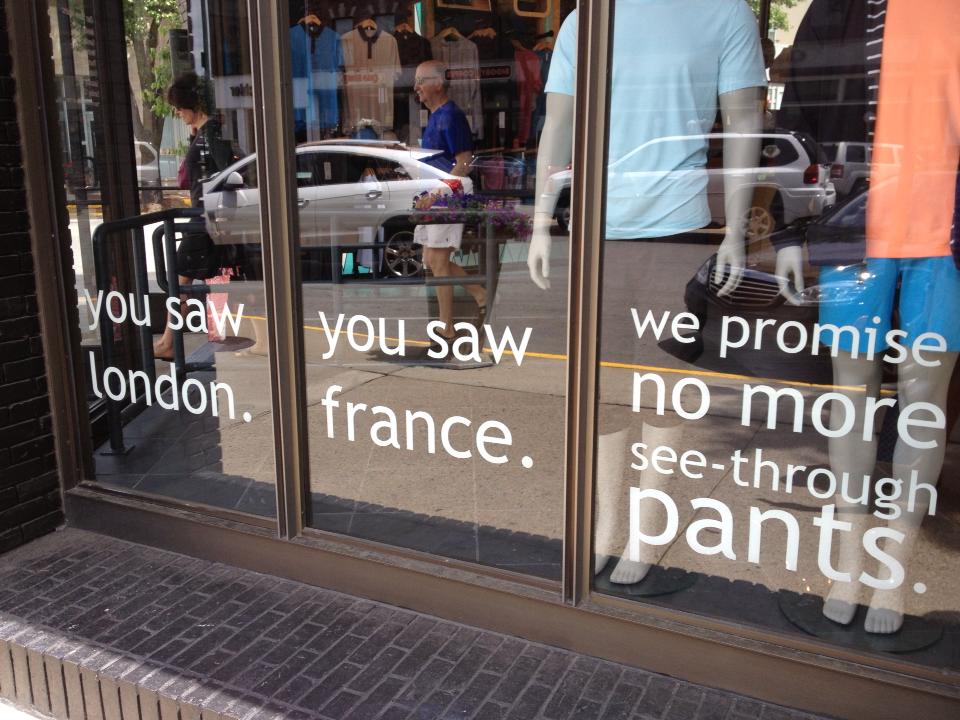
– Due to quality control snafus, Lululemon’s yoga pants delivered a little more than was supposed to meet the eye. The media, always a model of sober restraint when it comes to high-minded topics like see-through clothing, did its best to spin this story as salaciously as possible. Ultimately it went viral, resulting in loss of gobs of market value, as well as Lulu’s top management. At least they kept their sense of humor about it. (actually, there is a real lesson here: at the end of the day it’s about the product – and you can never take your eye off the ball).
2013 Lesson 4: The early bird still catches the worm – – if he tweets about it. Oreo cookies
– We now live in an era that enables, and requires, real-time marketing. As has been reviewed ad nauseam (guilty!), Oreo slam-dunked it with a timely tweet during the Super Bowl blackout. Meanwhile, given the opportunity of Marco Rubio’s magic cotton-mouth TV moment, the Poland Spring ad team not only didn’t stick the dive, they missed the pool entirely.
2013 Lesson 5: When life gives you lemons, make lemonade. When your meatball supplier tries to slip you some horsemeat, clean house IMMEDIATELY. IKEA
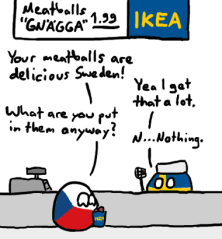
– When IKEA learned that some of its famous meatballs (150 million annually!) might contain traces of horsemeat, it immediately got rid of all meatballs in inventory, whether suspect or not. Cost of write-off? Probably pretty high. Benefit to reputation by immediately taking action? Priceless. Sales of meatballs since then? UP.
2013 Lesson 6: Hint: ‘Fail Fast’ is really just a euphemism for Test and Learn. It doesn’t mean your goal is actually to fail fast. JC Penney
– Here is a retailer that tried to do a 180 without twerking. Or more importantly, without considering that its customers preferred periodic discounts. Boom.
Easier to adapt to customer preferences than to try to force them to adapt to you.
2013 Lesson 7: There is No Such Thing as Bad PR (at least for Jeff Bezos) Amazon
– Amazon’s eerie delivery drones cleverly debuted on ’60 Minutes’ the day before Cyber Monday. Never mind that if you give it about 5 seconds’ thought, the barriers are significant (snow? wind? power lines? privacy issues? teen boys with slingshots?) – what it really shows is that in addition to any product you can think of, Amazon’s mission apparently also includes delivering PR to all homes.
2013 Lesson 8: If you go for the ‘wink-wink, joke’s on me’ approach, and people don’t get it, then ‘wink-wink, the joke’s on you’. Honda/Michael Bolton Holiday campaign
– If you didn’t see them, these spots feature the man of the strained tenor and shorn mullet singing soulful holiday-esque tunes from atop a Honda, next to a Honda, in a Honda showroom, behind a piano, behind a guitar, all to the indecipherable reactions of surprised, baffled, younger presumed car shoppers. It’s difficult to tell what the point is. The obvious assumption is that this is a quid pro quo: the 60-year old Bolton (perfect for a younger target!) has a new album that needs promoting (true) and Honda needs some breakthrough quality in the holiday car ad environment that generally features obnoxiously gift-wrapped luxury cars (true again).
But what’s Bolton doing up there on that car? Apparently, according to Adweek, this campaign is ‘poking fun at itself with melodramatic guitar solos and idiotic lyrical gems like “This special time of year, it’s filled with joy and cheer, for me and you and you and you, too’.” Well, I know something about misplaced melodrama and idiot lyrics and I didn’t catch it. If there’s a wink in there somewhere, it’s subtle enough as to be invisible.
So we’re left with a spot with bland cars, being promoted by bland music – – a perfect match, but I suspect probably not what they were going for.
The American public as a rule doesn’t respond well to ‘subtle.’ Witness, if you will, Ron Burgundy for Dodge – – a more effective celebrity hookup.
2013 Lesson 9: When in Rome, do as the Romans do. When trying to break into Southern California, and your name contains the word ‘Fresh’, don’t pre-wrap the fruits and vegetables. Tesco Fresh & Easy
– This one already has a coda. Big UK retailer Tesco created its Fresh & Easy chain in late 2007 to penetrate the Western US market with a fresh new smaller format store, famously after significant consumer research. The experiment failed when consumers didn’t respond well to new formats, new food presentation, and in some cases, truly foreign concepts. Ultimately F&E was sold to Yucaipa, which has added “competitive pricing, improved hours, fresher foods and assisted checkout” according to management. Everything, it appears, has been changed except the name.
– The obvious lesson – – listen to your customers (see Lesson 6).
2013 Lesson 10: You can say Social Media and B2B Marketing in the same sentence Maersk Shipping
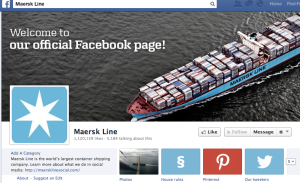
– Maybe it’s the exotic locations where its ships are shown. Or maybe it’s just the fact that deep down we’re all little kids and are awed by really cool big boats. Whatever the appeal, big freight shipper Maersk found a way to go from zero to one million+ in Facebook likes in about a year (good Forbes article here). Of course, no one places container orders on a Facebook page, but for very little cost (repurposing archival company photos) this enhances the Maersk brand, distances it a bit from its competitors, and likely provides meaningful recruiting and morale benefits.
Probably the big lesson for 2013 has been that while many old conventions are being challenged (e.g. static campaigns, role of social media), the key marketing fundamentals are still alive and well: understanding your customers and their needs is the surest way to success (or at least avoiding being in next year’s write-up).
I’m back after a short blog sabbatical. This post is in honor of Nigel’s 10th birthday.
Sorry, Nigel, I love you but you suck as a marketer. Sure, you have an unreal sense of smell – – you can smell me silently unpeeling a banana from another floor of the house so you might get a little piece of the action. And you’ve told me many times that this or that ad campaign really stinks. So far so good.
But, and I hate to break this to you, buddy, you’re color-blind. You couldn’t tell a green biscuit from a red one from a brown one. (That’s why I never present you with more than one at a time – – with no way to tell them apart, you’d starve before you made a choice).
Anyway, by being color-blind you miss a key differentiator that can make or break a product – – COLOR.
Humans, on the other hand, are attentive to differences in color, and that makes a huge difference.
– color not only calls attention to a single product in a crowded field, it is a strong mnemonic reminder to aid in brand recall, and can even convey desirable qualities about a brand. In short, color can mean a LOT, even if in itself it has no bearing on product performance.
This is before you were born, but there was a time where products in a category all looked alike.
– before 1956, all fiberglass insulation was yellow – but then Owens-Corning dyed theirs pink to differentiate from the competition, in 1964 hired the Pink Panther, and the rest, as they say, is history. They redefined what this category looks like and BECAME DIFFERENT (sorry for yelling. I’m not mad). More than 50 years later, they’re still leveraging the color Pink. Along the way they got trademark protection for pink in this category. On the other hand, Pepto-Bismol, another pink icon, was unsuccessful in protecting pink for the antacid category.
– If you did have full color sensitivity, Nigel, stopped ‘grooming’ yourself and picked your head up and looked around, you’d see lots of examples of where color has helped differentiate products.
– green in tractors (John Deere), teal in luxury jewelry (Tiffany), brown in package delivery (Brown, er, UPS, – – even if they’ve now moved on)
I’ve noticed a few myself.
MegaRed Krill Oil – -in a sea of sameness in fish oils (all honey-colored capsules), maker Schiff came out with a variation (krill) and underscored that difference by not only coloring their product and package red, but extending it to the name itself. I’m not sure if it’s any different from a functional standpoint, but it definitely has made a mark in this crowded field by being different.
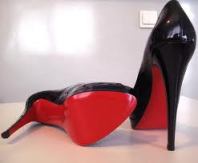
Christian Louboutin Shoes – – ok, you may be a little closer to this (literally) than me, but designer Christian Louboutin has staked a position in the market by coloring the soles of his namesake high heels bright red. Apparently this made enough of a difference that he was in court with Yves St Laurent regarding whether this design can be protected. Regardless of the outcome, red soles in this category have been permanently associated with Louboutin, and have drawn significant attention to his brand in a crowded field.
And differentiation, my friend, is what it’s all about. Don’t ever forget to think about color next time you’re taking potshots at this or that product when we’re shopping at PetSmart.
You’ve probably known someone like this – – returning a new dress the day after the big event (“wardrobing“); using influence to get a fake handicap parking tag, etc. Those who think the rules don’t apply to them; who make George Costanza seem almost normal.
Recently 2 equally intriguing and infuriating news stories raised a special challenge to marketers: Should the customer always be right? Isn’t that one of the Marketing Ten Commandments?
What if the customer is a big jerk?
Case 1) REI reduced its famous unlimited return policy to one year (still quite liberal).
– this was in response to increasing numbers of customers gaming the system, and in some cases bragging about it
– According to the Wall Street Journal, one customer “returned a backpack he bought in 2004, which he had hauled up the tallest mountain in Yosemite National Park and hundreds of miles. But it “was getting old and dirty, and I didn’t like it anymore,” he says. He returned the backpack; REI gave him a brand-new one which he later returned when he realized there was a newer model. His justification: Since he bought hundreds of REI products over the years, he says, the retailer still has made a healthy overall profit on his purchases.”
– This is just one of many similar stories, here are some reactions to the new policy, along with some amusing pretzel logic.
Case 2) Disney discontinued its policy that let physically handicapped guests and their parties avoid long waits in line.
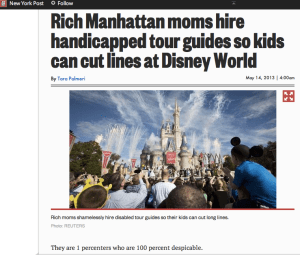
– This was in response to abuse of the system – – according to some delicious reporting in the New York Post, some wealthy parents were paying physically disabled ‘tour guides’ up to $1000 to accompany their parties, thereby allowing their kids faster access to rides. This remarkably selfish act of course mostly punishes the truly disabled kids; indirectly the PR hurts Disney as well.
But why is there a seemingly growing numbers of abusers, and what should marketers do about it?
FIRST, THE WHY: MY THEORY –> Abusing rules is a way of ‘Sticking it to the Man’: for someone who feels insufficient influence on their world, any way to exert some control on a more powerful entity is satisfying. This can apply to someone who feels economically disadvantaged; for the privileged it could simply mean an organization whose rules cramp their style. Anything goes.
An excellent scholarly description of ‘The Man’ is in this brief clip:
Definitive explanation of ‘The Man’
Except that now, due to politics and the state of the economy, the definition of ‘the Man’ is expanding; pretty much anything now qualifies as ‘The Man’. This, naturally, leads to greater return policy abuse.
Evolution of (the) Man: 1960s – The Government; 1970s – Your Boss; 1980s – The USSR; 1990s – Big Business; 2000s – The Other Political Party; 2010s – Any Company OR the Other Party OR anything else
WHAT TO DO ABOUT IT?
– the options are pretty clear: A) attract and presumably keep customers by keeping and advertising a liberal policy, OR B) manage profitability and integrity by installing guardrails to limit abuse The Case for A: Supports the original brand promise (‘satisfaction guaranteed’); doesn’t give a reason to defect; lifetime value of loyal customers may be profit-positive The Case for B: Limits financial liability from abuse; signals to honest customers that they’re not subsidizing dishonest customers; arguably can still have a liberal policy.
Personally, I’m supportive of adjusting the rules to match the times. In the case of REI, a one-year policy still supports the company’s core value of backing up its products. Thus, those customers for whom REI’s products and prices are appealing should remain customers. The minority of customers who abuse the system might claim to be loyal, but they’re loyal mostly to their dollars – they’ll shop online and either adjust to the policy or take their ‘business’ elsewhere.
In the case of Disney, it will almost certainly lead to a policy that may involve some additional steps for guests, but which will help to assure that Disney is doing what it can to continue to ensure a great experience – – which is absolutely core to the Disney brand promise. In the end, it shouldn’t affect attendance.
Compare it to Lawyers! Of course! And that’s what BP seems to be doing to support their brand.
Is this a good move? Vote Below.
You’ve probably seen BP’s full-page ads in the Wall Street Journal and other major papers. They’ve been unfolding since June while an appeals process went on; the final version is below.
At issue is BP’s claim that it is being taken advantage of by lawyers and people who were never financially hurt by the massive 2010 oil spill in the Gulf of Mexico. Along the way the ads have emphasized the $14 billion in restoration costs and $12 billion in claims paid out since the 2010 Gulf oil spill, as well as pointing an oily finger at lawyers who, they claim, are defrauding BP by securing settlements for parties who didn’t sustain any damage.
A BP spokesperson put it this way: “Today we are working to ensure that our willingness to do the right thing is not taken advantage of and distorted to provide windfalls to undeserving businesses, including law firms…”
So what is the point of a $370 billion company that committed a huge ecological mistake and is in an industry that the public generally views more negatively than positively, in placing these very public ads positioning it as a victim? Certainly the BP brand has taken its share of shots in the last few years; maybe they are trying to provide a positive counterbalance?
The answer might be illuminated by considering who the target might be.
– the general public? hardly – – seriously, a fight between an oil company and lawyers? Aren’t we hoping they both lose?
– Institutional investors? possibly – – but if the intent is just to demonstrate that BP is supporting its brand, running ads is pretty low on the list of investors’ considerations.
– Retail investors – – probably doesn’t hurt — probably pleased to see a company fight to preserve profitability. But there isn’t much meaningful outcome that would be expected from this group.
– Legislators? A likely target, and this might just be part of BP’s ongoing and significant lobbying efforts.
Without weighing in personally, I’ll leave it to my readers. It’s important to defend your brand, but how it’s done is really important.
Mini is a brand with 10 years of absolutely consistent positioning and execution. This leaves it free to have fun dramatizing its benefits, rather than having to explain or redefine itself.
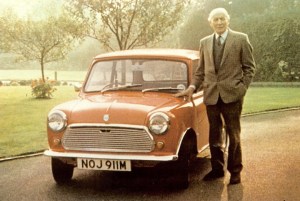
Introduced for the 2002 model year, the reimagined Mini Cooper was BMW’s very clever reinterpretation of Sir Alec Issigonis’s 1959 revolutionary original Mini (which sported 10 inch wheels!): retaining the basic lines and dimensions, but adding handling, power and an extra dose of sass.
It originally came in just 2 models, but you could customize it to an almost infinite degree to express your identity, and then follow its progress online as it went from order to manufacture and then shipped. I liked it so much I bought one (still have it 10 years later).
Sir Alec Issigonis and original 1959 Mini
2012 Mini Model lineup
Mini has always been about individuality and flouting typical automotive marketing convention.
No swoopy drives through fluttering autumn leaves here – – they’d rather slide a car through paint (see above).
And while the Mini concept is arguably approaching its limit (e.g. a Mini SUV, convertible, models approaching $40k), it has succeeded in maintaining its playful, nonconformist personality, with an impressive array of clever, tongue-in-cheek marketing, executed with a wink.
The (real) Mini goes up and down
(A collection of 20 AMAZING Mini ads can be found here – definitely worth checking out).
There’s a huge benefit in getting branding right, and then sticking with the program – – consumers know what you stand for, and every marketing dollar serves to strengthen the brand, in addition to delivering a message.
Next to perennial diet enemies fat and sugar, sodium has never gotten much respect — probably because overconsumption of sodium doesn’t lead to a spare tire or other jiggling parts. But too much sodium does contribute to heart disease and high blood pressure, and sodium reduction is now hitting the mainstream. How do we know this? Because the lawyers have gotten involved.
The Campbell Soup Company was recently hit with a lawsuit claiming that some of its Healthy Request soups contain too much sodium, despite a ‘Heart-Check’ endorsement from the American Heart Association (seen mostly on Campbell’s website), implying that Campbell’s is in the tank with the AHA (read: payola).
AHA Heart Check Mark
This is a case where technically Campbell seems to meet the AHA criteria, but where the consumer perception of benefit is probably greater than reality. Which means it cannot be a permanent solution.
The market will ultimately choose an approach that combines great taste, reasonable sodium levels, and some way to convey these benefits without implying a taste tradeoff. Not easy, but it’s happened before (trans-fats) and as awareness of sodium dangers gain visibility, a tipping point is inevitable.
Campbell’s Healthy Request Soups
A quick fact-check:
– To get the Heart-Check seal, a product must contain (among other things) no more than 480 milligrams of sodium per serving.
Never mind that the AHA advocates just 1500 mg per day of sodium, and that it classifies ‘low sodium’ as 150 mg or less per serving. It’s their seal and they can do what they want with it.
– A typical serving of Campbell Healthy Request soup has around 400 mg, which clearly fits the guideline.
Case closed?
Well, yes and no – each can has between 2 and 2.5 servings. And according to a recent survey, over 60% of consumers would eat a whole can at a sitting. Meaning the real sodium intake of just one soup experience could be 800-1000mg or more. Which wouldn’t seem to be too helpful in reducing the current American average intake of 3500mg/day to a commonly held target of 1500-2300mg.
– So there’s a fair argument that advertising as ostensibly ‘Heart Healthy’ is misleading.
– Considering that 75% or more of sodium intake is through processed foods, this sets an unhealthy precedent for using an association endorsement to market foods with healthy benefits. Americans can’t effect enough change with the salt shaker – it’s largely up to manufacturers to supply solutions.
Campbell has had its own corporate struggle with sodium. In 2010 it announced significant sodium reduction in many of its soups, only to reverse course in 2011 when sales declined. As Campbell is a public company, and is in business to make profits, it has justification in responding to marketplace demand.
Consumers care about sodium intake, but they care about taste more. So it seems that using sodium reduction as a mainstream messaging effort will be very challenging, as ‘reduced sodium’ translates for most people to ‘bland as cardboard’.
A more appropriate approach going forward might want to include the following steps:
1) Continued formulation to deliver reduced sodium with great taste. There are some great new salt alternatives available that should make this possible.
2) Use a so-called ‘stealth’ approach to reduce sodium gradually, and enable consumers to adjust their palates’ expectations over time. With less salt, over time, Americans might even be able to taste the delicate and sophisticated flavor nuances that exist in most processed foods. (the thyme! the basil! the hydrolyzed corn protein!)
3) Continue the use of benefit-focused claims (along the lines of ‘heart healthy’), as opposed to ‘less of’ formulation claims (e.g. ‘reduced sodium’) – this is one of the only ways to convey ‘good for you’ and ‘good tasting’ at the same time.
Long-term, whether carrying an endorsement or not, manufacturers will need to make sure that sodium reductions are real and truly help the consumer – and that the product tastes great.
But as it becomes easier for consumers to check nutritionals while shopping, the bar will inevitably be raised for both manufacturers and associations seeking an endorsement relationship.
Transparency is a foundation of good customer relations. But is it possible to mess up transparency? Carnival Cruise Line’s recent promise to disclose crime statistics indicates that it is comfortable with its historical communication approach.
Costa Concordia, Jan. 2012
Carnival might be thought of as the George Costanza of the cruise industry – a good policy might involve watching what they do, and then doing the opposite:
– Being transparent as a standard operating procedure builds the trust necessary to weather a crisis
– Public statements of remorse need to be focused on the damage done to customers, not to the company
– Hell hath no fury like a customer scorned; social media means the corporate ‘everything is ok’ statements are just not enoughanymore
Carnival Triumph Feb 2013
The Poop Cruise
A YEAR OF CRUISING DANGEROUSLY
Carnival has had a world of trouble recently – much of it self-inflicted as it conducted itself publicly:
– most tragically, the Costa Concordia capsizing in January 2012
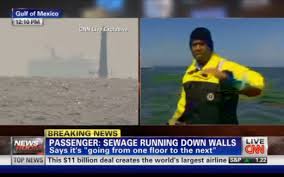
– so far in 2013 (a sample): the Triumph’s infamous 4-day no power, no toilets ‘Poop Cruise’, the Dream stranding passengers due to generator failure, and the Legend’s problems causing a cruise to be cut short
– Following Concordia, Chairman Micky Arison went underground at Carnival’s HQ in Miami, granting no interviews and delegating public statements to the CEO of Carnival’s Italian subsidiary.
Carnival’s reparations to its customers (including meager refunds and future cruise vouchers) were of questionable sincerity. As a result, not all prior customers have been actively evangelizing the brand (some amazing tales of woe can be read here).
Carnival’s public statements have tended toward defensive rather than disclosure:
– “I want to emphatically state that all the ships in our fleet are safe” (statement to Wall Street)
– “It’s still the safest form of transportation” (go-to industry non-statement based on a 1990 study – – Yes, we’re glad that we won’t die, but what are the stats about sewage exposure?)
– “The relative percentage of incidents for our cruise lines (versus competitors) is almost the same. Unfortunately for us…we’ve just been hit by a run here (in the year post-Concordia) that has been very unfortunate.” Carnival Vice Chairman (in a masterful ‘we are the real victims’ performance).
Evidence suggests that Carnival takes a ‘lowest cost option’ approach to maintenance and customer satisfaction, which, based on its general positioning as a lower-cost cruise line, is a perfectly reasonable option – – as long as things are working.
However, as a result of recent events, a Harris Interactive poll showed sharply decreased opinions of not only Carnival (its quality scores were down 28% vs. pre-Triumph), but for the industry overall.
CRIME ON BOARD
Now this week, Carnival announced (along with 2 other cruise lines) that it would be ‘voluntarily’ publishing crime statistics for its ships, apparently bowing to political pressure. A sample:
– From Oct. 2010 through June 2013, Carnival reported 121 incidents of thefts of over $10,000, assaults with serious injury, rape or sexual assault.
This was served up with predictably defensive statements:
– “…we are doing this voluntarily to remove all doubt about the relatively low level of crime on cruise ships especially when compared with comparable land-based crimes. It is important to highlight that what is being posted are allegations of crime. The majority of these are never substantiated as actual crimes after the initial investigation.”
– “I believe it showcases that cruising is safe, especially when you consider we have some 10 million passengers each year cruising with us. I think the crime stats on board for our four North American-based cruise lines would be an average of 41 alleged crimes per year.”
So now, in addition to sewage and engine fire fears, we get to worry about onboard crime. And it seems there’s a lot of room for crime beyond the very serious categories covered (who brings items worth over $10k on a Carnival cruise, anyway?). And there are huge questions about the comprehensiveness of the database – – by claiming an crime number, they are practically begging to be challenged.
Maybe more importantly, I want the company to pledge to minimize crime, not tell us that a certain amount of crime is acceptable.
Carnival has made many statements over the last 18 months, so one could claim they are being transparent. But what’s important is not necessarily the frequency of statements, it’s being proactive, honest and customer-centric.
Carnival’s current course has it in constant danger of running aground.

























 The Armchair MBA