Category Archives: Marketing Strategy

Direct Mail’s Identity Crisis

Posted on

We’ve all noticed that as emails have multiplied, the complexion of our snail mail has changed.

It seems that Direct Mail is an industry in dramatic transition.

Not only are marketers more able to individually profile and target consumers, but technology is starting to make it possible to eliminate most junk snail mail altogether.
– Consider PaperKarma, which automatically unsubscribes you from junk mail.
– Or more dramatically, the late, great disrupter Outbox, which went for the whole bundle in working through the USPS to allow consumers to digitize all of their postal mail so that individuals could get rid of junk mail, keep important things organized and never have to go out to their mailbox again. Despite strong market response, the USPS squashed Outbox.  See their very interesting story here.)

And yet, there are plenty of signs that there’s a lot more work to be done.

Consider the following examples:

1) Restoration Hardwareas posted last year, RH again sent its grandiose collection of ‘Source Books’ — only instead of 7 lbs, we got 15 lbs in the form of 12 separate catalogs with over 3000 pages.    We didn’t request this catalog, nor did we buy anything from RH in the last year (nor did we actually open the last shipment).

Restoration1

– The apparent environmental plunder generated predictable outrage, including a clever Tumblr called ‘Deforestation Hardware’.

Seems like an enormous waste to print and ship.  Yet RH claims that by sending once per year on heavy stock, they actually print fewer pages than many competitors, and encourage online shopping, which is a growing % of their business.  At the same time, the shipping label claims ‘UPS CARBON NEUTRAL SHIPMENT’, whatever that means.  You can find their whole array of disclaimers here.

Personally, I doubt that many consumers keep these things on the coffee table for a month, let alone a year, and the optics are a PR disaster.  It seems more like an ego play by the boss, Gary Friedman.  I’m just glad I didn’t run into my mailman the day he had to deliver these to the neighborhood.

Lesson:  As online shopping continues to morph, the role of ancillary vehicles (like direct mail) will continue to morph as well – – in this case, moving from an immediate revenue-generation prompt to (theoretically) serving as a visual brand reminder, much as broadcast media has traditionally done.

2)  Effective Targeting,  Or Not.   In the same week I received the RH catalog/doorstop, I also received glossy pitches for, in ascending order of preciousness:
a) Audi A8  (starts at $77k; optionable to $120k).  Nice car, but nope.

audia8

b) Around the World by Private Jet (sent by a company called TCS Expeditions and sets you back about $180k per couple for 25 days or so).  Apparently there are lots of these types of tours available; you can save $80k by going as a single!  Nope again.

WorldTravel

c) The jet itself.  Specifically the new Falcon 8X from Dassault.  Yes, I actually got a sales pitch for one of these.  About $58 million.  Nope yet again, even if the garage were bigger.

FalconJet

Somewhere someone has decided that I’m a good target for these extravagances.  I am not, nor is there much in my background to suggest that I am.

So I can’t understand why in this age of micro-targeting, Big Data and 1:1 marketing, that I’m being targeted.

3) DEX.  Like Gene Simmons, the Yellow Pages just won’t go away.  The days where YP was a household staple are long gone; they are now obsolete the second they land with a pathetic thud on your driveway.

Ironically, there is a QR code on the front of the book, which like a snake eating its own tail, leads you to the Dex app (below), as if to hammer home the printed version’s obsolescence.  And in case you needed a further reminder, there is a recycling link to help you dispose of the printed directory you just received.

Dex App

Clearly all of this cannot go on forever.  There are not enough dollars, hours, or trees to sustain this wasteful direct mail.

Lesson: at some point, the ability to get high-quality, appropriately targeted mailings might make a huge difference in an email-cluttered world.  But we’re not there yet.

Top 5 SWEET Treats from the Sweets and Snacks Expo (Part 2)

Posted on

Last in a series:  Here are the Top 5 Cool Sweets products I observed at the 2014 Sweets & Snacks Expo. (previously I reported on the Top 5 Snacks, available here.)   As always, all links and photos are active. SweetsShow

Chocolate is the centerpiece of the sweets part of the show.  And certainly by now we’ve seen every possible permutation of chocolate, no?

Shoes

No. Among a few evolving trends:  (thin ‘bark’-like chocolate products and ‘minis’, smaller versions of mainstream products) there were some exciting new products.

Top 5 Sweets Products

1.  Energy chocolate – Awake, Scho-ko-lade, energems

As you may know, chocolate already has some caffeine – about 12mg/oz typically.  These caffeinated chocolates think you need more. Awake has about 66/oz; 101 for a 1.55oz bar.  Scho-ko-lade is a 100 year old German formula that combines the caffeine from chocolate, coffee and the kola nut to deliver 95 grams for 6 sections (about as much as what’s in 8 oz of coffee).  And it comes in a nifty round tin as well.  Energems takes a different approach, calling itself a nutritional supplement and puts 15mg of caffeine in each stylish round candy.

– They all taste great and are an excellent excuse to work chocolate into your breakfast routine.

Awakezutaten_tin
energems


2.  Vitamin candy – Supercandy, Vitamingum, Vitamincandy

One thing the world didn’t think it needed is candy that is good for you.  All the company officials I spoke with were quick to mention that these are not supposed to replace sensible eating, but “as long as you’re having candy, why not have some vitamins as well” seems to be the prevailing rationale.  We are one very messed up species. – at any rate, there were some tasty examples.

Supercandy comes in hard, gummy and gum forms and promises B-vitamins, antioxidants and electrolytes.    Vitamincandy comes in 6 flavors and most offer a small dose of Vitamin C.  Vitamingum Fresh offers ‘Fresh Breath and 12 Essential Vitamins’.

– Ultimately, though, if you really feel you need to supplement your diet with vitamins, a pill is probably a more practical delivery system.

store-supercandy-gummy_1 vitamincandy vitamingum


3.  High-tech breath mints – EatWhatever

Perhaps inspired by 2-part epoxy resins, the folks at EatWhatever believe in “Two Steps to kissable breath”.  In this case, there are two pills – a gelcap that you swallow after a meal (“especially with smelly garlic or onion”), and while it’s de-funking you from the inside there’s also a mint to suck on for instant hit of date-saving fresh breath.

The mint tasted good (like most mints) but I only tried it once and can’t testify to the effectiveness of the 2-part system.  But they claim it works great – – you will just need to be clever to discreetly deploy this system in a date situation.

eatwhatever

4.  New chocolate shapes – Chocolate Moonshine hand painted artisan fudge bars

Just when you thought there’s nothing new, you run across the booth of the Chocolate Moonshine Company of Pittsburgh.  33 flavors, gorgeous presentation, and absolutely terrific fudge.  A bit pricey at $2/bar, but these are an innovative approach to an old product and are a great indulgence (especially if one of the 33 available flavors matches your team colors), and an even better gift.

ChocMoonshine

5.  MEGA candies – more of what you already get too much of

Finally, the good old American approach of “if I can’t give you something new, I’ll give you more of the old stuff”.

MEGA products are basically pumped up versions of old favorites, with absolutely no nod to nutritional benefits, GMO-free, added vitamins or any of that stuff.  If many of today’s new candy products are sensible like a Camry, these Mega products are 1960s V-8 powered muscle cars.

NY-based Megaload Chocolates sells all sorts of weird combinations that you might dream up on a sugar high:  Oreos sitting on peanut butter cups like the Space Shuttle on a 747, or topped with a chocolate chip cookie.  They may need to create one topped with a little insulin packet.

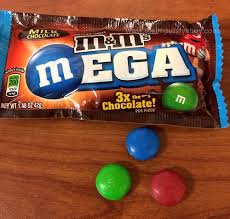
M&Ms MEGAs are comparatively tame, but prove that size matters in the chocolate world.  Same concept, just 3x the size you’re used to.  And the large size is surprisingly satisfying in your mouth.

MegaloadPic

Megaload Chocolates!

MegaM&Ms


Honorable mentions

–      Tabasco Chocolate – after chocolate with chiles and bacon, this was inevitable

Tabasco

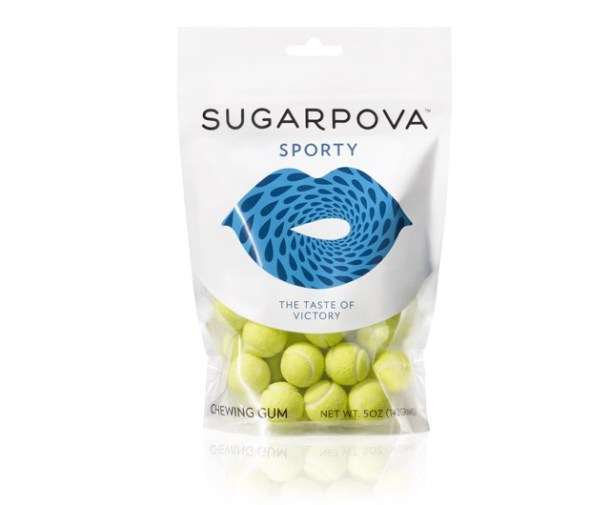
Sugarpova candies – yes, this is Maria’s vanity candy.  And she’s got game here too.  Sometimes you just need a good angle.

sugarpova

Customization (TicTacs) – the only line at the show was for making your very own custom TicTac blend.  Surprised there wasn’t more of this sort of personalization.  There will be.

TicTacPersonalized


Milk Flavoring Pods from JohnnyMoo.  It’s a version of a flavored milk straw that has taken two giant steps forward technologically and now looks a little like your very own Space Needle.  But much better tasting. Fun!

JohnnyMoo

–       Tongue tattoos from Tungtoos – Definitely an innovation I didn’t see coming.  Why, you ask?  Because, as the old punchline goes, we can.

Tungtoos

5 Snacks to Watch – Sweets and Snacks Expo, Part 1

Posted on

Last week was a double-dip of intense investigative pseudo-journalism. First the National Restaurant Association show, then the Sweets & Snacks Expo.

header-logo

Following summarizes The Armchair MBAs discoveries from 5 hours of walking the Sweets & Snacks Expo floor at McCormick Place in Chicago, 5 miles of shoe leather, and way too many samples.

The short story – while the overall sweets and snacks landscape is relatively stable (popcorn, nuts, chips, chocolate, etc), around the edges you could see green shoots of innovation.  And that was about the only green I saw at this show.

Snacks are covered today; Sweets to follow soon.

Snacks – mega trends

Popcorn dominated the floor, with dozens of options in every flavor, claim, and form imaginable. Many were jumping on the SkinnyPop ’35 calories per cup’ bandwagon – – when of course no one has EVER had less than 5 cups of ‘CrackPop’ at a sitting.  It is impossible to describe all the popcorn products that were shown.

Popcorn

–  Flavored nuts, veggie, fruit and grain based chips, and other things that started life simple and healthy and then got transformed beyond recognition.

–  Jerky. Around for centuries, jerky’s high protein/low carb profile has moved it beyond trucker feed to be now ready for its close-up.  At least 20 companies were showing off their jerky.

Here’s a little Brand Extension 101 for you:
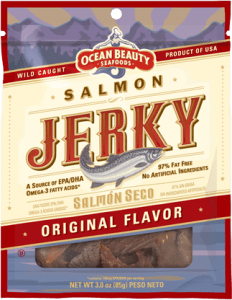
–  Expanded category definition: from beef to elk, bison, turkey, chicken, salmon (the salmon jerky is extra high protein, and tasted great  — if sometimes a little chewy)

OB-Jerky-Orig-232x300

RB-teriyaki-jerky

Flavor proliferation: pepper, acaí berry, ginger & wasabi, jalapeño, honey spice, chile ‘n lime, roasted cayenne, etc.

Price stratification: companies like Duke’s are now selling ‘small batch’ jerky at higher prices.

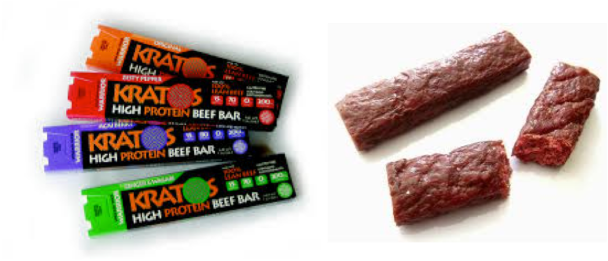
Form differentiation – a company called Kratos is trying to avoid the impending jerky shakeout by positioning (and shaping) their beef product like a healthy protein bar, complete with “Unleash your Warrior” tagline and impossibly fit people on their website.  Nice work, actually.

Untitled


5 snack products worth keeping an eye on:

1.  SuperSeedz gourmet pumpkin seeds – high protein, claims galore, 8 flavors and a clever name; delicious

SuperSeedz

2.  EatKeenwa Krunch – the only quinoa-based cluster snack that I noticed, and quite tasty, even if the ‘clusters’ crumbled a bit in the bag

quinoa-cluster-snack-eatkeenwa-krunch-vanilla-almond-raisin_large

3.  Ocean’s Halo seaweed chips – if I got the backstory right, 2 dads from Korea who grew up eating seaweed, and 2 dads from the U.S. who grew up eating tortilla chips got together on this – the not-surprising result being a hearty chip that is somewhat reminiscent of sushi. Surprisingly good, particularly with a salmon jerky chaser.  The only seaweed chips at the show.

Oceans Halo big_seasalt3

4. Snikiddy Eat Your Vegetables veggie chips –a strong claim of ‘1 full serving of vegetables in every ounce’, offset somewhat by fat count (7g/oz) which is a bit on the high side for a vegetable

snikiddy_EYV_jalapeno-470x5375. Simple Squares organic snack bars. Reflective of trends toward raw/paleo (minimally processed), simple label products. 5 ingredients, non-GMO, etc.

SimpleSquare


That’s it for this installment.  Coming up:  Sweets!

Top 5 Observations! – National Restaurant Show (Part 2)

Posted on

This is part 2 of coverage of the 2014 National Restaurant Association show – too much great stuff to fit into one post.

Screen Shot 2014-05-23 at 3.32.59 PM

I’ve ranked my top 10 observations; this post features my Top 5.

(If you missed my previous post, you can see #6-10 here).

Again, all links are live so please click through with abandon.

OBSERVATION #5.  School Lunch is a Battleground.

Remember when school lunch was a PBJ, apple and Twinkie in a paper bag or Superman lunchbox? How many ways would that not work now?

Two trends are making school lunch planning fiendishly difficult.

A) FLOTUS Michelle Obama’s Healthy, Hunger-Free Kids Act of 2010 sets limits for sodium, fat, sugar and calories, among other things.
– What’s happened is that compliant healthy meals are often too skimpy (or not tasty), kids are not eating them, and some schools are dropping out because they are losing money (even with subsidies).

Check out these funny-yet-sad tweets from kids complaining about their lunch offering:

Screen Shot 2014-05-23 at 3.22.14 PM

B) Separately, allergens (like nuts) are becoming more of a center of the plate issue.

The result of all this is that there were numerous products specifically positioned as not only allergen-free, but also satisfying the school lunch nutritional requirements.

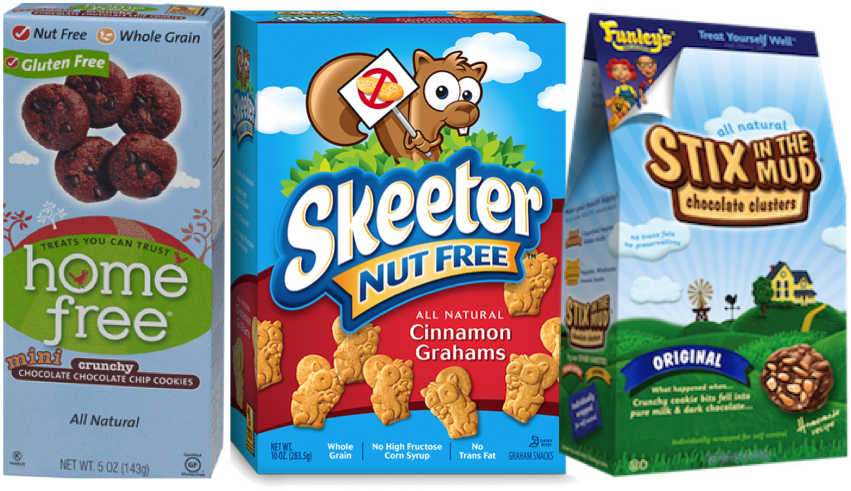
Home Free, Skeeter and Funley’s are on the market touting such mouth-watering claims as ‘Nut Free’, ‘School Compliant’ and ‘Gluten Free’ and other ‘free-from’ things.   Which is a shame, because beneath those claims they all tasted really good – a message that seemed somehow forced into 2nd place.

Cookies

Separately, organizations like Wholesome Tummies are offering alternative programs providing ‘fresh, nutritious and exciting foods’.

There were a lot of school nutritionists asking lots of questions.  And ultimately the market will decide.


OBSERVATION #4.  Liquor-flavored meat.

With these two manly ingredients, how could you lose? There were quite a few examples of meat flavored with some sort of macho alcohol. We’ve seen things like Jack Daniel’s barbecue sauce for years, but these examples had the flavor infused into the meat.

A few examples:
Family Brands has just introduced meat products infused with Ole Smoky White Lightnin’ Tennessee Moonshine. You can get pulled pork, sausage and other products flavored with with regular, apple pie or other moonshines. They taste great, but don’t overdo it – – you may get Dukes of Hazzard flashbacks.

OleSmoky

– Over at Zoe’s Meats, they’re offering Ghost Pepper Salami with tequila

– And my friends at Kronos Foods were sampling their brand-new Beer Can Chicken, which I can testify is better than anything I get from my smoker.  Perhaps one reason is that they use PBA (Premium Brown Ale), while I use PBR.

OBSERVATION #3.  Food Trucks Mainstreamed.

Food trucks have long been thought by some of as being on the funky fringe of foodservice, operating from recycled ice cream trucks. Well, this year served notice that food trucks are now driving right down the middle of the road.

FoodTruck

FoodTruckInt

Several companies offered custom foodservice trucks, built to spec and coming in at around $150,000. These are impressive, well-equipped, heavy duty vehicles specially built to bring the finest cuisines right to your doorstep.

At that point, whether you go for kimchi, po’ boy, pupusas or paletas is entirely up to you.


OBSERVATION #2 – RUNNER-UP:  Kallpod.  ‘What’, you say?

How many times have you had an otherwise great meal spoiled by:
– waiting for a refill on your drink
– waiting for your check
– otherwise having your server disappear into the ether never to be seen again

Well, this tech innovation gets super-high marks because it focuses on diner satisfaction.   What a concept.

The best analogy for Kallpod is the ‘Call Attendant’ button in an airplane – – only in this case it’s on your restaurant table and it’s wirelessly connected to a special Dick Tracy-like device that your server wears.

Kallpod

The concept is simple: you hit a button (refill, check please, etc) and your server gets a small vibration/shock and message like ‘check, table #8’. How great is that?  Awesome, although possibly less so if you’re a server, I suppose.

Reminds me a little of the Burger King Subservient Chicken that was compelled to respond to commands from strangers (shown in redemption video here):

http://adage.com/article/news/burger-king-s-subservient-chicken-video/292953/

So Kallpod offers something for everyone:

– Diners get quicker, better service and for a select few, the opportunity to indulge hidden sadistic tendencies
– Operators convert more drink requests, and can turn tables more quickly
– Servers get the opportunity to see their guests more, and for a select few, the opportunity to indulge hidden masochistic tendencies.

Kidding aside, this is a palm-to-forehead great idea, well executed.


And the winning #1 observation at this year’s NRA is:  SCHMACON!  

Yes, Schmacon. It’s not a trend or even a fad, it’s the sort of cosmic occurrence that we unfortunately see all too infrequently in our short time here on this mortal coil.

Schmacon2

My first minutes at NRA, at 9am, took me directly into the olfactory territory that the modest Schmacon booth was invisibly marking.

Schmacon is ‘smoked and cured glazed beef slices’ , but think of it as beef bacon, which by one account tastes like ‘crispy glazed pastrami’ (thanks Kevin Pang). By all accounts it is delicious, as demonstrated by the growing line for samples (of which I had two, for research purposes).

In addition, it is lower in calories, fat and sodium than traditional bacon.  A bit ironically, it is not pork but neither is it kosher.  But who are we to quibble about a technicality?

Schmacon is from Schmaltz Products in the Chicago area – a company with a funny name, but serious deli DNA.

Schmacon was a Food & Beverage 2014 award-winner.  I took home Schmacon literature and a scratch ‘n sniff button to remind me of my experience.  It’s mostly just for foodservice now, but you can taste it for yourself when it hits retail shelves later in the year.

———–

So that’s it for the Top 10.  I do have some Honorable Mentions directly below:

Ice Beer.  Basically a beer slurpee, complete with alcohol.

IceBeer


Nutella Poppers.  Like little chocolate beignets – awesome (and proof that carbs are alive and well)

Carbs!


Neat meat replacements.  Mixes made from nuts, beans, grains and other ingredients.  Really tasty with great texture.

Neat

Poppies Dough.  Terrific products (but I’d be lying if I didn’t say I had a little Seinfeld moment…)

Poppies


Top 10 NRA Show Observations (Part 1)

Posted on

Once again, I’ve taken one for the team and walked the floor at the National Restaurant Association show (yes, that NRA; sorry Mr. Nugent).

NRA

Show Floor – 2014 NRA – McCormick Place

In addition to things I reported on last year, there are some exciting new offerings.

Because there’s so much cool stuff, I’ve separated my Top 10 list into #6-10 (today’s post) and Top 5 (coming soon).  So here we go.

[NOTE:  as always, all links and photos are live: click on them to learn more]

Observation 10.  Tea!  Tea!  More Tea!  – as you may recall, tea was originally introduced at the 3000 B.C. NRA show (held outdoors in Wrigley Field).

The news this year is that every time you turned around you bumped into another tea purveyor trying to look old and mystical and yet hip at the same time. (sort of like Cher? Keith Richards?)  Dozens of them. Perhaps it’s an echo effect from Starbucks’s Teavana venture.  Or maybe they’ve been there all along and I’m just noticing.  At any rate, hot or cold, flavored or straight, Oprah’s Chai Latte or not, prepare to be offered tea more and more often.

DavidsonTea


Observation 9.  Greater Sales through Big Data.    Have you heard this term before:  ‘big data’?  Of course you have.  Not to be confused with ‘Satisfying Customers through Big Data‘ (more on that later).  The restaurant business is increasingly swimming in POS data, and LOTS of companies are trying to use it to help restaurants pry every last dollar from your wallet.

Essentially it comes down to driving traffic, increasing loyalty, up-selling, and above all, getting you to buy more high-margin beverages.  You out there, experimenting with different restaurants and learning about different food cultures?  Well, STOP IT!  Do you want to be just average, or do you want to be LOYAL?  Yes, a restaurant-centric, not consumer-centric way of looking at things.

Screen Shot 2014-05-20 at 9.56.30 PM

One loyalty company called Paytronix allows operators to send geofenced messages (it is what it sounds like), lets them pay for food with their phones, and more.  Just when we thought our ability to actually communicate with each other couldn’t get any worse, there are now even more distractions available.

Paytronix also models guest behavior to project potential high-value customers and nurture them. Which of course sounds familiar, since the casinos have been doing it for years.  Except you will never be comped drinks and a hotel room in a restaurant.

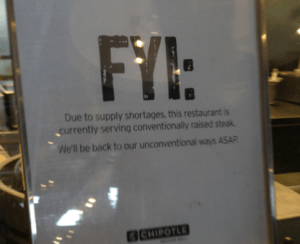
Observation 8.  Responsible/Local Sourcing – Whether it’s produce, protein or grains, where food comes from is increasingly getting attention.  However, it’s one thing to say it, quite another to do it on a meaningful scale.  As Chipotle found out recently when they faced a shortage of ‘responsibly raised beef’, reducing your supply options means the margin for error shrinks as well.

HydroponicsScreen Shot 2014-05-22 at 5.10.14 PM


Observation 7.  Mobile to help back office.  Could there be a less sexy title?  Doubtful.  The point here is rather than ‘mobile’ being a buzzword but not really ready for primetime, Mobile is starting to be leveraged in a way totally relevant to the frenetic nature of hospitality.

One startup, Partender, has developed a mobile app to get real-time inventory updates for the bar area.  In the bar business, making money is a lot about tightly controlling inventory to keep service levels high, while making as much cash available for the important stuff: hiring trick bartenders like Tom Cruise.

Seriously, I saw this app at work and it is slick, intuitive, and totally appropriate for the use.  When inventory is sitting on the shelves, it’s hard to input with a fixed desktop or laptop.  Mobile is increasingly adding real value where it makes sense..

Screen Shot 2014-05-22 at 5.15.48 PM

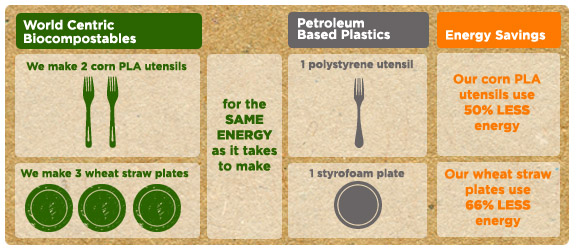
Observation 6.  Plant-Based Dinnerware – compostable products have been around a while; this year there were more products that were plant-based.  Specifically, companies like World Centric and Vegware offer tableware, utensils, napkins, hot/cold cups, to-go packages and more made from things like sugar cane, wheat straw, and corn.  As volume increases, costs will come down and you’ll see more of this approach.

energy-savings

…But wait – – Now you can also get utensils that you can not only eat with, but that you can EAT.  Foodie Spoon offers a selection of different serving shapes (spoons, cones, shapes) that you can put stuff on, and then eat the whole thing.  Think of a mini-me taco.

FoodieSpoon
So next time you’re at a party and a waiter offers you an elegant canapé on a spoon, amaze your friends and chomp the whole thing down.  (But maybe check first.)

THAT’S IT FOR OBSERVATIONS 6-10.   COMING SOON:  THE TOP 5, which promises to be even more exciting.

In the meantime, a few bonus experiences from the show:

Silpat Girl

Silpat Girl

Espresso Cheese!

Espresso Cheese!

Stay tuned!

9.6 Billion Coming for Dinner – how can we feed them?

If you are reading this and you’re not hungry, be thankful.  If you are hungry, remember what it feels like, and get yourself a snack.  In either case it’s important that you then read this post.

There are expected to be about 9.6 billion people roaming the planet by 2050 –  35% above today’s 7.1 billion, growing 190,000 daily for the next 36 years.  Who’s going to feed them all?  This is a huge challenge – – we cannot do this on ramen alone.

A new initiative is exploring ways to fit everyone around that big dinner table in 2050, using solutions we can all live with.  It’s called FutureFood 2050.  More below, but it considers novel approaches such as 3-D food printing, leveraging the awesome power of the world’s women, and more.  

THE CHALLENGE

World Hunger

This issue starts with a large serving of irony:  according to worldhunger.org, about 900 million people regularly go to bed hungry – – about one in six people in developing countries.  Yet, we produce enough calories globally to feed everyone now.  (Daily per-capita food production in 2012:  about 2700 calories (FAO), more than the 2000-2500 recommended for adult women and men).

The problem, as we know, is partially one of distribution – the food may exist, but many people simply have no access.   Unfortunately there isn’t (not yet, anyway) a way to electronically transmit calories around the world.

Why is this so hard to fix?  We did figure out how to get creme filling inside a Twinkie, right?

Twinkies

Well, it’s just a little more complicated – – there are some major dynamics at work, including:
POVERTY.  Between 1-2 billion people live on $1.25/day or less, concentrated in Sub-Saharan Africa and South Asia.
CONFLICT/DICTATORSHIPS/CORRUPTION.  These isolate refugees, or divert needed aid, or both.
INFRASTRUCTURE. About half of the food grown in developing countries is wasted because of insufficient processing, packaging and storage capability.  And it’s often impossible to import due to lack of reliable transport.  Related to this is access to water; an estimated 800 million people don’t have access to clean water.
CLIMATE CHANGE.  Whether you call it Global Warming or not, extreme droughts, flooding and the like disrupt ability to grow crops efficiently.
ENVIRONMENTAL RESPONSIBILITY.  Industry faces increasing challenges in producing food in a sustainable, responsible way.  And there is a phenomenal amount of food wasted in developed countries.

THE PATH TO A SOLUTION WE CAN AGREE ON

Swaminathan

The most important step has been recognizing the problem.  Importantly, the UN, through its Food and Agriculture Organization (FAO), has conducted World Summits on Food Security to develop policy solutions to solve hunger.

But that’s at a policy level –  ultimately consumer acceptance, with willingness to compromise, is key to program adoption.  And that’s not always easy.  There have certainly been some dramatic food-centered communications over recent years.  But they’re often at either end of the ’science is always bad’ or ’science is the only solution’ spectrum.  In reality, most actions balance benefit with consequences; progress is made by objectively agreeing on serving the common good.

So how can we identify programs that we can all live with?  I think we can agree that this is a problem worth solving together.

The Institute of Food Technologists (IFT) has created FutureFood 2050 to take the discussion out of the conference rooms and to the people, to create an open dialogue and ultimately workable solutions. 

[IFT has 18,000 global members; they are often thought of as food scientists but their purview also includes most of the food supply chain.]

FutureFood 2050 will work over the next 18 months or so, featuring 75 conversations with the world’s leading independent-minded thought leaders, about how they think we can get to a healthier, safer and better-fed planet.  These opinion leaders will include policy makers, cultural influencers, scientists, engineers, avant-garde chefs, entrepreneurs, and more.

The first three interviews, covering 3-D food printing, leveraging the power of women, and an ‘Evergreen Revolution” (agricultural productivity without ecological harm) are already available on the website: www.futurefood2050.com.  Very interesting reading.

These interviews will then be distilled into a documentary by Scott Hamilton Kennedy, an Academy Award-nominated director, to be released in 2015.  As he said in an interview recently: “the hard part isn’t getting great content, it’s ‘how do you fit this amazing conversation into just 90 minutes’?”.

2050 seems a long time away, but world hunger is a massively complicated problem to solve, and it’s not too early to start.  Keep your eyes open as new interviews are conducted – – ultimately solutions may well come from the most unlikely places.

And once we solve that, we’ll work on getting the Cubs into the World Series.

SELFIES: Narcissism is now officially a trend (How can you tell?)

The youth of our society regularly assault the rest of us with a regular stream of silly fads, most of which mercifully fade from view in short order (think Cronuts, #anything, the phrase ‘YOLO’, and hopefully soon, Bieber).

However, a select few cross over into the magical land of Trends, which have more longevity, presumably because they offer something of (more) lasting value.

Last week’s Sunday comics provided an unexpected validation of the latest fad-to-trend transition: the Selfie.

Of course you know that selfies are photos taken of one’s self, in some unique situation, typically for the purpose of sharing (usually via social media) to demonstrate how fabulous your life is.   Recent selfies in the news have included our President, Ellen DeGeneres and Boston Red Sox slugger David Ortiz.  All have fabulous lives.

Last week, 3 comics (‘Doonesbury’, ‘Dustin’ and ‘The Lockhorns’) featured the Selfie.

Now, for this writer to extract deeper meaning from the comics is not news.

However, it is particularly instructive when you consider that the average age of the cartoonists (Garry Trudeau; Steve Kelley/Jeff Parker; Bunny Hoest/John Reiner) is 65!

DustinApril 6

As an activity that started with teens and spread via social media, one would hardly expect this totally narcissistic behavior to be recognized, let alone embraced by retirement-age journalists.

And yet, to quote Edna Mode: “…here we are”.

EdnaMode

In the case of selfies, this is one technology and social media-driven fad that has gone mainstream.   Who would have guessed?

So what, you say?

1)   Demographics, technology and social change are shifting so rapidly that generalizing about which groups will be trend adopters isn’t necessarily a good idea.

A recently published Pew Study finds that while older consumers are indeed less likely to be online than younger consumers, still, 59% of consumers 65+ are going online, and 82% of those are online regularly.
Think about that the next time someone assumes that xyz technology or app is ‘only going to be popular among younger consumers’.

2)   Don’t overlook the comics as a barometer of the national social conversation.

We have seen a little of what the future looks like. And apparently, it looks like ourselves at arm’s length.

SeniorSelfie

Outrage at New Corporate Average Calorie Count Mandate: What took so long?

Posted on

After over a year, the food industry has finally begun to voice frustration with the upcoming Corporate Average Calorie Count (CACC) requirements that were a little-noticed insertion in the recently implemented Affordable Care Act.

Like it or not, this law has been on the books for over a year – – why the sudden passive-aggressive reaction?

Like Big Auto’s Corporate Average Fuel Economy (CAFE) standards, CACC requires all US-based food and beverage manufacturers making over 20 products to average at or below 100 calories-per-serving for all processed products by 2019.   While CAFE uses a sales-weighted mean, CACC counts all products equally.  “We decided to use a simpler approach that everyone – consumers, manufacturers, retailers – – and Congress – – could understand”, said HHS Secretary Kathleen Sebelius (who knows a thing or two about the importance of simplicity). Sebelius-calories

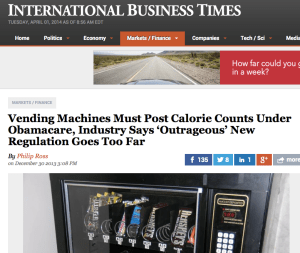
Companies need to submit CACC plans by the end of 2014, with final compliance targeted by 2019.  Excluded are imported products, unprocessed foods, dairy, ‘ingredient’ foods like peanut butter or oil, alcoholic beverages and products sold through foodservice, vending and convenience channels (although vending machines are impacted by the same provision in ACA and have to post calorie counts by the end of 2014) .  Companies not meeting standards will face penalties of $1,000 per calorie above the target level, multiplied by each $1 million of revenue of that company. ACA-Vending

Food manufacturers are just now starting to realize the size of the challenge.  “CACC creates significant costs for manufacturers, a huge compliance burden, and most importantly, is likely to remove choice and impact taste for consumers,” said Lloyd Braun, CEO of Peterman Bakeries of Omaha, NE.  “If it’s difficult for a smaller producer like us, it could be almost impossible for the Krafts and Pepsis of the world”.

Indeed, meeting the standard will be tough.  We took a look at PepsiCo to see what they are facing.

According to its websites, PepsiCo sells 1327 products across its Pepsi, Frito-Lay and Quaker businesses (not counting Tropicana).  Its Corporate Average Calorie Count now stands at 118.2, with beverages actually close to the standard at 102.6, brought up by Frito-Lay at 137.9 and Quaker at 150.7 (click on chart).

PepsiCo-Calories

To meet the 100 calorie corporate goal, PepsiCo will likely need a combination of reformulation, elimination of higher-calorie offerings, and addition of lower-calorie offerings.  This could mean fewer products like Grandma’s Cookies (210 calories), Quaker Breakfast Cookies (175) and Starbucks Frappuccino (290) and more like Rice Cakes (35), Matador Jerky (75) and lots more AMP Sugar-free Energy Drinks (15).  Happily, Quaker’s Quisp cereal checks in at an even 100 calories and thus seems safe.

As difficult as this current Pepsi Challenge is, they at least have the benefit of a large number of products (and frankly, a couple of large subsidiaries) to work with.  The CACC mandate could be terminal for those companies specializing in more indulgent fare, such as frozen pizza (285), fettucine alfredo (415) and Garrett’s Gingerbread CaramelCrisp Popcorn (300).

Still, the angst is real: A source inside PepsiCo explained: “We thought we had done our part by helping reduce Americans’ calorie intake by 6.4 trillion calories as part of the 2010 Healthy Weight Commitment Foundation initiative – – we are now quite frustrated that the current Administration is piling on with these new requirements. So frankly, not much work has been done yet”.

Well, it’s time to stop whining and get to work.   ACA is not going away, and your country is depending on you.

US Census goes to NSA Fantasy Camp

This is a story of abuse of a bully pulpit in the online survey arena – – by none other than the US Government.

First, some context:  Recently I opted to answer one of those familiar online surveys, because a) being involved in the survey business I was curious and b) they asked nicely.  I would have also opted for c) a reward, but no one was offering.

However, after about the tenth or eleventh screen of increasingly inane questions (“how many times, on average per month, did you take a left turn in your primary vehicle over the last 6 months?”), I punched out and the surveyer was left with bupkis – nothing.  If they’d kept it to about 5 minutes I would have been fine with it.

In surveying, as they say, just because you CAN doesn’t mean you SHOULD.  This applies equally to network TV, use of cellphones and enhancement surgery.  There is a diminishing marginal return at work.  But I digress.

ACS_logo

The big kahuna of survey abuse came in the mail a few weeks ago – – the American Community Survey, cheerfully served up by your US Census Bureau.   This is a MANDATORY* survey that is constantly updated, and according to the website (accessible by clicking the graphic above), “generates data that help determine how more than $450 billion in federal and state funds are distributed each year.”  This includes typical data such as demographics, but then goes WAY beyond that.

*up to $5000 fine for noncompliance – – yee-hah!

ACS - Census - Screenshot

For the record, I have in the past been a big user of US Census data, and I’m a believer in its value for many purposes.

The reason this one is so objectionable is not only the intrusive information it asks, and not only the burden of time required to complete it, but also the $5000 hammer that awaits you if you refuse.  (There are apparently more extreme enforcement tactics, such as agents scoping out your house, but we shall stick to the meat of the matter).  It struck me as so out there that I actually considered contacting the ACLU to see if they can really do this.  The feeling subsided.

What The Survey Asks – –  check it out for yourself here.
– the survey starts out innocently enough – – ages, kids, ethnicity, etc
– then it dives into 2 sections that would make the NSA (or at least the IRS) blush:
1) HOUSING – – not just the expected house age, size, # of rooms – – this survey asks things like:
– exact types of computers, which of 6 types of internet service, monthly fuel expense, annual fuel expense, condo fees, monthly mortgage cost, real estate taxes, estimated resale value and other stuff including this gem:  “How much is the regular monthly payment on all second or junior mortgages and all home equity loans on THIS property?
2) PERSONAL INFO – – commuting time, what time the person leaves home for work and how long they are gone (hmmm…)
– also questions about income that made me swear I was doing a second tax return:  ‘Wages, salary, commissions, bonuses, or tips from all jobs. Report amount before deductions for taxes, bonds, dues, or other items.  “Interest, dividends, net rental income, royalty income, or income from estates and trusts. Report even small amounts credited to an account.  Etc. [Editors note:  dont forget the small amounts when dealing with the IRS.]   

It goes on.  The point of this rant is that the good people at Census have the ability to use the power of the US Government to make sure we have usable planning data.  Fair enough.  But they didn’t know when to stop.  This is an imposition of hours, not minutes, and the absolute need for some of this data is questionable at best (suppose it is known what computers are at home and when you’re not…).  And we are being asked much of the same info from another government agency.

The ultimate irony is that the NSA has probably figured out how to get this info without us even knowing it anyway (only partially kidding).  So why impose this pain for arguably marginally useful information?  Because they can, I suppose.

Perhaps, like ACA, the designers of this survey would have been well advised to try it out themselves before subjecting all of us civilians to it.

Final thought:  Get off my lawn.  OK, rant over.

Chicago IFT: Michael Jacobson, CSPI, the Food Babe and the curious impact of social media

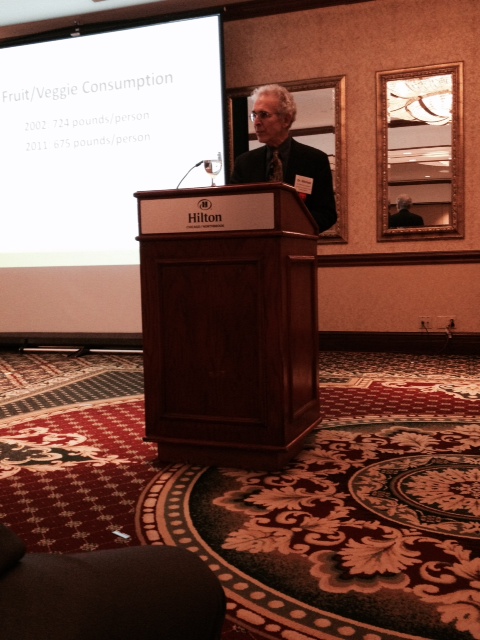
I had the privilege of attending a recent meeting of the Chicago Section IFT (Institute for Food Technologists).  The guest speaker was Dr. Michael Jacobson, Executive Chairman of the Center for Science in the Public Interest (CSPI), who spoke about America’s progress in becoming a healthier-eating nation.

Dr. Michael Jacobson

Dr. Michael Jacobson

Over the last 40 years or so, the CSPI has helped to reduce saturated fatssodium and sugar in our food supply, among other things.  While CSPI has often been a thorn in the side of Big Food in America, its efforts have resulted in meaningful change, usually brought about by government mandate (as opposed to corporate altruism).  And Jacobson is no party-line activist –  – he independently assesses the social benefits vs cost on any initiative, including things as controversial/PC as GMOs (he’s open-minded on this, in case you were wondering).

My key takeaway:  regardless of the advances in food science, our chances of becoming a healthier nation lie in the hands (and mouths) of the consumer.  The locus of influence in food and nutrition is becoming decidedly less institutional.

Food Scientists – heal!
Dr. Jacobson offered that while food scientists have culpability in having created most of the ‘Franken-foods’ that he reviles (“…a breakfast cereal that is nothing more than vitamin-enriched marshmallows…”), these scientists now play a key role in creating healthier alternatives that can be adopted by mainstream America.  

Two things occurred to me during Dr. Jacobson’s presentation, illustrating both the weakness and strength of the consumer:

1) You can build it but they will not necessarily come.  These healthier foods need to appeal to intended consumers for this to work, as was brought home by an attendee who commented that her school district’s new, more nutritional lunches, in addition to costing more, are also discarded much more often by the kids.

The problem is that consumers typically don’t want foods that make health claims.  Putting ‘reduced sodium’ on a package, for example, is almost like saying ‘don’t buy me’.

So the conundrum is:  how do you get people to eat healthier foods without them knowing it?  Not easy.

2) According to Dr. Jacobson, the rise in social media has accelerated the process overall, despite consumers’ sometimes misguided crusades.
Consumers, who previously had no voice, are now collectively applying pressure through social media.

Just this week, the so-called ‘Food Babe’ helped prompt the removal of azodicarbonamide from Subway bread, through a petition that is at 78,000 signatures and counting.  We have been unable to detect one shred of relevant credentials in the area of nutrition, food science, or science in general, about the Food Babe.  She apparently has an undergraduate degree in computer science.  But she cleans up well, is able to get access to influential people, and operates a successful blog.  And guess what – she’s helping dictate your food options!  Deal with it.

Vani Hari - the Food Babe

Vani Hari – the Food Babe

Earlier examples of removed ingredients include:
Kraft Singles removing an artificial preservative (sorbic acid)
General Mills’ Cheerios removing GMOs
And that’s just 2014.
Other recent examples are here, including Starbucks, Gatorade, Kraft Mac and Cheese, and Chick-Fil-A.  These are not inexpensive or simple changes to make, and speak to the power of the consumer.

Yes, the consumer is a fickle, capricious creature and quite often prone to acting immediately (or signing petitions) without checking facts.  But overall, the ability to project a collective voice is starting to make a difference in the food landscape – – and on balance, it appears to be for the better.