Category Archives: Marketing Strategy

…and Botswana makes it 100 Countries!

In a shameless act of self-promotion, this announces that as of today, The Armchair MBA has now reached 100 countries served!    A sort of crazy milestone considering its quite humble and uninformed beginnings, some 70 posts and 2 1/2 years ago.

100 Countries


But beyond cocktail party braggadocio, what does this say about the state of blogging?  Or, who cares?

First, some info.
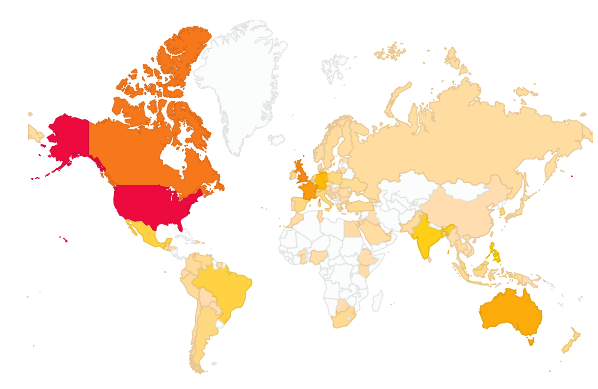
Below is a map of where my readers have come from. Darker colors indicate more readers.
– Clearly a bias toward English-speaking countries but plenty from elsewhere.
– While the US is by far the strongest reader source, average daily readership comprises about 5 or 6 countries, which shift daily.
– Notable in their presence:  China (a single rogue reader!), Botswana (which got me over the 100 hump today) and Papua New Guinea (only because I can’t not think about the combination of loincloths and laptops).
– Totally expected absences:  Cuba, Russian satellites, Iran, N. Korea, and most of Africa.  Is there media repression?  Of course.

While I have a strong base of followers (thank you!), most readership is not subscribed and comes from 2 sources:  LinkedIn (on one page or another) and online search results.  The latter group accounts for the majority of non-English country visitors.

Screen Shot 2014-10-09 at 3.14.30 PM

 Lessons learned?
– The global pull of The Armchair MBA has been surprising.  Part of the reason is that topics often have global relevance; one more support point for the theory that borders are increasingly irrelevant as it relates to business news/learning/sharing.
Posts have long tails – – there is a bump in initial readership but even the oldest posts get recurring views.  The internet is a great accumulator.   Full disclosure:  I recently experimented by taking a SEO approach and including all African nations in text form — it has resulted in some visits from Africa, but to the point below, it is slow.  But it is possible to proactively solicit traffic.
Propagation is steady but slow – – but even if initial readership is modest, much value is still retained as a post transitions from ‘news’ to ‘reference’TAMBA-credential
Having a blog like this pays nothing, but it does have its benefits:
Provides an outlet for my voice and is encouragement to continue to explore, think and opine
– Occasionally merits a media credential, enabling privileged access to trade shows/seminars and continued learning for myself and for my clients
Solicits feedback and additional points of view, often from some surprising sources
– And, every once in a blue moon, provides validation in the form of a ‘Like’.  Sort of like Facebook, only with much more work (including checking my sources).

Thanks for reading.  And thank you, Botswana.


We Tested it On You, So It’s Probably OK for Your Pet

I had the pleasure of attending a brand new trade show – Petfood 2.0 – in Chicago recently.

Petfood2.0logo

Not surprisingly, this show is still getting its furry legs under it – – a very manageable group of 35 disparate exhibitors made for a quick and interesting, if not yet cohesive, experience.

Overall, though, a larger theme presented itself:
Following thousands of years of dogs serving man, the tables have turned.
Man now serves dog.

Exhibit 1:  Hemp for Pets.

Now available from our friends at HempMeds, is a line of products made from hemp to benefit your pets.  aNew™ Pet Nutrition‘s products provide essential fatty acids (EFA – – Omega-3 and -6) and are made from a blend of hemp seed oil and raw hemp stalk oil (which is rich in cannabidiol – CBD).  EFAs, as we know, are highly beneficial – – just don’t ask the industry to agree on what the top benefits are.

pet_oil250

This innovation in pet health could not have been possible without the committed testing of hemp products by millions of Americans in the 1960s and 1970s.  So while the outcome of all that testing is up for discussion, your cat or dog is possibly benefiting now from what you did in college then.

OK, that’s not accurate.

While hemp is illegal to grow in the US, it is perfectly legal to import any part of the hemp plant in all 50 states.
And while the prospect of Fifi or Rover lying on his or her back contemplating the ceiling tiles for hours on end and giggling is intriguing, these products contain virtually no THC – the active ingredient that makes marijuana psychoactive.

Although it would be interesting to see if Nigel would behave any differently with the munchies.  Doubtful.

Hempmeds

Exhibit 2:   Functional ingredients for pets – – it worked on Man, so it’s probably safe for Rover.

We long ago realized that we could do better than feeding our pets Ol’ Roy (WalMart).  Thus emerged added value feed (e.g. Iams, Eukanuba, Science Diet, etc), offering different formulas for large breeds, older pets, etc. as well as some medical needs.

Meanwhile, human foods and beverages have increasingly been stuffed with a dizzying array of functional ingredients, many of which have no empirical basis in efficacy.  But we humans have shown that we’re willing to buy them anyway.  What did Charles Revson say about hope?

Based on this massively-scaled test market on mankind, it apparently has been deemed that animal-kind is now ready to safely ingest all sorts of functional ingredients that may or may not actually ever benefit them.

Petfood2.0

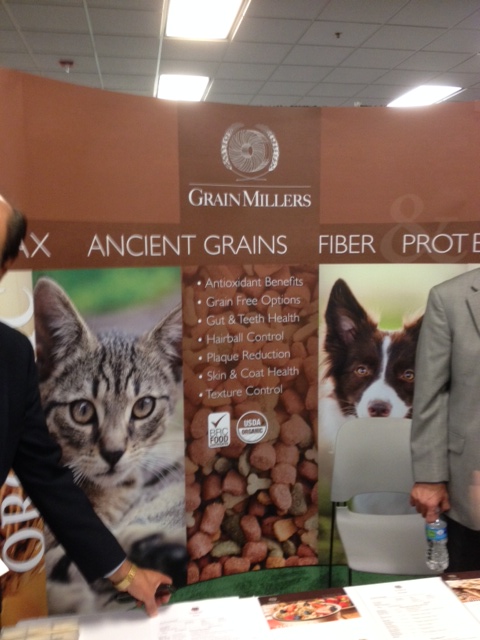
Incorporating things like ancient grains, fiber, medium-chain triglycerides, probiotics and ionic trace minerals, your pet can now get benefits heretofore only considered for the human species (notwithstanding hairballs and a healthy coat).

One company, PetNaturals of Vermont, offers products to address the following areas:
– Agility, Antioxidant, Bladder Support, Breath, Calming, Daily Multivitamin, Digestion, Hip & Joint, Immunity, Slim-down, Urine pH balance (really – to avoid yellow spots on the lawn), Periodontal health, Fecal function, and Skin/Coat health.

You dog and cat owners will probably recognize some of the benefit areas in the products below.

photo 1

We live in a world where the things we eat promise magical powers to fix whatever marketers insist needs fixing.  And regardless of the effectiveness, manufacturers have made a tidy business catering to hope.

Now, due to the significant sacrifice, expense and effort expended in testing on humans, our pets will soon be able to have their diets enhanced, and your wallet may end up just a little lighter.  So when your pet looks up as if to say ‘Thanks, Man’, now you know what’s going through that little brain.

I have no doubt that many of these ingredients can provide real benefits to some of the 150 million dogs and cats out there.

Except I’m not believing anything that promises intelligence to an Irish Setter.

Captex

Comcast Hacks its Own Email Service! On Purpose! Really!

UPDATE TO THIS POST – – SOLUTION FOUND!  and not from Comcast.

A helpful reader sent me the following recommendation, pasted below in its poetic entirety.

go here: http://xfinity.comcast.net/adinformation/
sign-in
Opt Out
Turn Off

Done and done! So easy…stop bitchin’!

———————————————————-

He was right – – it did work, very quickly.  Why couldn’t Comcast send this solution?

Original post  (below):

———————————————————-

How does Comcast spell customer?        Apparently, ‘H-O-S-T-A-G-E’.

In a bizarre marketing gambit to generate revenue through its Xfinity email service, Comcast has not only demonstrated that it values advertisers over customers, it has shown that it has mistaken customer captivity for loyalty.

When you have customers in a market where there are available alternatives, you need to do 2 things: a) keep them happy with superior service; and b) try to avoid giving them a reason to switch.

Here’s what I recently experienced:

SmallXfinityAdLargeXfinityAd

  • Without warning, a square advertising banner appeared on the upper left of my screen, covering key email commands (select, delete, refresh, etc). Comcast thus made it impossible to use its own email.  This ad never went away.
  • A mouse-over converted this box into a larger, even more annoying video ad, in effect acting as a palace guard, to ensure that customers couldn’t even try to get to the controls and read their emails.   Footprint of ads shown below.

XfinityOverlap

  • Disabling this ‘feature’ required an email to Comcast, and resulted in a 6-step, byzantine preferences-changing process that ‘may take up to 30 days to take effect’ (see below). What? Complicated process + 30 days to opt out?  Do you want me to switch?

comcast note


– Comcast calls this program ‘Segmented Advertising’, and provides an explanation that it tailors ads to based on customers’ preferences. (Not exactly a new concept, but what if our preference is to just get our email?)

ComcastSegmented

The upside-down-ness of this program is hard to believe, and is proof that at Comcast there is some kind of crazy monkey at the steering wheel.

A hacker working for a competitor would be hard-pressed to create a more annoying disruption for Comcast users – and they’ve done it for themselves.

Let’s break this down:

  • The ONLY reason anyone visits an email page is to use email
  • Disrupting email utility therefore eliminates the reason to use Xfinity email
  • An opt-out approach FORCES ALL CUSTOMERS through the exercise of disabling (creating ill will), and forces customers to immediately try out an alternative (Apple Mail and gmail for me).
  • Taking up to 30 days to take effect provides a great trial period for competitive email services
  • And to complete the cycle, fewer users of Xfinity email of course reduces reach and effectiveness of the offending ads

I’ve blacklisted the companies whose ads continuously and annoyingly popped up. For the record, they are:

  • Blain’s Farm & Fleet
  • Walter E Smithe Furniture
  • Howard Jewelry and Loan – The Pawn that Pays
  • Grossinger Auto Dealers
  • McGrath Audi of Glenview/McGrath Acura of Morton Grove
  • Golf Mill Ford
  • Evanston Subaru in Skokie
  • Highland Park Ford Lincoln Superstore
  • Peter Francis Geraci – bankruptcy attorneys
  • Luna Carpets
  • Ambiance Window Fashions

Since I’m not in the market for a car, home furnishings, farm equipment, bankruptcy help or pawn services, I will survive.

Finally, I’m writing this post/rant to share my experience (I was perfectly happy a week ago, mind you) and hope you share it with someone you love.  Especially if they work for Xfinity.

Again, the lesson, said a little differently:  in a world with ready options, don’t piss off your customers.

-0-0-0-0-0-0-0-0-0-0-0-0-0-0-0-0-0-0-0-0-0-0-0-0-0-0-0-0-0-0-0-0-0-0-0-0-0-

For those who are interested, below are screen shots of the process required to eliminate these ads (which hasn’t taken effect for me yet).

OptOut1 2 OptOut3 4 OptOut5 OptOut6

Shoes, Elephants and Michelangelo

A famous and probably apocryphal story relates how in the late 1800s, shoe companies sent scouts to Africa to assess opportunity. All came back and said: “no one in Africa wears shoes – – there is no opportunity” – except for the rep for Bata, who said: “everyone in Africa is barefoot – – there’s a huge opportunity”. Bata shoes are now ubiquitous in Africa.

Bata1

With its vast population, diversity and resources, why aren’t more companies committed to growth from Africa? Why do EMEA business strategies have no patience for the ‘A’? Certainly with that many people, shouldn’t African commerce, like life in Jeff Goldblum’s Jurassic Park quote, “find a way?”

The challenge is daunting, and figuring this one out is above my pay grade, but thinking about solving for Africa can make just about any other challenge seem pretty straightforward.

africa

There are of course very real reasons that Africa is challenging. A Sept 16 scan of Google News stories across 54 African nations (below), reveals overwhelming existential crises such as Ebola, terrorism, sectarian violence, mixed in with a standard dose of President-for-life type scandal (see: Mugabe, Robert), but not many commercial or consumer focused stories. Where much of the developed world has surplus calories, Africa has a basic food (and water) deficit. A quick look at per-capita incomes shows that African citizens are among the poorest in the world. Barriers, indeed.

Yet we are all still more alike than we are different. We all have needs: food, shelter, entertainment, and yes, shoes.  And so within a mass of challenges, there are opportunities.  Bata figured this out long ago – – it saw millions of bare feet, rather than cultural or economic barriers, and methodically penetrated the continent.

The key, as in eating an elephant, is to take it one bite at a time.  In fact, it’s really just another execution of basic marketing – identifying segments, understanding their needs and barriers, and creatively and selectively applying solutions.  Pricing? Access? Promotion? Distribution? Positioning? Unique benefits?  A solution is almost always available – it’s just not always obvious.EatingAnElephant Unlocking this potential may be gaining traction: PricewaterhouseCoopers’s Africa Business Agenda 2014 report was released last week.  The report, comprising surveys and interviews with 260 chief executives in 14 African countries, indicates that CEOs are optimistic about growth despite volatility and uncertainty on the continent.  From Business Report/Africa: “The Chief Executives acknowledge that a lot more needs to be done in terms of transforming the continent’s potential for exponential growth into tangible business opportunities”. There are examples where creative and focused approaches helped realize growth from similarly unlikely places.

  • In India, Colgate has carved out over 55% of the oral care market (~$600 million+) despite toothpaste penetration of only 55% (and only 15% of them brush twice daily), and a per-capita income ranked 120 of 164 countries in 2013 (World Bank).
    • This was done by offering more affordable sizes, and innovating a multi-layer distribution system to penetrate the largely rural population
  • In Mexico, concrete giant Cemex, through its Patrimonio Hoy (‘Private Property Today’) program, has enabled many low-income families to build onto their homes on an installment plan at affordable levels.
    • For example, in this innovative program, one family pays $18 per month for $960 in construction materials, allowing them to add stepwise onto their home.

Whether it is Africa, India or a mass of consumers (or customers) at home, the same principles apply.  Where there is need, solutions are always possible.

Michelangelo

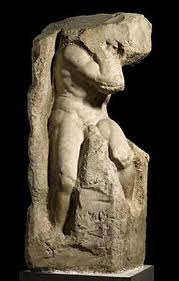
As Michelangelo said: “Every block of stone has a statue inside it and it is the task of the sculptor to discover it”.

-0-0-0-0-0-0-0-0-0-0-0-0-0-0-0-0-0-0-0-0-0-0-0-0-0-0-0-0-

A Day In The Life of Africa – September 16, 2014

Country                                              Story 1                                        Story 2
Algeria                                                al Qaeda                                        Soccer
Angola                                                Sub-Saharan investment             Oil Exploration
Benin                                                  Ebola                                             Trade
Botswana                                           Crackdown on press                     Ebola
Burkina Faso                                      Soccer                                          Trade
Burundi                                              3 nuns murdered                             —
Cameroon                                          Soccer                                            —
Cape Verde                                        Soccer                                         Tropical storm
Central African Republic                 Muslim-Christian violence              —
Chad                                                  Guys named Chad                         —
Comoros                                            Islamic oil deal                   Indian Ocean Comm.
Dem. Rep. of the Congo                    Ebola                                          Mineral dev.
Djibouti                                               al Qaeda                                     Violence
Egypt                                                Fighting Islam                          Muslim B’hood exiles
Equatorial Guinea                           UN Ambass. accused          Call for national unity
Eritrea                                             Leather export trade                   US travel warning
Ethiopia                                           Relations with Egypt                   Egypt opposition
Gabon                                                Soccer                                            —
Gambia                                              Anti-gay legislation                       Ebola
Ghana                                                Ebola                                           Soccer
Guinea                                               Corruption                                    Ebola
Guinea-Bissau                                   Ebola                                           Political instability
Ivory Coast                                        Soccer                                             —
Kenya                                                Cost of living                          Investment/trade
Lesotho                                             Coup attempt                                   —
Liberia                                               Ebola                                                —
Libya                                                 Migrant boat capsizes                    Islamic terrorists
Madagascar                                      Lemurs                                            Locust infestation
Malawi                                               Political scandal                              Soccer
Mali                                                    al Qaeda                                          Sectarian violence
Mauritania                                          Moving weekend to Fri/Sat              Business/trade
Mauritius                                            Foreign investment                          Murder invest.
Morocco                                            Anti-racism demonstrations                —
Mozambique                                      Elephant poaching                           Political rivals
Namibia                                              Foreign trade                                    —
Niger                                                  US drone base                                 Baby trafficking
Nigeria                                               Building collapse                              Ebola
Rep. of the Congo                           Ebola                                              Political corruption
Rwanda                                             Genocide 20th anniv.                Rebuilding efforts
São Tomé and Príncipe                     Infrastructure dev.              New: cellular roaming
Senegal                                             Ebola                                               Soccer
Seychelles                                         Tourism                                            Protected species
Sierra Leone                                      Ebola                                                —
Somalia                                              anti-al Qaeda/ISIS                           anti-Shebab
South Africa                                       Pistorius trial                                    Rugby
South Sudan                                      Foreign aid worker ban            Internal peace
Sudan                                                Condemned Christ. woman         Peace with S. Sudan
Swaziland                                          UK power investment           Royal family antics
Tanzania                                            Foreign investment                       Infrastructure
Togo                                                  Qatar investment                          Soccer
Tunisia                                               Economic pressure                         Security
Uganda                                              Foiled terrorist attack               US warns Americans
Zambia                                              Political leader dies                          Soccer
Zimbabwe                                         $3B mining deal w/Russia                  —

The Loyalty Program That Will Survive the Apocalpyse – – and Why

The future of shopping and loyalty is mobile – – we are continually reminded about this.  Digital loyalty programs can leverage vast storehouses of data and sophisticated analytics, and can deliver individualized promotions at a time, place and shopping occasion that optimizes ROI.

JewelOscoPromoSo why the heck is there, sitting on my kitchen counter, a sheet for gluing small stamps received with each shopping trip at the local Jewel (Albertson’s)?  (If enough stamps are collected, a piece of Cuisinart cookware can be ours!).  

After all, this is an utterly low-tech, old media, one-size-fits-all loyalty promotion here in the digital age.

Ultimately the reasons for this low-tech promotion’s survival are related to its low-techness, and can be helpful to more tech-driven modern programs.

S&H GreenStamps

SinclairS&H_greenstamps

Hard to believe but this is essentially the same concept as S&H Green Stamps, which debuted over 100 years ago and were highly popular from the 1930s to the 1980s.  You got stamps when you bought stuff, filled out books (typically 1200 stamps) and could then win prizes from a catalog.  Stores that gave out these stamps used it as a competitive advantage.

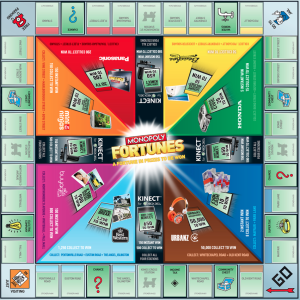
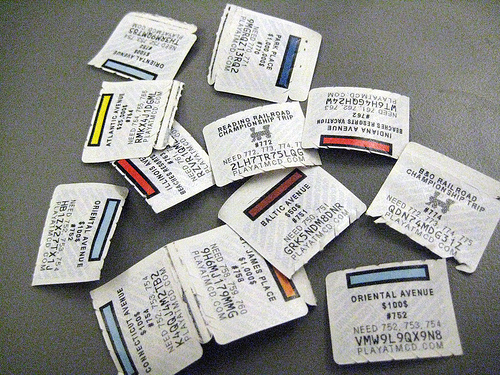
And this is not an isolated grocery type program – – McDonald’s famously runs its Monopoly program, where customers get game pieces on everything they buy, and can win big prizes if they collect the right stamps.

mcdonalds-monopoly2013-300x300McDonalds_monopoly_pieces

 So what accounts for these games’ popularity? 

1) Simplicity – no apps, no logging on or passwords, no points to track online, no devices at all.  Just shop, stick, rinse and repeat.  It’s likely that there is greater appeal among older users for some of these promotions, but that doesn’t explain the McDonald’s popularity.

2) Can visualize success – each new stamp makes progress tangible and encourages continued participation

3) User involvement – Unlike an automatic electronic promotion, manually applying the stamps actively involves the participant, much like adding the proverbial egg to the cake mix turned Mom into a baker – increasing personal commitment level.

4) Closed-ended – a finite promotion period, so no long-term commitment or long wait for a payoff

5) It’s fun! – there’s an excitement to participating in these promotions!  It’s not just a mercenary exercise in repetitive purchases; there’s often an element of chance (and like gambling and golf, hope is what brings people back in the face of continued abject failure).

I’ve not seen any statistics about whether any of these promotions is more effective at driving shopper loyalty than any other.  I know that stamp programs definitely impact our shopping habits at home.

In any case, it’s clear that digital/mobile is the future of loyalty programs, even if the transition will take some time.

But some of the factors that make these old-school promotions popular can help make future loyalty efforts more successful.  

And until tech can replicate all of the above factors, it’s likely we’ll be shopping, sticking and winning, well into the future.

WalMart Sets Nutrition Back 50 Years With These Spots

I don’t remember where I was when I saw the first of these spots, but it smacked me upside the head like a pouch of pasteurized cheese food product.

In the sausage-making process wherein retailers devise merchandising schemes and then pressure manufacturers to fund them, WalMart seems to have inadvertently sewn together a nutritional monster of an advertisement (two, actually).

The tagline on the spots: “Get a Smarter Start to School” couldn’t be more off the mark.

These ads take us back to a time when nutrition is an afterthought at best, and where the convenience of instant food is paramount.  
Sorry, but quick + non-nutritious ≠ smart.

UnhealthyWalMart

The setup:

A typical impossibly lovely and fit TV family is gathering before dinner and Mom asks what they want.  Of course the young kids, being kids, throw the long ball by asking for their favorite processed foods:  Hot Pockets and Chef Boyardee.  The husband, being, well, a guy, goes to his mental bacon file and all he can come up with is…Bacon Mac and Cheese.
Mom, the savvy and conscientious gatekeeper, decides she can easily avoid hassle and effort by immediately capitulating; three package openings, three microwave beeps and a token salad later, dinner is served.  Mom is hero.

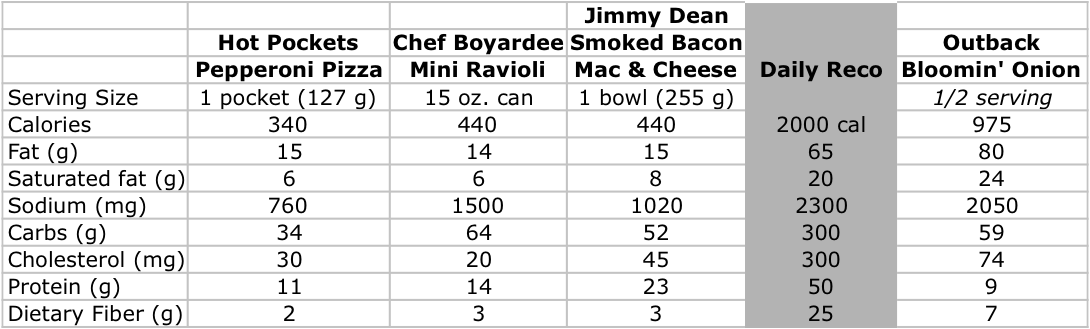
No problem, right?  Well, let’s assess the nutritional damage (Daily limits according to Netrition.com).

WalMartDinnerNutritionals

(We’ve assumed the young lady would eat one Hot Pocket, the young man would eat one can of Mini Ravioli and Dad would eat until interrupted by dessert).

In terms of calories, these are not horrible (but also don’t include other things served with dinner).  In the case of protein, they perform well (particularly Dad’s, because bacon).  On the other hand they provide a fairly heavy dose of saturated fat, carbs and sodium.  And not much fiber.  So nutritionally, this isn’t particularly ‘smart’, and in restaurant terms, steers more toward Bloomin’ Onion than Chez Panisse.  It is definitely not a model for a balanced, nutritious meal.

More insidious is the positioning of convenience above everything, where instant food, regardless of its merits, is the solution to ‘what’s for dinner’.  The entire family seems to have completely slept through years of nutritional messaging, PSAs and school programs, and I’m guessing Michelle Obama would not endorse this spot.
The audience gets a great reinforcement of instant food as good habit, and a great opportunity to model simple, nutritious eating is missed.  Not good.

There is a breakfast companion ad in this campaign, where the featured items are Froot Loops, Frosted Flakes and Jimmy Dean’s Pancakes and Sausage (on a stick).  No additional comments necessary, except if the same family is bookending its day with WalMart’s meal suggestions, that puts a LOT of pressure on lunch.

On the other hand, it’s probably not easy to match program participants to be nutritionally balanced.  And at the end of the day, business is business.

Check out this Kraft Mac & Cheese ad from the 1950s, and hang in there for the hot dog meal suggestion.

We have some significant weight/health issues in this country, and I wish we could do better.

Little League Whiffs on a Golden Opportunity

For most people in Chicago, and many across the U.S., this year’s Little League World Series rivaled any other sport in excitement and inspiration. This was in no small measure due to a few unexpected subplots.

Yet Little League, with a chance to embrace a unique opportunity to broaden its appeal, missed a golden opportunity in its TV marketing effort.

For those who didn’t follow the LLWS (which ended yesterday), two story lines completely dominated the coverage, and for good reason:

chi-jackie-robinson-west-fans-20140823-004 jrwcoverDJButler

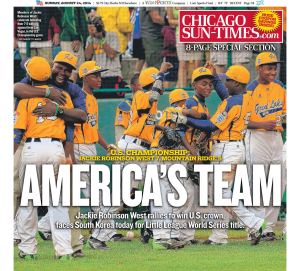
1) A team of kids from Chicago’s South Side, Jackie Robinson West, overcame significant odds to reach (and win!) the U.S. Little League Championship game (falling short in the World title game to a very strong South Korean team). These kids, all African-American, are generally from less privileged backgrounds, yet showed how far a person can go, through preparation, determination, poise and pluck. It was a joy to watch these kids play, and they truly united the city of Chicago across all socioeconomic and demographic strata, a particularly welcome shift from Chicago’s more typical tragic stories of violence.  They are true role models for everyone, not least those for whom organized sports may be less accessible.

Mo'Ne 2) Mo’ne Davis, from Philadelphia’s Taney Dragons team, became the first girl to pitch a complete game shut-out in the LLWS, with pitches over 70 mph. For opposing batters, that would equal a major league pitch of over 90 mph (due to the shorter distance to the plate). Mo’ne’s heroics helped her team to third place overall, and created significant publicity for her, including the cover of Sports Illustrated.  For girls everywhere, Mo’ne is a fantastic role model.

These two stories elevated Little League to a meaningful place in cultural significance, with stories about opportunity, teamwork, dedication and perhaps above all, inclusion.

Unfortunately, during the broadcast Little League, in a continuation of its ‘I am Little League’ campaign, showed a PSA that completely missed an opportunity.  The faces in the otherwise well-done spots were for the most part straight out of Norman Rockwell circa 1950: charming kids but not a person of color, and certainly not a girl, in sight.  (I saw this spot but was unable to locate it online.)   

Here’s a fairly typical PSA from earlier in 2014; based on this past week, ‘I am Little League’ is now quite inaccurate:

In a world where organized sports for kids are increasingly specialized and expensive, there are too few examples of kids participating for the sheer love of the game (as opposed to a stepping stone to a pro career), or examples of girls competing effectively with boys on equal terms.  

This year’s LLWS was a tremendous chance to say “We’re Little League – – we don’t care where you’re from – – if you want to play, we want you!”.

So perhaps this year’s LLWC was two big steps forward, and one back, but at least it’s headed in the right direction.  Now if you’ll excuse me, I need to make plans to attend Chicago’s parade Wednesday for the Jackie Robinson West team.

Why does my phone company want to be my girlfriend?

For that matter, why do an insurance company, car company, and fast feeder also want to be my girlfriend?  (and where were they when I was an undergrad?)

Well, actually, they want to be your girlfriend too.  And I’m talking about long-term girlfriend, not quick little fling girlfriend* (example of that below).

Why?  Quite simply, they want you to like them.  And likeability is very good for a brand.   All else being equal, people would rather do business with a company they like. 

If you’ll work with me on the analogy, these are companies in very competitive, undifferentiated, and more functional than fun businesses.  We’re talking AT&T, Progressive, Toyota and Wendy’s.  They know there are other comparable offerings out there, so they do not want to play hard to get.  They want to be the brand you’re comfortable with and want your parents to meet (if you’re a guy).  If you’re a woman, they’re someone who’d be fun to hang around with.

Here’s a directory of the most prominent of the current ‘girlfriend’ spokespersons.

Girlfriends

Why do these spokespersons work so well?  They’re funny, smart and pretty.  Not beautiful, pretty – – girl next door pretty.  There’s a difference.  Progressive’s Flo, of course, started this recent wave, but all have serious comedy/performing chops.  They are naturally funny, and they’re in on the joke.  All are dressed conservatively, as if to maximize appeal without overt sex appeal.

In short, you like them for all the right reasons.  And if the advertising is successful, some of this likeability/appeal rubs off on the brand and helps you like the company just a little bit more than the competition.

Here are sample clips from each of these spokespersons.  They would seem to appeal to all major genders equally.

Toyota’s Jan (her expression at around :15 is pure comedic genius):

Progressive’s Flo:

AT&T’s Lily Adams:

Wendy’s Red:

These are fun spots, they build the product into the story, they catch your attention, and refreshing the campaign minimizes wearout.  And — they respect the viewer – wow!

So what’s wrong with beautiful?  Well, none of these women is Gisele Bündchen.  (actually if you look closely, Gisele Bündchen isn’t even Gisele Bündchen.  But that’s another story).

The reason:  beautiful just wouldn’t work.  Like it or not, it seems that model-beautiful and funny are virtually never celebrated in the same person (quick – – name a supermodel who cracks you up).   Using someone known primarily for their looks would be distracting, confuse the messaging, and rather than be likable, would make the spokesperson seem unattainable for guys and threatening for women.

*For an example of the exact opposite of the ‘girlfriend’ approach, check out the most recent Carl’s Jr. ad.  Suffice it to say, if you want the Texas BBQ Thickburger, you want it once, so you can tell your friends you had it.  But you would probably not respect yourself in the morning (warning, barely safe for work):   https://www.youtube.com/watch?v=MvKuhpZjA4M

The Carl’s Jr spot, like most of their work, has it all:  contrived, cynical, pandering, insulting, demeaning.

Likability is good.   I wish more brands tried it.

Microsoft’s Epic S*** Sandwich RIF Letter

Posted on

Elop

We’ve all seen letters/press releases announcing reductions in force  – – usually brief, sometimes using euphemisms – – and many of us have been impacted by them.  Not fun.

We’ve also been schooled that when you have something unpleasant to say (say, in a private performance review), surround it with a positive lead-in and a positive ending – the so-called S*** Sandwich.

We have now seen what happens when a senior executive (seemingly without adult supervision) attempts to use said Sandwich approach on a massive scale, publicly, with consequences that impact an enormous number of people.  And it ain’t pretty.

Yesterday, Stephen Elop, inherited when MS bought Nokia and now running Microsoft’s Devices Group, sent a letter to MS employees announcing a huge reduction in force (12,500 employees).  He drops this bomb after 10 paragraphs of corporate-speak (bread #1), and then devotes all of 2 sentences to huge staff reduction, one of which is reserved to cover the human impact.  He then goes on to describe other steps being taken to achieve the corporate goals (bread #2).

You can read the entire letter below.  By doing a quick scan, you can see that there is a single number in the entire 1000+ word missive:  12,500.  And you can bet that that number is the one takeaway shared by all MS employees.

This letter is not a secret: it is posted on Microsoft’s own site:  http://www.microsoft.com/en-us/news/press/2014/jul14/07-17announcement2.aspx

This has the feel of someone who is trying to sneak in some bad news without the other person noticing: “Hey, how ya doing?  Like the new haircut.  Cool about LeBron coming back to Cleveland.  Sad news about Johnny Winter.  I ran over your dog.  Hey, I think the Cubs can make a comeback in July”.

Anyone who has gone through the trauma of being involuntarily detached from their livelihood knows that it is always shocking and usually devastating.  It needs to be treated with sensitivity, with regard for the dignity of those affected.

It is nice to know that this RIF is in the service of the very detailed strategic corporate goals outlined in Mr. Elop’s letter.

So for those of you who are affected:  my sympathies, both in the event and in the way it has been positioned
To Mr. Elop:  Easy for you to say

Below is the entire text:

-0-0-0-0-0-0-0-0-0-0-0-0-0-0-0-0-0-0-0-0-0-0-0-0-0-0-0-0-0-0-0-0-0-0-0-0-0-

Hello there,

Microsoft’s strategy is focused on productivity and our desire to help people “do more.” As the Microsoft Devices Group, our role is to light up this strategy for people. We are the team creating the hardware that showcases the finest of Microsoft’s digital work and digital life experiences, and we will be the confluence of the best of Microsoft’s applications, operating systems and cloud services.

To align with Microsoft’s strategy, we plan to focus our efforts. Given the wide range of device experiences, we must concentrate on the areas where we can add the most value. The roots of this company and our future are in productivity and helping people get things done. Our fundamental focus – for phones, Surface, for meetings with devices like PPI, Xbox hardware and new areas of innovation — is to build on that strength. While our direction in the majority of our teams is largely unchanging, we have had an opportunity to plan carefully about the alignment of phones within Microsoft as the transferring Nokia team continues with its integration process.

It is particularly important to recognize that the role of phones within Microsoft is different than it was within Nokia. Whereas the hardware business of phones within Nokia was an end unto itself, within Microsoft all our devices are intended to embody the finest of Microsoft’s digital work and digital life experiences, while accruing value to Microsoft’s overall strategy. Our device strategy must reflect Microsoft’s strategy and must be accomplished within an appropriate financial envelope. Therefore, we plan to make some changes.

We will be particularly focused on making the market for Windows Phone. In the near term, we plan to drive Windows Phone volume by targeting the more affordable smartphone segments, which are the fastest growing segments of the market, with Lumia. In addition to the portfolio already planned, we plan to deliver additional lower-cost Lumia devices by shifting select future Nokia X designs and products to Windows Phone devices. We expect to make this shift immediately while continuing to sell and support existing Nokia X products.

To win in the higher price segments, we will focus on delivering great breakthrough products in alignment with major milestones ahead from both the Windows team and the Applications and Services Group. We will ensure that the very best experiences and scenarios from across the company will be showcased on our products. We plan to take advantage of innovation from the Windows team, like Universal Windows Apps, to continue to enrich the Windows application ecosystem. And in the very lowest price ranges, we plan to run our first phones business for maximum efficiency with a smaller team.

We expect these changes to have an impact to our team structure. With our focus, we plan to consolidate the former Smart Devices and Mobile Phones business units into one phone business unit that is responsible for all of our phone efforts. Under the plan, the phone business unit will be led by Jo Harlow with key members from both the Smart Devices and Mobile Phones teams in the management team. This team will be responsible for the success of our Lumia products, the transition of select future Nokia X products to Lumia and for the ongoing operation of the first phone business.

As part of the effort, we plan to select the appropriate business model approach for our sales markets while continuing to offer our products in all markets with a strong focus on maintaining business continuity. We will determine each market approach based on local market dynamics, our ability to profitably deliver local variants, current Lumia momentum and the strategic importance of the market to Microsoft. This will all be balanced with our overall capability to invest.

Our phone engineering efforts are expected to be concentrated in Salo, Finland (for future, high-end Lumia products) and Tampere, Finland (for more affordable devices). We plan to develop the supporting technologies in both locations. We plan to ramp down engineering work in Oulu. While we plan to reduce the engineering in Beijing and San Diego, both sites will continue to have supporting roles, including affordable devices in Beijing and supporting specific US requirements in San Diego. Espoo and Lund are planned to continue to be focused on application software development.

We plan to right-size our manufacturing operations to align to the new strategy and take advantage of integration opportunities. We expect to focus phone production mainly in Hanoi, with some production to continue in Beijing and Dongguan. We plan to shift other Microsoft manufacturing and repair operations to Manaus and Reynosa respectively, and start a phased exit from Komaron, Hungary.

In short, we will focus on driving Lumia volume in the areas where we are already successful today in order to make the market for Windows Phone. With more speed, we will build on our success in the affordable smartphone space with new products offering more differentiation. We’ll focus on acquiring new customers in the markets where Microsoft’s services and products are most concentrated. And, we’ll continue building momentum around applications.

We plan that this would result in an estimated reduction of 12,500 factory direct and professional employees over the next year. These decisions are difficult for the team, and we plan to support departing team members with severance benefits.

More broadly across the Devices team, we will continue our efforts to bring iconic tablets to market in ways that complement our OEM partners, power the next generation of meetings & collaboration devices and thoughtfully expand Windows with new interaction models. With a set of changes already implemented earlier this year in these teams, this means there will be limited change for the Surface, Xbox hardware, PPI/meetings or next generation teams.

We recognize these planned changes are broad and have very difficult implications for many of our team members. We will work to provide as much clarity and information as possible. Today and over the coming weeks leaders across the organization will hold town halls, host information sharing sessions and provide more details on the intranet.

The team transferring from Nokia and the teams that have been part of Microsoft have each experienced a number of remarkable changes these last few years. We operate in a competitive industry that moves rapidly, and change is necessary. As difficult as some of our changes are today, this direction deliberately aligns our work with the cross company efforts that Satya has described in his recent emails. Collectively, the clarity, focus and alignment across the company, and the opportunity to deliver the results of that work into the hands of people, will allow us to increase our success in the future.

Regards,

Stephen

-0-0-0-0-0-0-0-0-0-0-0-0-0-0-0-0-0-0-0-0-0-0-0-0-0-0-0-0-0-0-0-0-0-0-0-

Jobs Cut

A Non-Techie’s Guide to the Internet Commerce Trade Show (IRCE)

Posted on

This year was the 10th anniversary of the Internet Retailer Conference and Exhibition (IRCE) and my first year of attendance.

IRCE logo

Trying to neatly summarize this sort of confab without a experience as an e-commerce operator is sort of like assuming you can translate Portuguese based on having watched the World Cup.  The show was large, chaotic and alien – sort of like walking into 100 Star Wars bars simultaneously.

So while I have decent e-retailing experience, I will not attempt to make sense of all of this.

But I do have some observations.

E-Commerce is based on a few simple objectives, not too different from the marketing funnel used for any other product marketing, but with different terminology:
– gain the right customers’ attention  (‘engagement’, ‘click thru’, ‘open rate’)
– encourage purchase (‘conversion’)
– efficiently delivering (‘fulfillment’, ‘final mile’)
– establish a relationship (‘customer experience’)
– encourage repeat purchase (‘loyalty’, ‘retention’)
– encourage WOM, referrals (‘evangelism’)
– etc.

Simple, no?  I mean, we all shop online, how difficult could it be?

Well, let’s illustrate some of the complexities using a typical grocery store as the template.  Imagine running this store.

This is a store where:
the store itself serves the entire world — yet it needs to be built to serve the right volume of customers profitably
– finding the store requires a guide — yet the description that will lead to your store changes every 6 months
– your most loyal customers can be lost if a competitor offers to carry the groceries to the car for free
one of your big vendors (i.e. ISP) can have a bad day and you are unable to open, with no control
competitors can pop up virtually next door – instantly – and go away just as fast
– about 4 in 10 customers fill up their carts and then exit the store, leaving the cart in the aisle
a person with bad intent could lock the doors of your store –  from thousands of miles away
your loyal shoppers are barraged with promotional messages from stores right next door – and around the world
your competitors’ customers don’t necessarily live nearby – – but you still have to find them
– some of your competitors sell products to an enormous store that’s in every market, and which sells them cheaper (hint: starts with an ‘A’)
– and all of this is changing at light speed — Yikes!

On the other hand, all is not lost.  Imagine if your store could:
remind customers when important events are, and even suggest items to buy for the occasion
– send customers totally personalized communications, including catalogs – – as often as you want, for almost nothing
make recommendations to your customers about what they might love, based on what they’ve already bought
– send customers not just promotions, but at the exact time that you know they typically buy, and the deals that they respond to
enable your customers to tell all their friends about your great store – – instantly, when they’re most excited
follow up every single purchase to make sure everything is ok
dress your store up for the holidays or another event – – instantly
change what your store offers based on what your customers are buying elsewhere
enable customers to order merely by touching the picture in the ad

This is the magic of e-tailing.  The ability to reach and influence is remarkable, and the rules are constantly changing.

Here are a few companies whose products looked interesting:

Ship 2 My ID – – from their website: “Ship2MyID is a social commerce enabler that will allow users to buy items online and send them to others without needing to know the receiver’s physical address. Both the sender and the receiver’s physical addresses are kept hidden from each other, and the receiver has to accept the shipment, ensuring security.”  Got it?  You give them your email or social media ID, they help someone ship something to you without their knowing your address.  yes, me too.

ShipToMyID


OrderGroove – encourages all-important loyalty by enabling subscription ordering (i.e. they figure out when you run out of vitamins, diapers, dog treats, whatever, and facilitate having the manufacturer send to you.)

Ordergroove

Bitpay – Still don’t understand bitcoins?  Doesn’t matter.  With these guys, your store can still accept them.

From their site:  “Instant conversion, no transaction fee, and bank deposits in US Dollars, Euros, GBP, CAD and more. We take the bitcoin exchange rate risk, your customers get the best rate on the market, and you get a payment you can count on, every time.”

Sounds pretty low-risk to me.

Bitpay

FeedVisor – Algorithmic Repricing for Amazon Sellers!   I will admit – – not 100% sure what these guys do.  Maybe not even 50%. There was a crowd of intimidating techies crowded around the booth so I just gave them wide berth and moved on.

Algorithmic Repricing


The IRCE show is one trade event that is actually worth attending every year, because you know that in a year everything will be completely different.