Author Archives: davetuchler

BUT WHAT IF THE CUSTOMER IS A BIG JERK?

You’ve probably known someone like this – – returning a new dress the day after the big event (“wardrobing“); using influence to get a fake handicap parking tag, etc.  Those who think the rules don’t apply to them; who make George Costanza seem almost normal.

Recently 2 equally intriguing and infuriating news stories raised a special challenge to marketers:
Should the customer always be right?   Isn’t that one of the Marketing Ten Commandments?

What if the customer is a big jerk?

REI Guarantee

Case 1) REI reduced its famous unlimited return policy to one year (still quite liberal).
– this was in response to increasing numbers of customers gaming the system, and in some cases bragging about it
– According to the Wall Street Journal, one customer “returned a backpack he bought in 2004, which he had hauled up the tallest mountain in Yosemite National Park and hundreds of miles. But it “was getting old and dirty, and I didn’t like it anymore,” he says.  He returned the backpack; REI gave him a brand-new one which he later returned when he realized there was a newer model.  His justification: Since he bought hundreds of REI products over the years, he says, the retailer still has made a healthy overall profit on his purchases.
– This is just one of many similar stories, here are some reactions to the new policy, along with some amusing pretzel logic.
Screen Shot 2013-09-27 at 3.56.24 PM

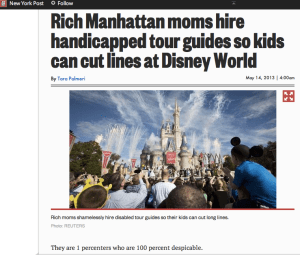
Case 2) Disney discontinued its policy that let physically handicapped guests and their parties avoid long waits in line.
– This was in response to abuse of the system – – according to some delicious reporting in the New York Post, some wealthy parents were paying physically disabled ‘tour guides’ up to $1000 to accompany their parties, thereby allowing their kids faster access to rides.  This remarkably selfish act of course mostly punishes the truly disabled kids; indirectly the PR hurts Disney as well.

Many companies have built loyal followings with liberal return policies.  Business Insider lists their top 10 here.

But why is there a seemingly growing numbers of abusers, and what should marketers do about it?

FIRST, THE WHY:  MY THEORY –> Abusing rules is a way of ‘Sticking it to the Man’:  for someone who feels insufficient influence on their world, any way to exert some control on a more powerful entity is satisfying.   This can apply to someone who feels economically disadvantaged; for the privileged it could simply mean an organization whose rules cramp their style.  Anything goes.
An excellent scholarly description of ‘The Man’ is in this brief clip:

School of Rock:  'The Man'

Definitive explanation of ‘The Man’

Except that now, due to politics and the state of the economy, the definition of ‘the Man’ is expanding; pretty much anything now qualifies as ‘The Man’.  This, naturally, leads to greater return policy abuse.

Evolution of (the) Man:  1960s – The Government;  1970s – Your Boss;  1980s – The USSR; 1990s – Big Business; 2000s – The Other Political Party;  2010s – Any Company OR the Other Party OR anything else

WHAT TO DO ABOUT IT?
– the options are pretty clear:   A) attract and presumably keep customers by keeping and advertising a liberal policy, OR B) manage profitability and integrity by installing guardrails to limit abuse
The Case for A:   Supports the original brand promise (‘satisfaction guaranteed’); doesn’t give a reason to defect; lifetime value of loyal customers may be profit-positive
The Case for B:  Limits financial liability from abuse; signals to honest customers that they’re not subsidizing dishonest customers; arguably can still have a liberal policy.

Personally, I’m supportive of adjusting the rules to match the times.
In the case of REI, a one-year policy still supports the company’s core value of backing up its products.  Thus, those customers for whom REI’s products and prices are appealing should remain customers.  The minority of customers who abuse the system might claim to be loyal, but they’re loyal mostly to their dollars – they’ll shop online and either adjust to the policy or take their ‘business’ elsewhere.

In the case of Disney, it will almost certainly lead to a policy that may involve some additional steps for guests, but which will help to assure that Disney is doing what it can to continue to ensure a great experience – – which is absolutely core to the Disney brand promise.  In the end, it shouldn’t affect attendance.

What do you think?

How do you make a $370 Billion Oil Company seem Sympathetic?

Compare it to Lawyers!  Of course!  And that’s what BP seems to be doing to support their brand.

Image

Is this a good move?  Vote Below.

You’ve probably seen BP’s full-page ads in the Wall Street Journal and other major papers.  They’ve been unfolding since June while an appeals process went on; the final version is below.

At issue is BP’s claim that it is being taken advantage of by lawyers and people who were never financially hurt by the massive 2010 oil spill in the Gulf of Mexico.  Along the way the ads have emphasized the $14 billion in restoration costs and $12 billion in claims paid out since the 2010 Gulf oil spill, as well as pointing an oily finger at lawyers who, they claim, are defrauding BP by securing settlements for parties who didn’t sustain any damage.

A BP spokesperson put it this way: “Today we are working to ensure that our willingness to do the right thing is not taken advantage of and distorted to provide windfalls to undeserving businesses, including law firms…”

[This is not the first time an erstwhile villain garnered our sympathy by bravely battling an even more evil opponent.  In 1964 many of us had to admit that we were secretly rooting for Godzilla as he withstood the savage attacks of Mothra.  But I digress.]

Godzilla vs Mothra

So what is the point of a $370 billion company that committed a huge ecological mistake and is in an industry that the public generally views more negatively than positively, in placing these very public ads positioning it as a victim?  Certainly the BP brand has taken its share of shots in the last few years; maybe they are trying to provide a positive counterbalance?

The answer might be illuminated by considering who the target might be.
– the general public?  hardly – – seriously,  a fight between an oil company and lawyers?  Aren’t we hoping they both lose?
– Institutional investors?  possibly – – but if the intent is just to demonstrate that BP is supporting its brand, running ads is pretty low on the list of investors’ considerations.
– Retail investors – – probably doesn’t hurt — probably pleased to see a company fight to preserve profitability.  But there isn’t much meaningful outcome that would be expected from this group.
– Legislators?   A likely target, and this might just be part of BP’s ongoing and significant lobbying efforts.

Without weighing in personally, I’ll leave it to my readers.   It’s important to defend your brand, but how it’s done is really important.

Image

A MINI appreciation of branding consistency

I recently saw an online ad for Mini USA, talking about how the brand is “not normal”.

Mini Ad

2013 Mini USA Ad

The big news here is that there is no news.

Mini is a brand with 10 years of absolutely consistent positioning and execution.  This leaves it free to have fun dramatizing its benefits, rather than having to explain or redefine itself.

mini bathroom 2

Introduced for the 2002 model year, the reimagined Mini Cooper was BMW’s very clever reinterpretation of Sir Alec Issigonis’s 1959 revolutionary original Mini (which sported 10 inch wheels!):  retaining the basic lines and dimensions, but adding handling, power and an extra dose of sass.

It originally came in just 2 models, but you could customize it to an almost infinite degree to express your identity, and then follow its progress online as it went from order to manufacture and then shipped.  I liked it so much I bought one (still have it 10 years later).

Sir Alec Issigonis and 1959 Mini

Sir Alec Issigonis and original 1959 Mini

Mini-2012-Model-Lineup

2012 Mini Model lineup

Mini has always been about individuality and flouting typical automotive marketing convention.

No swoopy drives through fluttering autumn leaves here – – they’d rather slide a car through paint (see above).

And while the Mini concept is arguably approaching its limit (e.g. a Mini SUV, convertible, models approaching $40k), it has succeeded in maintaining its playful, nonconformist personality, with an impressive array of clever, tongue-in-cheek marketing, executed with a wink.

Mini yo-yo

The (real) Mini goes up and down

 (A collection of 20 AMAZING Mini ads can be found here – definitely worth checking out).

There’s a huge benefit in getting branding right, and then sticking with the program – – consumers know what you stand for, and every marketing dollar serves to strengthen the brand, in addition to delivering a message.

Marvin Gaye vs Robin Thicke – Blurred Copyright Lines?

We take a break from more typical weighty matters with a lighter story for the weekend.

There’s a bizarre and public music copyright jousting match going on, which raises a few questions:
Who’s in the right?  And has the very public legal wrangling damaged either party’s brand?  YOU be the judge!   You’ll need to invest about 20 seconds (below).

Blurred Lines

Robin Thicke – Blurred Lines

Marvin Gaye

Marvin Gaye


The Song of the Summer of 2013 was Blurred Lines by Robin Thicke.*- it’s a catchy party tune, complete with the standard provocative lyrics and misogynistic video.  If you’re under 20 you’ve heard it at least 500 times.
*Alan Thicke’s son.  Their career arcs have definitely crossed.

Here’s the catch:  many people who heard Blurred Lines heard a strong similarity to Marvin Gaye’s Got to Give It Up  (1977).  The Estate of Marvin Gaye (he died in 1984) sure did, and made a legal claim that the similarity was too close.

Gayes strike first:  The Gaye Estate notified Robin Thicke’s lawyers and preemptively offered that if “…plaintiffs do not pay a monetary settlement of the Gayes’ claim, the Gayes intend to initiate litigation for copyright infringement against plaintiffs.”

Thicke’s camp responds, with a polite lawsuit: “Plaintiffs, who have the utmost respect for and admiration of Marvin Gaye…reluctantly file this action…The suit requests legal confirmation that “there are no similarities between plaintiffs’ composition and those the (Gayes) allege they own”.”

In other words, Marvin Gaye’s heirs claim they’ve been ripped off and want damages; Robin Thicke’s lawyers want a judge to confirm that this similarity doesn’t constitute infringement.

Because of the players involved, this otherwise mundane dust-up has garnered intense 24/7 global media coverage, with one result being you will have a hard time finding these videos online (but I’ve found them for you).

More to the point, it would seem that this increasingly public legal activity would undercut the appealing image that any musical artist strives for, and that this would harm their brand and consequently their ability to make money.
– so there’s 2 questions:  was Marvin Gaye ripped off, and will this harm either Gaye’s or Thicke’s brand?

Listen to just the first 10-15 seconds of each song, starting with Blurred Lines (below) and see what you think.

I found Blurred Lines starting at :40 on this outtake from Jimmy Kimmel:

http://music.yahoo.com/blogs/stop-the-presses/robin-thicke-pharrell-williams-join-jimmy-kimmel-hilarious-170809874.html

Got To Give it Up can be sampled here:

http://blog.al.com/wire/2013/08/does_thickes_blurred_lines_inf.html

SO – – Was Marvin Gaye ripped off?

My opinion:  The two songs’ similarity is striking and unmistakable.   But while I personally have great regard for Gaye’s genius (if not his personal conduct), it doesn’t seem that recreating a 35-year old beat should constitute infringement.

Will this hurt the images of either artist to the extent that they’ll suffer a financial impact?

NO!  Of course not!!  Trick question!

Their brands would be damaged if anyone in their fan base noticed or cared, and neither is going on here.

Robin Thicke’s fans don’t watch/listen to the news and almost certainly have never heard of Marvin Gaye.  This will not make one iota of difference.  Lawsuits are boring grownup stuff.

From the Marvin Gaye standpoint, there are now a lot of people listening to his music as a result of this skirmish, which has probably revived music sales.  And if his personal brand has survived coverage to date, it can definitely survive this.  No harm, no foul.

Net, this is an interesting event to watch unfold, but solely for the amusement factor.   Have a good weekend.

Is soup good food? Hard to tell sometimes.

Next to perennial diet enemies fat and sugar, sodium has never gotten much respect — probably because overconsumption of sodium doesn’t lead to a spare tire or other jiggling parts.  But too much sodium does contribute to heart disease and high blood pressure, and sodium reduction is now hitting the mainstream.  How do we know this?  Because the lawyers have gotten involved.

The Campbell Soup Company was recently hit with a lawsuit claiming that some of its Healthy Request soups contain too much sodium, despite a ‘Heart-Check’ endorsement from the American Heart Association (seen mostly on Campbell’s website), implying that Campbell’s is in the tank with the AHA (read: payola).

AHA Heart Check Logo

AHA Heart Check Mark

This is a case where technically Campbell seems to meet the AHA criteria, but where the consumer perception of benefit is probably greater than reality.   Which means it cannot be a permanent solution.

The market will ultimately choose an approach that combines great taste, reasonable sodium levels, and some way to convey these benefits without implying a taste tradeoff.  Not easy, but it’s happened before (trans-fats) and as awareness of sodium dangers gain visibility, a tipping point is inevitable.

Campbell's Healthy Request Soups

Campbell’s Healthy Request Soups

A quick fact-check:

–       To get the Heart-Check seal, a product must contain (among other things) no more than 480 milligrams of sodium per serving.

  • Never mind that the AHA advocates just 1500 mg per day of sodium, and that it classifies ‘low sodium’ as 150 mg or less per serving.  It’s their seal and they can do what they want with it.

AHA Heart Check Nutritionals

–       A typical serving of Campbell Healthy Request soup has around 400 mg, which clearly fits the guideline.

Campbell HR ChickenNoodle Nutritionals

Case closed?

Well, yes and no – each can has between 2 and 2.5 servings.  And according to a recent survey, over 60% of consumers would eat a whole can at a sitting.  Meaning the real sodium intake of just one soup experience could be 800-1000mg or more.  Which wouldn’t seem to be too helpful in reducing the current American average intake of 3500mg/day to a commonly held target of 1500-2300mg.

–       So there’s a fair argument that advertising as ostensibly ‘Heart Healthy’ is misleading.

–       Considering that 75% or more of sodium intake is through processed foods, this sets an unhealthy precedent for using an association endorsement to market foods with healthy benefits.  Americans can’t effect enough change with the salt shaker – it’s largely up to manufacturers to supply solutions.

Campbell has had its own corporate struggle with sodium.  In 2010 it announced significant sodium reduction in many of its soups, only to reverse course in 2011 when sales declined.   As Campbell is a public company, and is in business to make profits, it has justification in responding to marketplace demand.

Consumers care about sodium intake, but they care about taste more.  So it seems that using sodium reduction as a mainstream messaging effort will be very challenging, as ‘reduced sodium’ translates for most people to ‘bland as cardboard’.

A more appropriate approach going forward might want to include the following steps:

1) Continued formulation to deliver reduced sodium with great taste.  There are some great new salt alternatives available that should make this possible.

2) Use a so-called ‘stealth’ approach to reduce sodium gradually, and enable consumers to adjust their palates’ expectations over time.   With less salt, over time, Americans might even be able to taste the delicate and sophisticated flavor nuances that exist in most processed foods. (the thyme!  the basil!  the hydrolyzed corn protein!)

3) Continue the use of benefit-focused claims (along the lines of ‘heart healthy’), as opposed to ‘less of’ formulation claims (e.g. ‘reduced sodium’) – this is one of the only ways to convey ‘good for you’ and ‘good tasting’ at the same time.

Long-term, whether carrying an endorsement or not, manufacturers will need to make sure that sodium reductions are real and truly help the consumer –  and that the product tastes great.

But as it becomes easier for consumers to check nutritionals while shopping, the bar will inevitably be raised for both manufacturers and associations seeking an endorsement relationship.

Transparency – still not clear to Carnival Cruise Lines

Transparency is a foundation of good customer relations.  But is it possible to mess up transparency?  Carnival Cruise Line’s recent promise to disclose crime statistics indicates that it is comfortable with its historical communication approach.

Costa Concordia, Jan. 2012

Costa Concordia, Jan. 2012

Carnival might be thought of as the George Costanza of the cruise industry – a good policy might involve watching what they do, and then doing the opposite:
Being transparent as a standard operating procedure builds the trust necessary to weather a crisis
– Public statements of remorse need to be focused on the damage done to customers, not to the company
– Hell hath no fury like a customer scorned;
social media means the corporate ‘everything is ok’ statements are just not enough anymore

Carnival Triumph Feb 2013

Carnival Triumph Feb 2013

Triumph2

The Poop Cruise

A YEAR OF CRUISING DANGEROUSLY

Carnival has had a world of trouble recently – much of it self-inflicted as it conducted itself publicly:
– most tragically, the Costa Concordia capsizing in January 2012
– so far in 2013  (a sample): the Triumph’s infamous 4-day no power, no toilets ‘Poop Cruise’, the Dream stranding passengers due to generator failure, and the Legend’s problems causing a cruise to be cut short

– Following Concordia, Chairman Micky Arison went underground at Carnival’s HQ in Miami, granting no interviews and delegating public statements to the CEO of Carnival’s Italian subsidiary.

Carnival’s reparations to its customers (including meager refunds and future cruise vouchers) were of questionable sincerity.  As a result, not all prior customers have been actively evangelizing the brand (some amazing tales of woe can be read here).

Carnival’s public statements have tended toward defensive rather than disclosure:
– “I want to emphatically state that all the ships in our fleet are safe” (statement to Wall Street)
– “It’s still the safest form of transportation” (go-to industry non-statement based on a 1990 study – – Yes, we’re glad that we won’t die, but what are the stats about sewage exposure?)
– “The relative percentage of incidents for our cruise lines (versus competitors) is almost the same.  Unfortunately for us…we’ve just been hit by a run here (in the year post-Concordia) that has been very unfortunate.” Carnival Vice Chairman (in a masterful ‘we are the real victims’ performance).

Evidence suggests that Carnival takes a ‘lowest cost option’ approach to maintenance and customer satisfaction, which, based on its general positioning as a lower-cost cruise line, is a perfectly reasonable option – – as long as things are working.

However, as a result of recent events, a Harris Interactive poll showed sharply decreased opinions of not only Carnival (its quality scores were down 28% vs. pre-Triumph), but for the industry overall.

Carnival’s most decisive move?  Firing its advertising agency, of course.

CRIME ON BOARD
Now this week, Carnival announced (along with 2 other cruise lines) that it would be ‘voluntarily’ publishing crime statistics
for its ships, apparently bowing to political pressure.  A sample:
– From Oct. 2010 through June 2013, Carnival reported 121 incidents of thefts of over $10,000, assaults with serious injury, rape or sexual assault.
This was served up with predictably defensive statements:
– “…we are doing this voluntarily to remove all doubt about the relatively low level of crime on cruise ships especially when compared with comparable land-based crimes. It is important to highlight that what is being posted are allegations of crime. The majority of these are never substantiated as actual crimes after the initial investigation.”
– “I believe it showcases that cruising is safe, especially when you consider we have some 10 million passengers each year cruising with us.  I think the crime stats on board for our four North American-based cruise lines would be an average of 41 alleged crimes per year.”

So now, in addition to sewage and engine fire fears, we get to worry about onboard crime.  And it seems there’s a lot of room for crime beyond the very serious categories covered (who brings items worth over $10k on a Carnival cruise, anyway?). And there are huge questions about the comprehensiveness of the database – – by claiming an crime number, they are practically begging to be challenged.

Maybe more importantly, I want the company to pledge to minimize crime, not tell us that a certain amount of crime is acceptable.

Carnival has made many statements over the last 18 months, so one could claim they are being transparent. But what’s important is not necessarily the frequency of statements, it’s being proactive, honest and customer-centric.

Carnival’s current course has it in constant danger of running aground.

Cruising IFT 2013 – my Top 10 Trends (Special Double Issue!)

Posted on

Don’t let the unsexy ‘Institute of Food Technologists’ name throw you; IFT’s members are basically the source of the Nile for foods and beverages.  IFT’s national Expo was just held in Chicago, where I walked the many miles of the McCormick Place floor so you didn’t have to.  It was where you could see ingredient innovations that will show up without warning in tomorrow’s new foods and beverages.

IFT2013 Main Hall

IFT 2013 – McCormick Place Floor

So for your edification, I hereby present my Top 10 Observations.

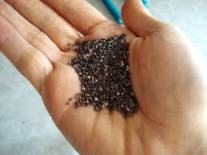
1) Chia.  No, not Chia Pets (although it’s the same plant) or even Chia LaBoeuf. An ancient grain, chia seeds promise high levels of Omega-3, ALA, fiber, calcium and minerals.  One marketer, Salba, targets their ‘super chia seeds’ at ‘smarty-pants’ consumers.  And you will need to think about it a little: like wheat germ, chia seeds aren’t generally eaten alone; they are typically sprinkled on or mixed in with other foods.

Chia Seeds

Chia Seeds

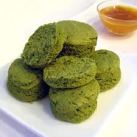
2) Matcha. This finely ground, premium green tea powder has been used ceremonially for millennia in Japan, and is offered in top restaurants worldwide.  For culinary purposes, matcha’s high amino acid content delivers a umami taste profile that can enable lower salt content.  Matcha can also be used as a colorant, due to its distinct green hue. The matcha makers were pushing all manner of green foods made with matcha, not all of which were ready for prime time.  High in antioxidants, you will likely have your first matcha moment at some point soon.  Arigatou gozaimasu.

Matcha 1

Ceremonial Matcha Tea

Matcha 3

Matcha Green Tea Jelly

Matcha scones

Matcha Scones

3) Saskatoon Berries.  So I’m at the Canada pavilion (they’re so nice there) and there’s a display showing Saskatoon berries (aka Prairie Berries) positioned as the next super fruit, with higher antioxidants than all your previous favorites (acaí, goji, etc.).  I try them — and they’re good!  Blueberry-sized but more fleshy, with just a hint of tartness.  Already well-liked for the obligatory preserves, pies and such, you may well be seeing Saskatoon berries showing up in more foods and beverages.  Trivia:  the province Saskatoon was named for the berry, not the other way around.  Who knew, indeed.

Saskatoon berries

Saskatoon Berries

SaskatoonFestival2Saskatoon pie

4) The word ‘pulse’. OK, I don’t live in Legume World, so maybe you’re familiar with the word; it’s always been just beans, peas and lentils to me.  But a lot more grain processors have started using the word pulse; my guess is you’ll be hearing it a lot more in the future.  Probably because it sounds a lot more sophisticated than talking about lima beans. (‘I’m in the pulse business, yeah baby!’)

Pulse grains

Pulse Grains

5) Bamboo Fiber.  This ingredient has long been used for textiles; I just hadn’t seen it in food.  Providing fiber’s benefits of texture, as well as bulking properties that accelerate one’s, ahem, transit time, it is used in juices, baked goods, pasta, sauces, among other applications, and is non-caloric.  And it’s label-friendly, too, being able to be called ‘vegetable fiber’.  I just don’t know the cost for all these benefits – – maybe we’ll sort that out next time around.

Bamboo

you know what this is

6) Natural food dyes.  Not surprisingly, the EU clean label trend has finally waded ashore from the Atlantic and is starting to make greater inroads in US food formulation.  Consumers increasingly want to see natural colors on the label (and of course, we know that everyone who claims to read labels always does).  So instead of CSPI whipping boys Yellow 5 or Red 40, get ready for more paprika, lycopene, annatto, turmeric and of course, cochineal extract.  But if you find out that the color comes from crushed insects, or algae, or your Velveeta doesn’t have its characteristic hi-glo orange-yellow hue anymore, don’t come crying to me.

Natural food coloring - Tribune

Natural food colorings (from Sensient Technologies)

7) Safety testing.  Ever since Roman praegustators, there has been a need for food testing.  And as the stakes have risen recently (see: melamine), based on my observation, so has the number of companies offering testing services to meet SQF and BRC standards (some great tech-speak that can score you some major points in the IFT cocktail hour – – but perhaps not in too many other places).
Tests for pathogens, listeria, salmonella, E. Coli, as well as fraudulent ingredients, can be done using HPLC, genetic molecular testing, straightforward micro testing, mass spectrometry, colony counting and zone sizing, and numerous other approaches that I don’t understand, using chemicals, software, and machinery.  As a consumer, it’s good to know that there is such a focus on safety.  As an IFT show-goer, it was disappointing – the food safety guys don’t tend to give out free food or tchotchkes.

IFT2013 testing

This software helps detect ingredients that shouldn’t be there, in this case tartaric acid. It can also see if that gluten-free claim is really true, or if there actually was any Benzedrine in Mrs. Murphy’s Ovaltine.

8) Sodium reduction.  The holy trinity of ingredients to avoid are fat, calories and sodium.  The consequences of over-consuming the first two are visible.  Sodium reduction helps with non-visible dangers like hypertension (dangers that Americans typically are excellent at ignoring), and as a result there has been less urgency.  But it seems that this is changing.  There were quite a few sodium reduction products offered promising great taste, using approaches as disparate as different crystal shape, blended granules, microspheres, starch and baking solutions, and more.  You heard it here first, the age of real sodium reduction has arrived.

IFT Salt

9 in 10 Americans over age 2 eat too much sodium

9) Alternatives to traditional ingredients.  What do you do for news when the main building blocks of food (like wheat flour) are not only mature, but facing new challenges (like GMO-free, gluten-free, etc.)?  You introduce new ways to get there.  Hence flours from sweet potatoes, soy, sesame, flax, coconut, rice, spelt, almond, buckwheat, spirulina and more.  Each has its own taste profile, nutritional benefits, and processing limitations.  You won’t see this stuff in your Twinkies, but it’s coming elsewhere, and it will be great to have more taste, texture and nutritional options.

IFT Sesame Flour

Sesame Flour

10) Maple Water.  Still trying to wrap your head around coconut water?  Well, clear out some mindspace for maple water.  It’s so new, it wasn’t even in the show – – I heard about it from a friendly Canadian.  It seems the Quebec maple producers have launched this product as a thirst quencher, ingredient, and in any case, an all-around transparent strategy to extend revenues from the maple crop.  It is supposed to have a distinctive flavor, slightly sweet.  Coconut water from the south, now maple water from the north, it seems the US has its flavored water NAFTA obligations covered.

IFT_maple-water

(actually, it’s not yet clear exactly what they want us to do with this stuff)

—————-

Bonus points for using this ingredient in YOUR product.

IFT2013 pop-rocks

Open to suggestion.

That’s it – see you at next year’s show!

Relaunching Twinkies – – Attempting Marketing Alchemy?*

Posted on

*Alchemy: “A process by which paradoxical results are achieved or incompatible elements combined with no obvious rational explanation.”  Source:  The Internet

You may have heard that Twinkies are now available again.

NewTwinkies

New Twinkies Collector’s Edition Package

In the spirit of ‘don’t waste a good crisis’, post-bankruptcy, union-free Twinkies management is aggressively marketing the product at relaunch, including PR, a billboard in Times Square, social media, retail presence, and an increased shelf life to 45 days, from 26 previously. (yikes!)

However, they are attempting an extremely difficult balancing act: adjusting enough to develop a new franchise, while simultaneously not alienating the current customer base.  This is a tightrope walk at best; there may be actually no way to serve these two masters with one product.  Twinkies may be trapped in a box.

Pulling this off, based on what’s already been tried in the past, would be a huge success.

As everyone knows, with one ‘Twinky’ containing 150 junk calories and 2.5g of saturated fat (13% of the recommended daily intake), this iconic brand had become out of step with current food trends.  And that’s not to mention 30+ ingredients.

Twinkies ingredients

What’s a Twinkie really made of?

Twinkies had actually achieved some level of cult status for its indestructibility, celebrated in (among other things) a 2012 Super Bowl Chevy Silverado ad.

chevy-super-bowl-blog480

Surviving the Apocalypse – 2012 Chevy Super Bowl Ad

So with much fanfare Twinkies is now relaunching, but long-term growth will still depend on either getting current older consumers to buy more, or getting new younger consumers to buy.  Or some combination.  There’s no other way.  And therein lies the rub.

Is it possible to keep the core elements consistent enough to satisfy the loyalists, while at the same time changing enough to appeal to a new crop of consumers?  Difficult.  New Coke of course comes to mind, as does JC Penney.

Further, this was a product that was off the shelves for a year or so while competitive ersatz Twinkies (now there’s a concept) chased some of the unmet demand.  So it would appear that they have their work cut out for them.

Can they pull it off?  Some clues may come from the new owners (Metropolous brothers) from an interview in March 2013 (my interpretation):
– statement that the brand is bullet-proof (“cannot be killed“)
– confidence that core consumers have high loyalty and can be kept while new ones added (through viral and other guerrilla marketing)
– goal to leverage “younger hipster consumers”…who are “on the pulse of what’s trend-setting
– focus on merchandising and retail execution – with separate grocery and convenience strategies
– willingness to play with the core formula (e.g. the shelf-life extension)
– expectation that product innovation will help grow the business going forward
– statement about cost savings, not being “slowed down with analytics or bureaucracy

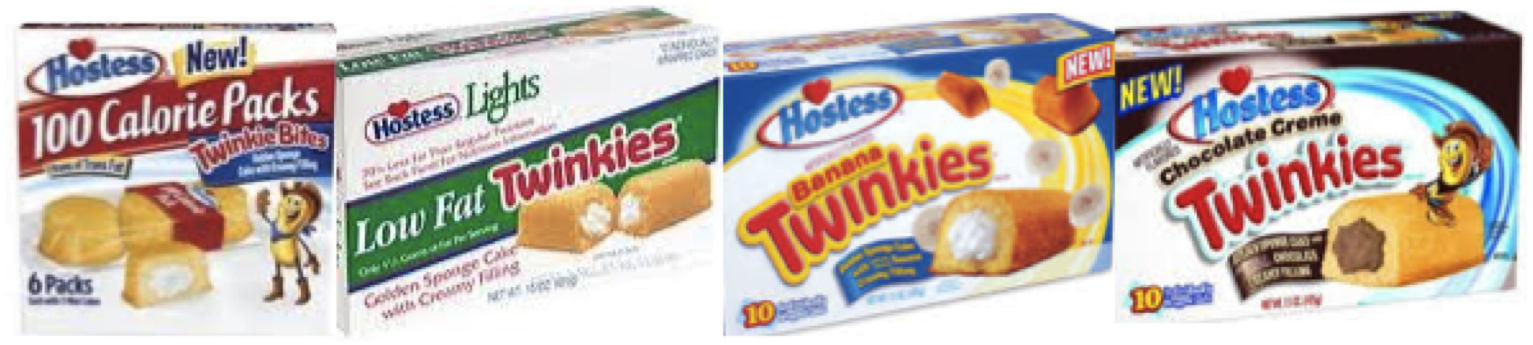
TwinkiesExtensions2

Twinkies Historical Line Extensions

I respect the ambition and energy of the new owners.  However, I will hold to my comment about 6 months ago:  despite the incredible publicity, it may be difficult to achieve much upside.).  There is nothing obvious in what we’ve seen so far to support a turnaround, and in fact there may be a few areas of concern:
– focusing on retail blocking and tackling is an excellent move and should yield good results – for the current product
brand awareness is not the same as brand elasticity.  And affection doesn’t necessarily translate to purchase.  Many of us fondly remember the Good Humor bars of our youth.  Do you have any in your freezer right now?
innovating an iconic product may not be that easy – – this is a product with just one proven form. Former management unsuccessfully introduced 100-calorie packs, low-fat, banana and chocolate creme versions.  So extending the Twinkies brand is not exactly an original idea.
willingness to change the original product – – they’re already smaller.  What’s next? Take away a man’s Polysorbate 60 and there could be hell to pay.

Net, we wish new management luck – – it would be great to have Twinkies always within arm’s reach.  But attempting to deliver on two strategies with a single product is a tall order.

Zimmer and Deen – Are pitchmen still a good idea?

Posted on

Sort of weird that both George Zimmer and George Zimmerman are in the news this week.  One is defending himself, the other is a men’s clothing marketing icon and decidedly playing offense, and is the one we’ll discuss here.  We’ll also discuss the slow-motion self-destruction of Paula Deen, food celebrity.

The upshot of these stories:
– Companies need to realize that consumers tend to instinctively side with the person, not the company
– Increasingly, sponsors are cutting ties with celebrities at the first hint of controversy – – because they think they have no choice
– Ultimately celebrities get our attention but it’s harder than ever to have a 30-year spokesperson

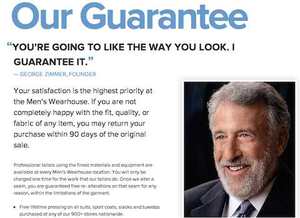
Zimmer-Guarantee

Link to Men’s Wearhouse History

George Zimmer, founder of midscale clothier The Men’s Wearhouse and famous after umpteen years saying “You’re gonna like the way you look – – I guarantee it”, was booted from the organization last week.  The reasons have evolved into a sort of ‘he said, she said’ PR battle (one good summary is here).  In the end, though, the reasons aren’t important.  What’s important is that the company looks cold and heartless for mercilessly getting rid of the old guy who, yes, founded the place, but apparently can’t appeal to the more important younger shoppers.  And that has translated into consumer antipathy towards MW, which has decidedly lost the PR war.

We remember Wendy Kaufman, the popular straight-talking ‘Snapple Lady’ who was dumped right after the company was bought for $1.7B by Quaker Oats.  Quaker was 0-for-2 on that one – -it eventually unloaded Snapple for $300 million 3 years later to Triarc Brands, which immediately reinstated her as spokesperson, to the delight of consumers.

In January 2012, William Shatner (who has had more career changes than Madonna) was terminated as Priceline pitchman (‘The Negotiator’) after 14 years, apparently due to a change in their business strategy.  Credit to Priceline for offing Kirk in a suitably campy explosion.  On the other hand, a survey by Priceline.com discovered that 94% of customers wanted him back.  So this past January he returned, in different, but still amusing executions.  Good move, Priceline.

On the other hand, when celebrities clearly behave badly, a company is justified in letting them go.  O.J. Simpson, Lance Armstrong, Kobe Bryant (a seemingly endless list of pitchmen gone bad is here), which brings us to the case of Paula Deen.

Paula Deen Cries

Ms. Deen, longtime Food Network celebrity chef, is being fired by seemingly every sponsor she has (Food Network, Caesars, Smithfield Foods and now Wal-Mart).  Her crime?  Well, aside from glorifying heart-attack food, she admitted to using a racial slur several decades ago during a robbery.  OK, 30 years ago, she certainly could have moved beyond that mindset, right?  Well, she compounded the controversy by a continuing series of self-inflicted misfires in ensuing interviews.  She deserves to be heard and to have a chance for redemption, but she also can afford better PR advice.

Her sponsors, seeing this story take on a life of its own, probably figured that inaction on their part could be interpreted by some as tacit approval of using racist words.  So they needed to disconnect as a defensive play.  Fair?  Who knows; in this 24/7 news cycle the truth is less important than perception and reaction precedes facts.  But Paula Deen won’t starve, and business is business.  So it’s an understandable move by her sponsors.

On the other hand, the $1500+ Paula Deen cruise, where the food star mingles with guests and does cooking demos, has seen sufficient goodwill-fueled demand to require the cruise line to add another 500-person cruise to the schedule.  And her upcoming cookbook has seen a 1300% surge on Amazon since the incident.

Famous people can still move product – – but increasingly these relationships require caution – – and lawyers – – on both sides.

What is Velcro doing in my kitchen?

Posted on

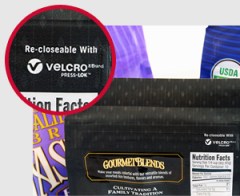
Recently during a demanding session in my exciting new role as Observer in the kitchen, I noticed that a plastic pouch of Lundberg Family Farms Rice had a Velcro closure!  Velcro® PRESS-LOK™, to be accurate, according to the logo printed on the package back.  (technically speaking, PRESS-LOK™ uses a hook-and-hook approach rather than the original Velcro hook-and-loop).

Velcro PRESS-LOK

Velcro® PRESS-LOK™Velcro2Branded ingredient logo

Like you, I’m used to seeing Velcro in jacket closures, little people’s shoes, the IPass transponder on my windshield, wallets, and a zillion other things.  ZZ Top even had a song called ‘Velcro Fly‘ but I’m not sure what they were specifically talking about.

But I’d never seen Velcro used in a food product before.  Why is this, and is it a good idea?  Does a Velcro logo on the package back do anyone any good?  Do I want to be thinking about muddy, stumpy little shoes when I’m (watching someone) chopping kohlrabi for dinner?

Velcro adds value to lots of products, but air- and water-tight seals have never really been part of the equation.  If it’s my food, I want that seal to be so impermeable that if called on to do so, the package swells up like a dead opossum once it goes past the sell-by date.

So, here’s my take.  In short, for ingredient branding to work there needs to be a meaningful new consumer benefit, or strong marketing support, or both.  This arguably has neither.

1) Expanding its applications to foods could be a nice business opportunity for Velcro — but there’s no guarantee.
If PRESS-LOK doesn’t work beyond the relatively unchallenging demands of a benign product like rice (or more importantly, if consumers don’t think it does), PRESS-LOK for food might go the way of the infamously loud, late and great compostable SunChips bag from Frito-Lay – – the answer to a question no one asked (not that you could have heard them).  (F-L Canada at least offered consumers earplugs.  But I digress…).

sun chips earplugs 2

2) This is not likely to bring ’em to the store 6-on-a-mule for Lundberg Family Farms Rice.  You can’t see ‘Velcro’ on the package front (in fact, you can’t even find it on their site), so it’s unlikely to generate new triers.  And one has no idea of what added benefit having a Velcro closure provides.  So any benefit to Lundberg will be if the Velcro closure provides an incredible consumer experience.  But it’s hard to imagine that happening, this being rice and all.
On the other hand, if Lundberg ever wants to sexy up some rice, they need only look to our German friends for how to inject a little Verführung in their brand messaging.

http://www.youtube.com/watch?v=wv6WETcb_pM

Net, from an ingredient branding standpoint, this ends up as perhaps a base hit but not a big deal.  Yes, you’ve now got Velcro introduced into the conversation in a food context, but it’s kept really low-key and the advantages of using Velcro in food packaging are never made clear.  So it’s an interesting alternative to the ubiquitous zip-lock closures but not likely the next Intel Inside.   (For those interested, Landor published a very good article on ingredient branding not too long ago.)

As for me, it’s time to grab a beer, today’s paper, drag my stool over to the kitchen, and get to work.