Category Archives: Branding

What is Velcro doing in my kitchen?

Posted on

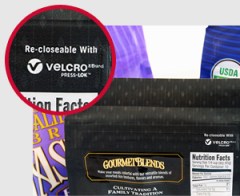
Recently during a demanding session in my exciting new role as Observer in the kitchen, I noticed that a plastic pouch of Lundberg Family Farms Rice had a Velcro closure!  Velcro® PRESS-LOK™, to be accurate, according to the logo printed on the package back.  (technically speaking, PRESS-LOK™ uses a hook-and-hook approach rather than the original Velcro hook-and-loop).

Velcro PRESS-LOK

Velcro® PRESS-LOK™Velcro2Branded ingredient logo

Like you, I’m used to seeing Velcro in jacket closures, little people’s shoes, the IPass transponder on my windshield, wallets, and a zillion other things.  ZZ Top even had a song called ‘Velcro Fly‘ but I’m not sure what they were specifically talking about.

But I’d never seen Velcro used in a food product before.  Why is this, and is it a good idea?  Does a Velcro logo on the package back do anyone any good?  Do I want to be thinking about muddy, stumpy little shoes when I’m (watching someone) chopping kohlrabi for dinner?

Velcro adds value to lots of products, but air- and water-tight seals have never really been part of the equation.  If it’s my food, I want that seal to be so impermeable that if called on to do so, the package swells up like a dead opossum once it goes past the sell-by date.

So, here’s my take.  In short, for ingredient branding to work there needs to be a meaningful new consumer benefit, or strong marketing support, or both.  This arguably has neither.

1) Expanding its applications to foods could be a nice business opportunity for Velcro — but there’s no guarantee.
If PRESS-LOK doesn’t work beyond the relatively unchallenging demands of a benign product like rice (or more importantly, if consumers don’t think it does), PRESS-LOK for food might go the way of the infamously loud, late and great compostable SunChips bag from Frito-Lay – – the answer to a question no one asked (not that you could have heard them).  (F-L Canada at least offered consumers earplugs.  But I digress…).

sun chips earplugs 2

2) This is not likely to bring ’em to the store 6-on-a-mule for Lundberg Family Farms Rice.  You can’t see ‘Velcro’ on the package front (in fact, you can’t even find it on their site), so it’s unlikely to generate new triers.  And one has no idea of what added benefit having a Velcro closure provides.  So any benefit to Lundberg will be if the Velcro closure provides an incredible consumer experience.  But it’s hard to imagine that happening, this being rice and all.
On the other hand, if Lundberg ever wants to sexy up some rice, they need only look to our German friends for how to inject a little Verführung in their brand messaging.

http://www.youtube.com/watch?v=wv6WETcb_pM

Net, from an ingredient branding standpoint, this ends up as perhaps a base hit but not a big deal.  Yes, you’ve now got Velcro introduced into the conversation in a food context, but it’s kept really low-key and the advantages of using Velcro in food packaging are never made clear.  So it’s an interesting alternative to the ubiquitous zip-lock closures but not likely the next Intel Inside.   (For those interested, Landor published a very good article on ingredient branding not too long ago.)

As for me, it’s time to grab a beer, today’s paper, drag my stool over to the kitchen, and get to work.

Warby Parker, and why Brands Don’t Matter

Posted on

Brands don’t matter?!?  Blasphemer!  Heretic!  Neanderthal!  Republican!  Put down that crack pipe!

This is of course counter to everything you hear (and if you know me, everything I say).

But it’s true, with an asterisk: Brands often DON’T matter – – until they do.  Then they matter a lot.  It all depends on what value is delivered.

At the risk of alienating my friends in the branding business:  look at some of the more successful recent brands , or just brands you’ve used everyday and never really thought about (Yahoo!  Google.  Zappos.  Ebay.  Subway. Apple.  AT&T.  Starbucks. Blackberry. Target. Kindle. MiO. Allegra.).  Even better, musical artists:  Stone Temple Pilots.  Foo Fighters. Neutral Milk Hotel.  Arcade Fire.  Queen – – no, strike that last one.  Anyway, you get the point – – does any of these in any way describe the product or service?  (and let’s not get started on prescription medicines…). Asked another way, did the brand have a material impact on success?

WarbyParker

Which brings us to Warby Parker.  Warby Parker is a relatively new web-driven mail-order prescription eyeglass business that has totally disrupted this space.  The concept:  shop online, they send you 5 frames to try out at home, you pick one, get them your prescription and you’re immediately sent designer eyeglasses for $95!  So from a value perspective it’s a great deal – – sort of in the same mold as Target – – call it cheap chic or funky frugal or whatever – – their value recipe is cooking right now.

But that’s not all.  Like Zappos, WP have distinguished themselves with over the top customer service.  Every message, call, post or Tweet is answered personally, promptly, and cheerfully.  The combination of value and service has created a significant buzz that is helping to propel the business very quickly.

So where does the ‘Warby Parker’ name come from?  Who cares?* — because of a winning value proposition and excellent execution, it NOW means something very valuable and unique that drives customer loyalty – -and that’s the value of a brand.

*According to the WP website, it is actually a combination of two characters’ names from Jack Kerouac’s work.

Sure, the exceptions to the ‘brands don’t matter’ statement could fill an e-book:  Oikos and Chobani convey Greek; Twitter suggests short bursts of conversation; SquareSpace describes a computer screen, Orapup means something to do with a dog’s mouth, etc.  These and others can help quickly telegraph what’s going on, particularly where authenticity is critical or where marketing funds are limited.  And certain brands can definitely convey a sense of quirkiness — or seriousness — that is core to the product or service’s desired positioning.

However – – while many electrons are spilled proclaiming the value of brands, the most important thing is ultimately not the brand itself, but the lasting value and relevance that the brand delivers.

JCPenney, Fresh and Easy, Webvan: “Did someone remember to tell the customer how brilliant we are”?

OK, that headline is a bit harsh.  But so is the world of retailing – – no matter how high-concept and inspired a new retailing idea is, if it doesn’t integrate the core consumer in the development process, there could be trouble.  We will respectfully dance on a few graves and illustrate with 3 cases.

BordersQuote

Case 1:  JCPenney.  By now we all know that Ron Johnson flew a bit too close to the sun, banking on his reputation and the obvious hubris gained during his successful run at Apple.  He applied the Apple Store model (where the stars were ultimately the products) to JCPenney, with an immediate switch to an everyday pricing approach (since reversed), and store remodels including branded mini-boutiques.  All, famously, without testing.  The result:  a disastrous $4 billion sales slide, imploding stock price, his ouster and most recently JCP looking to the capital markets to secure another $1 billion in operating cash.  Ouch.

30-OFF-COUPON-CODE-JCPENNEY-CLEARANCEJCPenney - WSJ

—> Diagnosis: Less brilliant, more tone-deaf.  The plan counted on consumers to see things Ron’s way:  “Hey! JCP now offers reliable low pricing all the time, so you can trust us!”  The catch:  consumers apparently liked the way they already shopped – -they were used to buying on deal, and there was not much merchandise at JCP that couldn’t be bought elsewhere.  And elsewhere is apparently where consumers went.

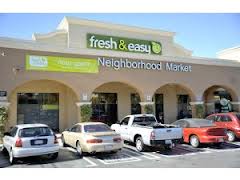
Case 2: Tesco’s Fresh & Easy Neighborhood Markets.  British supermarket giant Tesco announced it will shutter and take a $1.5 billion write-down on its F&E chain, after cumulative losses exceeding $1 billion and 5 years after noisily entering the California market. Fresh & Easy, which famously touted its in-depth consumer research, opened smaller format (10,000 sq. ft) stores and promised “convenience, fresh produce and tasty prepared foods”  (LA Times).

Fresh N Easy

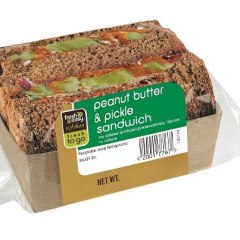
FreshEasy PB&Pickle

—>Diagnosis: They didn’t walk the talk.  Rather than truly adapting to Americans’ shopping habits, Tesco essentially imported its own model and assumed that customers would do the adapting.  A few examples of British norms that didn’t make it here: pre-wrapped produce (heavy on the watercress!) and pre-packaged sandwiches (but no fresh deli), fewer familiar branded products in favor of higher-priced private label, and a policy against couponing.

According to respected researcher The Hartman Group“We believed then, and said it repeatedly in the following years, that Tesco had an innate desire — an arrogance if you will — to do things their way rather than make adjustments that catered to the needs and expectations of American shoppers. Despite Tesco’s vaunted success in the European marketplace, the resulting retail experience in Fresh & Easy was artificial, sterile and increasingly without a relevant proposition.” (bold added)

Case 3:  Webvan.  The mother of all examples of misjudging the consumer.  Founded in the late 1990s by Louis Borders (of bookstore fame), Webvan was an online grocery retailer offering delivery within a 30-minute window.  Funded by Silicon Valley venture capital, Webvan hired away the president of Andersen Consulting (now Accenture) and was heavily capitalized ($1 billion for warehouse infrastructure, plus vans, computers, etc.)  By 2001 Webvan was bankrupt (although subsequently bought by Amazon, where it exists in a much smaller form).

webvan truck webvan stock price

—> Diagnosis: Webvan management and investors incorrectly assumed that consumers would immediately adapt to their genius.  Grocery buying is very personal, an ingrained habit, and expecting large numbers of people to abruptly abandon what they’ve been doing for years was naive at best. In the heady days of the dot-com bubble #1, funding was fast, and it was big (Borders himself said “It’s $10 billion or zero“.  He was right).  So the inclination was go big or go home, leading to huge advance spending, astronomical traffic expectations, and a spectacular flameout when consumers didn’t sign up as the financial pro formas had assumed.  By one estimation, Webvan would have had to sign up two-thirds of the tech-savvy households in the San Francisco area.  This is probably one of the best examples of misjudging (or conveniently ignoring) consumer input, breathing one’s own exhaust, as well as the adage ‘Easy come, easy go’.  A short, fun post-mortem can be found here.

Are New NCAA ‘Play-Out’ Exhibition Games the Real Madness?

Posted on

You may have already heard that late Sunday night the NCAA abruptly announced the biggest change to the NCAA Division 1 Men’s Basketball tournament (‘March Madness’) since at-large teams were first allowed in 1975 (previously only one team per conference was invited).

The short story: on Final Four Sunday, April 7, the day before the Final, there will be now be 3 so-called ‘Play-out’ exhibition games between former No. 1 or No. 2 regional seeds that have been eliminated (including Ohio State, Indiana, Duke, Kansas, Georgetown and Miami; specific matchups and times to be determined).  These games carry no official significance but clearly will have strong fan appeal.  CBS will schedule these games so as to not interfere with the Academy of Country Music Awards broadcast, which starts at 8pm EST.

March-Sadness

NCAA officials explained these changes as an effort “to satisfy the unexpectedly strong recent demand among NCAA Basketball’s rapidly growing fan base, particularly internationally”.  It is no secret that March Madness has evolved into an enormously popular event.  Even President Obama took time from his schedule to weigh in.  In addition, the event’s female viewers, already 48% of the audience, make up an increasingly ardent fan base.  Still, satisfying new fans is not at the center of this decision.

The real motivator is much simpler:  Money.   Turner Sports and CBS, seeing early tournament exits by most of the more popular top seeds, are exploiting the networks’ unsurpassed ability to create more hours of high-quality entertainment.  Advertisers have already signed on, and since the participating schools were offered a generous share of the revenues, gaining their participation was relatively simple.  Only former No. 1 seed Gonzaga declined the offer, due to a conflict with a Tech N9ne concert in Seattle.

BBall Money

This is a sad example of short-sightedness, laying bare the craven quest for TV ratings that we now see is the real driver behind many of the sporting world’s decisions.  Unfortunately, it is a severe body blow for the integrity of NCAA Basketball and big-time sports.  Clearly, the theory goes, while everyone loves a Cinderella, you still don’t really expect huge numbers to tune in for Wichita State, right?  So, why not just bring in the biggest names for a curtain call?

Here’s why –  in this era of sports free-agency and seemingly limitless payrolls and budgets, it’s important to remember that the unexpected can and does happen – – with talent, grit and maybe a little luck, on any given day, David can slay Goliath.  Hence the excitement for FGCU and Wichita State.  They’re the real reason we tune in to March Madness, even if they do destroy our brackets.  Diluting the event with meaningless games just for spectacle will only cheapen the NCAA brand while overshadowing the teams deserving of our attention.

So, a message to the NCAA, CBS and Turner Sports:  you’ve got a jewel in the current March Madness (as long as the field doesn’t expand) – and it’s exactly what people are looking for — as is.

Butterfly Bakery: Heading back into the cocoon

Today’s news brings us the cautionary tale of Butterfly Bakery, which is no doubt trying to find a cocoon to hide in after an onslaught of mostly self-inflicted pain.  This is primarily a lesson on the importance of transparency, authenticity and speed in the age of 24/7 public scrutiny.

ht_butterfly_bakery_blueberry_muffins_nt_130314_wblog

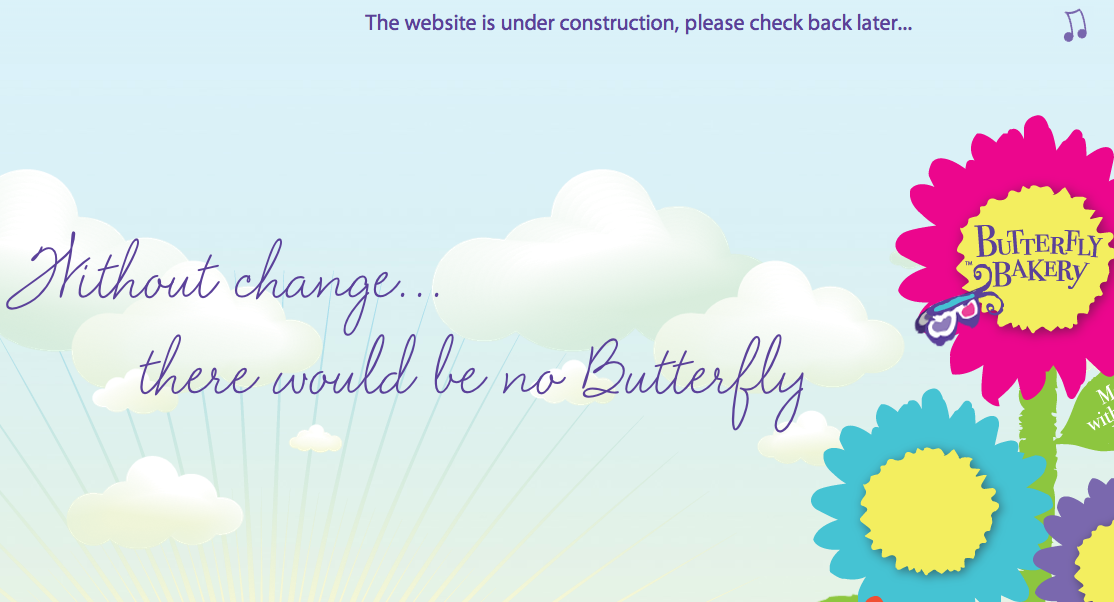
The short story:  Butterfly Bakery, a small Clifton, NJ baker of special baked goods (e.g. sugar-free, no sugar added, gluten-free, etc), is suffering through its 15 minutes of fame courtesy of the FDA, which forced it to close its doors after discovering that sugar and fat levels in several of its muffin and cookie products were well above what was claimed on the label.  Selected products had 3x the stated levels of sugar and 2x the indicated amount of fat.  This has led to some explanatory statements on the BB Facebook page and caused the charming looking website to be taken down.  The Twitter feed has also stopped.

ButterflyBakeryScreenShot

So — what’s the big deal?  Isn’t this just another case of the government unfairly picking on the little guys while ignoring ‘big business’?  After all, only 3 products of 45 were cited.

Well, yes and no — but mostly no.

– it turns out that the original FDA complaint is almost 2 years old, and that BB was well aware of the issues.  Here is an excerpt from their Facebook statement:  “Butterfly Bakery, Inc. acknowledges the claims in the FDA press release dated March 13, 2013. Butterfly Bakery voluntarily entered into a consent decree and has been working with the FDA and a team of technical and regulatory experts since May 31, 2011, to improve its processes and ensure compliance with all Butterfly Bakery products”. [bold added]

– May 2011?  Based on comments on their FB page, their customer base was clearly not aware of anything, and they are now suitably outraged.  2 years is plenty of time to reformulate, repackage, explain to customers, and flush out all inventory.  An FDA inquiry would seem to have been a strong hint to watch nutritional claims closely.

A matter of health – these products draw heavily from diabetics and celiac sufferers, for whom safe, tasty treats are often difficult to find.  BB’s products apparently tasted great, which is now not surprising since that’s largely what sugar and fat are for.  So whether intentional or not, BB enticed customers with better taste, while simultaneously putting them in danger because of misleading labeling.  This is not just a case of ‘I’m mad you didn’t tell me’, it’s a case of putting consumers at risk.

You never get a 2nd chance to make a first impression – – Butterfly Bakery has now gotten its first national publicity, which is hugely negative, and they will forever be associated with this scandal.  They will immediately forfeit retail distribution and may have trouble regaining it. But perhaps most importantly, they have violated the trust of their most important constituency – their customers, which may be impossible to restore.

Collateral damage – – other unrelated Butterfly Bakeries have already had to start issuing disclaimers that this doesn’t apply to them.  But clearly potential customers will have pause before buying from them.

The upshot:  Hindsight is 20/20, but Butterfly Bakery could have positioned themselves most positively back in 2011 if they had acknowledged some inaccuracies in labeling, offered refunds, and pledged to a new level of scrutiny.  They would have been seen as being committed to their customers.  Now the opposite is true, and their options are limited.  At least they have not made the mistake of trying to fight hand-to-hand on Facebook (see Applebee’s case).

Orapup — A newfangled innovation to tackle dog breath — and have fun doing it

Posted on

Orabrush is in the business of cleaning human tongues.  And they are growing their business by doing a fantastic job with their social media effort.  But this isn’t about Orabrush – it’s about Orapup – – a line extension designed for guys like Nigel – – and about how company assets can be creatively leveraged to create new revenue streams.

First, about Orabrush – – their marketing effort, like your breath should be after using their product, is fresh, cool and quite personal.  If you want a quick whiff, check out their website:  cheeky home-grown and user-generated videos featuring a guy who looks like Neil Patrick Harris (a zillion YouTube views), not so tongue-in-cheek product claims, and a lot of we-don’t-take-ourselves-too-seriously fun.  They have a counter of tongue brushes sold online; at the time of this writing it was at 2,982,076 – so if you were lucky, maybe you were able to watch it hit 3 million.

So how does a company like this innovate?  Well, in some ways just what you’d expect; in others, the opposite.

They currently have a name, a product, a following, an online presence and retail distribution.  In coming up with Orapup, they certainly leveraged technology, their name, and their online fans (who suggested the product in the first place).  But because they can’t leverage a distribution system (Orabrush is not set up for pet channel distribution), rather than try to use media spending to first drive retail distribution for Orapup, they’ve done the reverse:  in-depth data analysis of focused online ads to tweak the marketing formula dynamically, then focusing local online media to efficiently drive sales where there is distribution, growing organically from there.  Ad Age did a good writeup; you can read it here.  Love their video (the first 15 seconds are worth the price of admission):

Orapup has taken a decidedly modern approach:  Crowdsourcing the idea, crowd funding (they raised an initial $60k and conducted research at the same time), generating buzz (and demand) by taking pre-orders online (they got 60,000 online orders to generate $750k revenue before shipping the first product), and THEN pulling the trigger on shipping product and driving retail distribution.  In this way, they’ve leveraged their loyal followers, created pent-up demand, covered some of the upfront investment, and delivered a product that has demonstrated demand.  All while mitigating the typical risks of a new product (stale product on shelves, etc.)

This is an excellent example of a few things:

‘Traditional’ marketing is an endangered species – – sometimes it’s best to avoid the tried and true – -marketers need to creatively leverage the evolving array of available resources and experiment with new approaches.

Empowering consumers to have a voice in product development can reduce development time/cost/risk (and avoid aimless R&D safaris) – – in addition to creating an enthusiastic group of advocates.

Let the numbers be your friend – – by constantly monitoring, analyzing and adjusting, marketers can optimize their marketing mix and quickly respond to marketplace changes

Orapup is a fun product that has extended the Orabrush franchise with low risk, manageable investment, and arguably a nice shot of positive buzz that is consistent with the overall fun brand persona.

It is a great example of how to creatively innovate.

Anheuser-Busch: Guilty until Proven Innocent?

Posted on

Was it just a few weeks ago that Maker’s Mark made headlines when it reversed its plan to reduce its alcohol level by 3%?  Well, now Anheuser-Busch is expending resources to deal with a similar product quality perception situation; the difference here is that this story is not of its own making (Maker’s Mark had announced a planned change before changing their minds).

Social media and 24/7 coverage have made companies’ reputations more at risk than ever — and while it can take as little as a few well-placed keystrokes to ignite a PR firestorm, it often costs much more to avert or manage a crisis.

A-B Beers

A series of class action lawsuits has been filed in several states, accusing A-B of adding water to 10 of its beers, lowering alcohol content to a level below what is claimed on the label.  The lawsuits are reportedly based on information from former employees at the company.

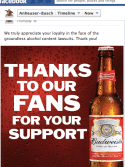
The now not-surprising effect has been widespread negative buzz for A-B, which they have had to deal with immediately.  So far, A-B has denounced the lawsuits in a statement and posted test results and notes to their customers on Facebook and Twitter, as well as a full-page ad that ran today in numerous large newspapers.

BudweiserFacebook2

BudweiserFacebookA-B Watered Down Beer Lawsuit.JPEG-02312

Even this modest level of expenditure is no small potatoes for an issue that may well be 100% unfounded.  In fact, other companies caught in the same situation have spent significantly to manage the message (Taco Bell spent millions in 2011 to tell its side of the story when accused of mislabeling beef content, a suit that was eventually dismissed).  In the current climate of ‘post first, ask questions later’, when caught in this sort of negative story, companies are often well-advised to react immediately and with strength – – regardless of what the facts may eventually bear out.  The alternative is to passively let the brand message be controlled by social media, which is not really an option.

These days, brands would be wise to budget some contingency funds to deal with the possibility of such a media-enabled drive-by.  In fact, it could be argued that Anheuser-Busch should be more aggressive now to get ahead of public perception.  It would not be surprising to see them dial up the spending in the near future.

Nigel has just very astutely asked me: what happens if they’re actually found guilty?  Well, if that happens, as Anheuser-Busch InBev has a market cap of around $150 billion, it wouldn’t be long before the company feels pain the billions rather than millions.  That’s the difference between being accused of doing something bad, and actually doing something bad.

Maker’s Mark: We all make mistakes, here’s a great example of how to handle it

BULLETIN:  Management listened! (and acted)  Good for them!

Screen Shot 2013-02-17 at 7.38.21 PM

Very recently Maker’s Mark made the news by announcing a reduction in alcoholic volume from 45% to 42% (otherwise known as diluting).  This commentator (and more importantly, consumers) questioned the wisdom of the move, which Maker’s Mark explained as necessary to meet demand.

Today (Sunday) Maker’s Mark announced via Facebook and Twitter that they have reversed their earlier decision and are keeping the product as is.

We applaud management for acting quickly and decisively based on consumer input.  The response has been immediate and positive – – already there are 24,000 positive comments on Maker’s Mark FB page.  They have turned a negative into a positive and reclaimed the loyalty of their customers.

You can go to their site for the full announcement.  Below is an excerpt.

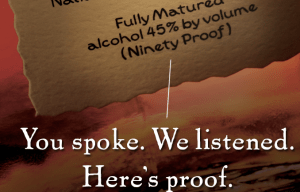
You spoke. We listened. 

Dear Friends,

Since we announced our decision last week to reduce the alcohol content (ABV) of Maker’s Mark in response to supply constraints, we have heard many concerns and questions from our ambassadors and brand fans. We’re humbled by your overwhelming response and passion for Maker’s Mark. While we thought we were doing what’s right, this is your brand – and you told us in large numbers to change our decision.

You spoke. We listened. And we’re sincerely sorry we let you down.

So effective immediately, we are reversing our decision to lower the ABV of Maker’s Mark, and resuming production at 45% alcohol by volume (90 proof). Just like we’ve made it since the very beginning.

Maker’s Mark: Missing the Mark

I know absolutely nothing about bourbon, but even I have to comment on what appears to be a classic case of unintended mixed messaging (and perhaps short-sighted judgment), that may likely have a huge negative impact on a classic brand.

Maker’s Mark is a venerable premium bourbon whisky, taking 6-8 years to make.  It even has an Ambassador’s program of people who enthusiastically and voluntarily evangelize the brand.  It is a unit of Beam.

MakersMarkRecently Maker’s Mark, in dealing with a ‘bourbon shortage’, announced that it would permanently reduce from 45% ABV (alcohol by volume) to 42% ABV, in order to be able to fulfill growing demand.  There is no change in price.  USA Today has a good commentary – you can find it here.

Maker’s Mark management explains this formulation change in the language of alcohol reduction, in order to ‘extend supplies’. But it didn’t take long for the public (and press) to explain the change as dilution, and the motivation reinterpreted as being profit-driven (as opposed to consumer-driven).  Additionally, MM management stated that the new formulation was tested with MM users who ‘couldn’t tell the difference’.  (apparently this taste panel was MM employees).

We live in an increasingly transparent world – why would this explanation create issues?  Well, several reasons, dealing with both the communication as well as the decision itself.

1) Don’t mess with my product.  Consumers are extremely sensitive to, and skeptical of, any sort of formulation change.  Loyal users, remember, are loyal because they’re happy with the product as is.  Any stated change, even a purported ‘improvement’, is almost by definition a change for the worse.  New Coke was over 25 years ago but the lesson holds now more than ever.  In addition, by clearly stating there will be a reduction in alcohol content, MM is in effect saying we’re compromising one of the core elements of the product.  In this case, not only different, but clearly worse.   This fundamentally hurts this premium brand’s value.

2) Perception is reality – – even if there is no noticeable change (and that’s a little doubtful), the fact that consumers know they’re drinking a diluted product will give them the perception that it’s not the same.

3)  Don’t violate my trust.  This is even more pronounced in a luxury category like whisky, which is extremely personal, one’s choice is both a badge and source of pride, and where there is a greater than average emotional connection between user and brand.  Any attempts to disguise or cleverly position product changes will be seen as a betrayal and will undermine loyalty in a hurry.  Again, the brand will suffer.

4) Beware ‘small unnoticeable changes’.  I once heard incremental product changes explained this way:  You can start with a Snickers bar and remove a peanut every year; not noticeable but one day you’ll wake up with a Three Musketeers.  The fact that Maker’s Mark used an internal panel fails in two ways:  a) this is no substitute for actual quantitative testing with consumers and b) it smacks of breathing one’s own exhaust — I can just imagine the action standards that were set.

5) Don’t ignore the power of social media.  Reaction, judged by comments on Maker’s Mark FB page, is decidedly negative, most in the ‘betrayed’ or ‘I’ll never use this brand again’ category.  The Chairman’s response/comment, which was tweeted recently, can be found here.  But to the extent that this defends their position rather than acknowledging negative consumer responses, sounds a bit like the Applebee’s fiasco.

In the end, the market will be the ultimate judge.  But in a) diluting a premium product in the first place and b) being aggressively transparent with a negative message, Maker’s Mark may have unwittingly lost in the long run.

Faced with a shortage (of bourbon or profits), Maker’s Mark may have been better off with a modest price increase (not optimal but would reinforce the premium image), and then taking the opportunity to promote its shorter-lead-time new products (Maker’s 46 and Maker’s Mark White) while core MM capacity is built.  In any case, perhaps in this case it would have been better to soft-pedal a quality change in the core product.

Where is the Olympic brand going?

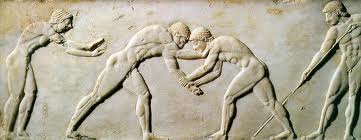
Wrestling was just eliminated from the 2020 Olympics by the International Olympic Committee.  What?  And golf and tennis are included?  Apparently wrestling was odd man out – 26 ‘core’ sports vying for 25 spots, and the criteria included things like television ratings, ticket sales, anti-doping policy and global participation and popularity.

wrestling

—>  Why should we care?  Why should the Olympics care?  The Olympic credo is ‘Citius, Altius, Fortius‘ –  Higher, Faster, Stronger – – and the Olympic brand had come to mean a way to settle the ancient traditional arguments about who’s the fastest man, who’s the strongest man, etc.  Over the years, the Games tried to hew closely to this idea, but inevitably had to adapt to survive, most importantly becoming gender-equal, but also bowing to media-driven economics by adding sports that would be unrecognizable to Baron de Coubertin (e.g. beach volleyball, BMX cycling) but that appeal to a target demo.  One of my earlier posts lamented the reinstatement of golf to the 2016 Games (it was an Olympic sport in 1904), because along with tennis, there are already ample opportunities annually to decide the top athletes in these sports, and that they would necessarily crowd out something else more worthy of the Olympic spotlight.

—> Wrestling is now just one of an at-large list of candidates including roller sports, sport climbing, wakeboarding and wushu that will apply for participation in 2020.

—> Perhaps we’ve reached a tipping point.  With this move, the meaning of the Olympic brand becomes less clear.  While it originated as the indisputable contest to crown the world’s best in the basic athletic skills for the following 4 years, as it gradually sheds its legacy and chases ratings, it now seems on its way to becoming another (albeit very large) global media/entertainment extravaganza.