Category Archives: Social Media

Top 10 2013 Mostly Accidental Marketing Lessons

This is the time of year where instead of being productive, people put together lists.
So here’s my look back at 10 events in 2013 that provided (purposely or not) great learning.

2013  Lesson 1:  Measure Twice, Cut Once.  Make that: Measure three times.
Healthcare.gov rollout
(honorable mention for Chicagoans:  Ventra public transit card rollout).
– So many lessons here.  It’s the lesson that keeps on giving.  Reminder: even if your brand isn’t one-sixth of the national economy you probably still want to test a new e-commerce site.  Test, test and then test again.

jon_stewart_obamacare

2013 Lesson 2: A brand CAN do a 180 in a Single Day 
Miley Cyrus
– And in this case it took about 5 minutes.  The recipe: take one tweens’ idol named Hannah Montana.  Remove most clothes, liberally add makeup, a big foam finger and nationally televised awards show; mix aggressively using the body and add a large dash of idiot grin.  Voila!  You’ve now transformed from Hannah Montana into what looks like the love child of Gene Simmons and Dita Von Teese, without the charm.
The winner:  probably Miley and her handlers, but hard to know yet.  The clear losers: Millions of formerly innocent Hannah fans.  Also, the general cultural level in the US.
So yes, it is possible to completely change your brand’s image in a day.  But it might involve twerking.

Hannah to Miley

2013 Lesson 3: There is such a thing as too much transparency
Lululemon
– Due to quality control snafus, Lululemon’s yoga pants delivered a little more than was supposed to meet the eye.  The media, always a model of sober restraint when it comes to high-minded topics like see-through clothing, did its best to spin this story as salaciously as possible.  Ultimately it went viral, resulting in loss of gobs of market value, as well as Lulu’s top management. At least they kept their sense of humor about it. (actually, there is a real lesson here: at the end of the day it’s about the product – and you can never take your eye off the ball).
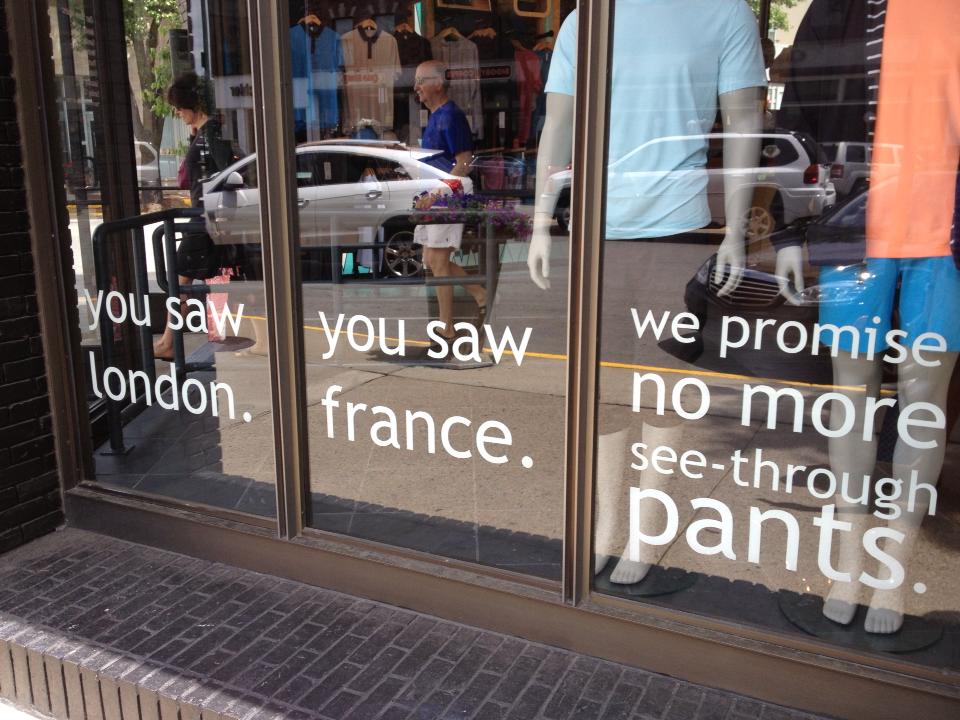
Lululemon Store Window

2013 Lesson 4:  The early bird still catches the worm – – if he tweets about it.
Oreo cookies
– We now live in an era that enables, and requires, real-time marketing.  As has been reviewed ad nauseam (guilty!), Oreo slam-dunked it with a timely tweet during the Super Bowl blackout.  Meanwhile, given the opportunity of Marco Rubio’s magic cotton-mouth TV moment, the Poland Spring ad team not only didn’t stick the dive, they missed the pool entirely.

oreo-super-bowl-tweetMarco Rubio drink

2013 Lesson 5:  When life gives you lemons, make lemonade.  When your meatball supplier tries to slip you some horsemeat, clean house IMMEDIATELY.
IKEA
– When IKEA learned that some of its famous meatballs (150 million annually!) might contain traces of horsemeat, it immediately got rid of all meatballs in inventory, whether suspect or not.  Cost of write-off?  Probably pretty high.  Benefit to reputation by immediately taking action?  Priceless.  Sales of meatballs since then?  UP.
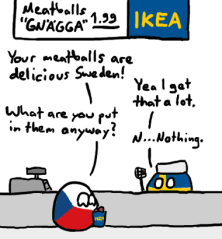
IKEA meatballs

2013 Lesson 6:  Hint: ‘Fail Fast’ is really just a euphemism for Test and Learn.  It doesn’t mean your goal is actually to fail fast.
JC Penney
– Here is a retailer that tried to do a 180 without twerking.  Or more importantly, without considering that its customers preferred periodic discounts.  Boom.
Easier to adapt to customer preferences than to try to force them to adapt to you.

jcpenneymadnessJCP quarterly

2013 Lesson 7:  There is No Such Thing as Bad PR (at least for Jeff Bezos)
Amazon
– Amazon’s eerie delivery drones cleverly debuted on ’60 Minutes’ the day before Cyber Monday.  Never mind that if you give it about 5 seconds’ thought, the barriers are significant (snow? wind? power lines? privacy issues? teen boys with slingshots?) – what it really shows is that in addition to any product you can think of, Amazon’s mission apparently also includes delivering PR to all homes.

Amazon drone

2013 Lesson 8:  If you go for the ‘wink-wink, joke’s on me’ approach, and people don’t get it, then ‘wink-wink, the joke’s on you’.
Honda/Michael Bolton Holiday campaign
– If you didn’t see them, these spots feature the man of the strained tenor and shorn mullet singing soulful holiday-esque tunes from atop a Honda, next to a Honda, in a Honda showroom, behind a piano, behind a guitar, all to the indecipherable reactions of surprised, baffled, younger presumed car shoppers.  It’s difficult to tell what the point is.  The obvious assumption is that this is a quid pro quo: the 60-year old Bolton (perfect for a younger target!) has a new album that needs promoting (true) and Honda needs some breakthrough quality in the holiday car ad environment that generally features obnoxiously gift-wrapped luxury cars (true again).
But what’s Bolton doing up there on that car?  Apparently, according to Adweek, this campaign is ‘poking fun at itself with melodramatic guitar solos and idiotic lyrical gems like “This special time of year, it’s filled with joy and cheer, for me and you and you and you, too’.”  Well, I know something about misplaced melodrama and idiot lyrics and I didn’t catch it.  If there’s a wink in there somewhere, it’s subtle enough as to be invisible.
So we’re left with a spot with bland cars, being promoted by bland music – – a perfect match, but I suspect probably not what they were going for.
The American public as a rule doesn’t respond well to ‘subtle.’   Witness, if you will, Ron Burgundy for Dodge – – a more effective celebrity hookup.

Bolton on car

2013 Lesson 9:  When in Rome, do as the Romans do.  When trying to break into Southern California, and your name contains the word ‘Fresh’, don’t pre-wrap the fruits and vegetables.
Tesco Fresh & Easy
– This one already has a coda. Big UK retailer Tesco created its Fresh & Easy chain in late 2007 to penetrate the Western US market with a fresh new smaller format store, famously after significant consumer research.  The experiment failed when consumers didn’t respond well to new formats, new food presentation, and in some cases, truly foreign concepts.  Ultimately F&E was sold to Yucaipa, which has added “competitive pricing, improved hours, fresher foods and assisted checkout” according to management.  Everything, it appears, has been changed except the name.
– The obvious lesson – – listen to your customers (see Lesson 6).
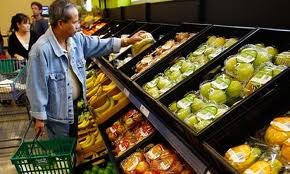
fresh and easy vegetables

2013 Lesson 10:  You can say Social Media and B2B Marketing in the same sentence
Maersk Shipping
– Maybe it’s the exotic locations where its ships are shown.  Or maybe it’s just the fact that deep down we’re all little kids and are awed by really cool big boats.  Whatever the appeal, big freight shipper Maersk found a way to go from zero to one million+ in Facebook likes in about a year (good Forbes article here).  Of course, no one places container orders on a Facebook page, but for very little cost (repurposing archival company photos) this enhances the Maersk brand, distances it a bit from its competitors, and likely provides meaningful recruiting and morale benefits.
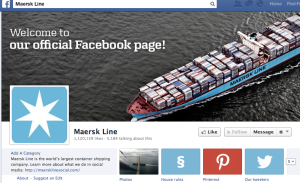
Maersk Facebook

Probably the big lesson for 2013 has been that while many old conventions are being challenged (e.g. static campaigns, role of social media), the key marketing fundamentals are still alive and well:  understanding your customers and their needs is the surest way to success (or at least avoiding being in next year’s write-up).

Happy New Year.

United Airlines, Mom’s Missing Jewelry, and the Asymmetry of Customer Feedback

Dad used to say “If you don’t have anything nice to say, don’t say it”.  Mom prefers the double-positive version.

What if people spent the same energy to praise good deeds as they do publicly complaining?

woman-wagging-finger

Someone rub you the wrong way?  Got your knickers in a knot?  Well, post it somewhere and see if you can get it to go viral.

It’s easy to rage publicly over real or perceived slights.  We can turn millions against a company, deserved or not, while we bloviate in anonymity with no repercussions.  It’s like punching the schoolyard bully in the face remotely from your basement. And generally, it’s how a lot of people tend to roll.

Well, sometimes companies actually do good things due to someone’s actions; unfortunately people seem to be less motivated to share when things turn out well – – isn’t that what we’re entitled to? – – so you’re not likely to hear about it.  And so the story of United Airlines, my mom and the lost jewelry.  But first a quick bit of context.

Remember the ‘United Broke My Guitar’ guy?  Back in 2009 United Airlines broke his guitar and refused to compensate him for it.  In frustration, he posted a song on YouTube (13 million hits), wrote a book, and became something of a travelers’ cause célèbre.  Ultimately, of course, United realized it had screwed up, rightfully made him whole, and learned a painful lesson about ‘an ounce of medicine’ or something like that.

This weekend my 82 year old mother flew into town and discovered she had lost her jewelry bag.  On her return trip, since she of course gets to the airport 4 hours early, she had time to check United lost & found.  Lo and behold, not only did United have it, but the jewelry bag was immediately returned to her, intact and untouched!

Blue Jewelry Bag

It apparently had slipped out of her bag in the overhead compartment on the way over.  This means not only did all the passengers, staff, and cleaning crew ignore a temptation, but somehow THE SYSTEM WORKED:  It found its way to Lost and Found, was properly coded into the system, and a United representative was actually able and willing to locate it and immediately give it back to its owner.  Wow.

I don’t know about you, but I lose more than my fair share of things and I NEVER get anything back.  And this was a jewelry bag within a complex system with thousands of flights and hundreds of thousands of passengers daily.  (Full disclosure:  it was costume jewelry – – Mom’s been to the rodeo a few times – – but they didn’t know that).

This must happen with some regularity.  So why don’t you generally see companies praised publicly for excellent customer service?  Mom has been a professional pianist for over 60 years and is in fair voice, so she could do her version of Guitar Guy on YouTube, but she has a full schedule of 35 students a week and like all of us, is too busy.

I also suspect that praising a big company just isn’t cool; you’re not sticking it to the Man when you say something positive.  This will be just one of many transactions of this United representative, the majority of which likely won’t have as happy an ending.  And that’s too bad.

AirlineAgent2

Maybe the readers of this post could forward it to a few people as a reminder that sometimes good things happen because someone gave extra effort, and that it wouldn’t be so bad to send out an Attaboy once in a while.   See if you can get it picked up.  You might just make someone’s day.  Here’s a little primer on how to get started.

Butterfly Bakery: Heading back into the cocoon

Today’s news brings us the cautionary tale of Butterfly Bakery, which is no doubt trying to find a cocoon to hide in after an onslaught of mostly self-inflicted pain.  This is primarily a lesson on the importance of transparency, authenticity and speed in the age of 24/7 public scrutiny.

ht_butterfly_bakery_blueberry_muffins_nt_130314_wblog

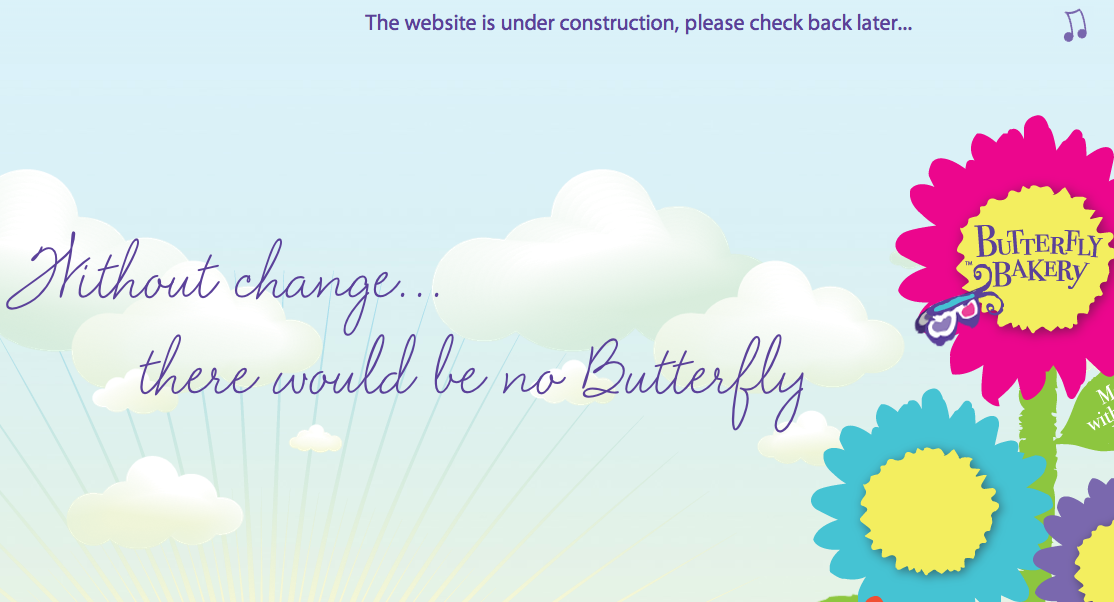
The short story:  Butterfly Bakery, a small Clifton, NJ baker of special baked goods (e.g. sugar-free, no sugar added, gluten-free, etc), is suffering through its 15 minutes of fame courtesy of the FDA, which forced it to close its doors after discovering that sugar and fat levels in several of its muffin and cookie products were well above what was claimed on the label.  Selected products had 3x the stated levels of sugar and 2x the indicated amount of fat.  This has led to some explanatory statements on the BB Facebook page and caused the charming looking website to be taken down.  The Twitter feed has also stopped.

ButterflyBakeryScreenShot

So — what’s the big deal?  Isn’t this just another case of the government unfairly picking on the little guys while ignoring ‘big business’?  After all, only 3 products of 45 were cited.

Well, yes and no — but mostly no.

– it turns out that the original FDA complaint is almost 2 years old, and that BB was well aware of the issues.  Here is an excerpt from their Facebook statement:  “Butterfly Bakery, Inc. acknowledges the claims in the FDA press release dated March 13, 2013. Butterfly Bakery voluntarily entered into a consent decree and has been working with the FDA and a team of technical and regulatory experts since May 31, 2011, to improve its processes and ensure compliance with all Butterfly Bakery products”. [bold added]

– May 2011?  Based on comments on their FB page, their customer base was clearly not aware of anything, and they are now suitably outraged.  2 years is plenty of time to reformulate, repackage, explain to customers, and flush out all inventory.  An FDA inquiry would seem to have been a strong hint to watch nutritional claims closely.

A matter of health – these products draw heavily from diabetics and celiac sufferers, for whom safe, tasty treats are often difficult to find.  BB’s products apparently tasted great, which is now not surprising since that’s largely what sugar and fat are for.  So whether intentional or not, BB enticed customers with better taste, while simultaneously putting them in danger because of misleading labeling.  This is not just a case of ‘I’m mad you didn’t tell me’, it’s a case of putting consumers at risk.

You never get a 2nd chance to make a first impression – – Butterfly Bakery has now gotten its first national publicity, which is hugely negative, and they will forever be associated with this scandal.  They will immediately forfeit retail distribution and may have trouble regaining it. But perhaps most importantly, they have violated the trust of their most important constituency – their customers, which may be impossible to restore.

Collateral damage – – other unrelated Butterfly Bakeries have already had to start issuing disclaimers that this doesn’t apply to them.  But clearly potential customers will have pause before buying from them.

The upshot:  Hindsight is 20/20, but Butterfly Bakery could have positioned themselves most positively back in 2011 if they had acknowledged some inaccuracies in labeling, offered refunds, and pledged to a new level of scrutiny.  They would have been seen as being committed to their customers.  Now the opposite is true, and their options are limited.  At least they have not made the mistake of trying to fight hand-to-hand on Facebook (see Applebee’s case).

Orapup — A newfangled innovation to tackle dog breath — and have fun doing it

Posted on

Orabrush is in the business of cleaning human tongues.  And they are growing their business by doing a fantastic job with their social media effort.  But this isn’t about Orabrush – it’s about Orapup – – a line extension designed for guys like Nigel – – and about how company assets can be creatively leveraged to create new revenue streams.

First, about Orabrush – – their marketing effort, like your breath should be after using their product, is fresh, cool and quite personal.  If you want a quick whiff, check out their website:  cheeky home-grown and user-generated videos featuring a guy who looks like Neil Patrick Harris (a zillion YouTube views), not so tongue-in-cheek product claims, and a lot of we-don’t-take-ourselves-too-seriously fun.  They have a counter of tongue brushes sold online; at the time of this writing it was at 2,982,076 – so if you were lucky, maybe you were able to watch it hit 3 million.

http://www.youtube.com/watch?feature=player_embedded&v=nFeb6YBftHE

So how does a company like this innovate?  Well, in some ways just what you’d expect; in others, the opposite.

They currently have a name, a product, a following, an online presence and retail distribution.  In coming up with Orapup, they certainly leveraged technology, their name, and their online fans (who suggested the product in the first place).  But because they can’t leverage a distribution system (Orabrush is not set up for pet channel distribution), rather than try to use media spending to first drive retail distribution for Orapup, they’ve done the reverse:  in-depth data analysis of focused online ads to tweak the marketing formula dynamically, then focusing local online media to efficiently drive sales where there is distribution, growing organically from there.  Ad Age did a good writeup; you can read it here.  Love their video (the first 15 seconds are worth the price of admission):

http://www.youtube.com/watch?feature=player_embedded&v=E96EbDtMptU

Orapup has taken a decidedly modern approach:  Crowdsourcing the idea, crowd funding (they raised an initial $60k and conducted research at the same time), generating buzz (and demand) by taking pre-orders online (they got 60,000 online orders to generate $750k revenue before shipping the first product), and THEN pulling the trigger on shipping product and driving retail distribution.  In this way, they’ve leveraged their loyal followers, created pent-up demand, covered some of the upfront investment, and delivered a product that has demonstrated demand.  All while mitigating the typical risks of a new product (stale product on shelves, etc.)

This is an excellent example of a few things:

‘Traditional’ marketing is an endangered species – – sometimes it’s best to avoid the tried and true – -marketers need to creatively leverage the evolving array of available resources and experiment with new approaches.

Empowering consumers to have a voice in product development can reduce development time/cost/risk (and avoid aimless R&D safaris) – – in addition to creating an enthusiastic group of advocates.

Let the numbers be your friend – – by constantly monitoring, analyzing and adjusting, marketers can optimize their marketing mix and quickly respond to marketplace changes

Orapup is a fun product that has extended the Orabrush franchise with low risk, manageable investment, and arguably a nice shot of positive buzz that is consistent with the overall fun brand persona.

It is a great example of how to creatively innovate.

Anheuser-Busch: Guilty until Proven Innocent?

Posted on

Was it just a few weeks ago that Maker’s Mark made headlines when it reversed its plan to reduce its alcohol level by 3%?  Well, now Anheuser-Busch is expending resources to deal with a similar product quality perception situation; the difference here is that this story is not of its own making (Maker’s Mark had announced a planned change before changing their minds).

Social media and 24/7 coverage have made companies’ reputations more at risk than ever — and while it can take as little as a few well-placed keystrokes to ignite a PR firestorm, it often costs much more to avert or manage a crisis.

A-B Beers

A series of class action lawsuits has been filed in several states, accusing A-B of adding water to 10 of its beers, lowering alcohol content to a level below what is claimed on the label.  The lawsuits are reportedly based on information from former employees at the company.

The now not-surprising effect has been widespread negative buzz for A-B, which they have had to deal with immediately.  So far, A-B has denounced the lawsuits in a statement and posted test results and notes to their customers on Facebook and Twitter, as well as a full-page ad that ran today in numerous large newspapers.

BudweiserFacebook2

BudweiserFacebookA-B Watered Down Beer Lawsuit.JPEG-02312

Even this modest level of expenditure is no small potatoes for an issue that may well be 100% unfounded.  In fact, other companies caught in the same situation have spent significantly to manage the message (Taco Bell spent millions in 2011 to tell its side of the story when accused of mislabeling beef content, a suit that was eventually dismissed).  In the current climate of ‘post first, ask questions later’, when caught in this sort of negative story, companies are often well-advised to react immediately and with strength – – regardless of what the facts may eventually bear out.  The alternative is to passively let the brand message be controlled by social media, which is not really an option.

These days, brands would be wise to budget some contingency funds to deal with the possibility of such a media-enabled drive-by.  In fact, it could be argued that Anheuser-Busch should be more aggressive now to get ahead of public perception.  It would not be surprising to see them dial up the spending in the near future.

Nigel has just very astutely asked me: what happens if they’re actually found guilty?  Well, if that happens, as Anheuser-Busch InBev has a market cap of around $150 billion, it wouldn’t be long before the company feels pain the billions rather than millions.  That’s the difference between being accused of doing something bad, and actually doing something bad.

Marco Rubio and the New Watergate: Missed Opportunity

These days it’s simply not good enough to have a token effort at social media – if you’re in, you need to be all-in.  A recent column by Kate McMahon on MorningNewsBeat (below) summarizes it nicely, using the recent case of Marco Rubio and comparing Poland Spring’s inaction to Kraft’s opportunistic action for Oreos during the Super Bowl (instantly creating and Tweeting a catchy message during the blackout).

MarcoRubioWater

Oreos Super Bowl

The new imperative is not just to manage your followers in real time, but to take advantage of the ability to jump on opportunities real-time, as they present themselves.  So there’s a defensive reason (manage potential crises proactively) and an offensive reason (take quick advantage of spontaneous good luck by leveraging through social media).

The full text and link to Kate’s commentary is below.  By they way, MNB is a great quick digest of a variety of consumer and retail issues, every day.

http://www.morningnewsbeat.com/Home/Home_S.las?Date=2013-02-20&Source=Newsletter&A=41188&C=#A41188

——————-

Kate’s Take: Drip, Drip, Drip

by Kate McMahon

Welcome to Watergate 2013.

We are referring, of course, to Florida Sen. Marco Rubio’s awkward lurch for a bottle of Poland Spring water and subsequent slurp during his Republican rebuttal to the president’s State of the Union address last week.

Within minutes the Twitter universe lit up with #watergate tweets, and social media watchers anxiously waited for Poland Spring to capitalize on its prime-time product placement moment.

And waited.

And waited.

Even Rubio himself good-naturedly tweeted a photo of an empty Poland Spring bottle right after the speech and has since parlayed his guzzle into a $125,000 boost to his campaign PAC coffers through the sale of Rubio water bottles (certainly abetted by a “Saturday Night Live” spoof).

But as the hours ticked by, and the gulp was replayed on newscasts, parodied on YouTube and the talk of Twitter, Poland Spring remained radio silent.

When contacted the next morning a spokesperson said: “I haven’t seen what’s going on on Twitter.”

Not an acceptable response, particularly for the top-selling spring water brand in America, owned by the multi-billion dollar international conglomerate Nestle.

And finally at 1:20 p.m. Poland Spring weighed in with a Facebook post showing a tiny Poland Spring bottle looking at its reflection in a mirror with the caption: “Reflecting on our cameo. What a night.”

Witty, yes, but way too late. The headlines that followed shouted “squandered,” “missed opportunity” and “fumbled.” The Huffington Postcompared the 14-hour lag to “roughly 14 years in social media time.”

Turns out Poland Spring stopped posting on its two Twitter accounts as of July 2010 and January 2011, respectively. Really?

The lead-footed response had the bad luck to follow a timely moment of social media marketing by Oreo during the Super Bowl blackout. Oreo was already in the game with a commercial, but tweeted “Power Out? No Problem” and a picture of an Oreo with the caption “You can always dunk in the dark.”

(Tide also sent out a tweet saying “We can’t get your blackout. But we can get your stains out” and Walgreen’s chimed in with “We do carry candles” but it was Oreo that got all the attention.)

In fact, the Oreo tweet was retweeted 10,000 times in one hour and lauded as the advertising winner of the night.

And it illustrates the phenomenon that major nationally televised events are essentially “two screen experiences” – what people are watching and what they are tweeting simultaneously.

Since Oreo had a commercial airing during the Super Bowl, cookie execs and its ad agency team had gathered in a “mission control center” to watch the game and monitor social media channels.

With all the key players on hand, they were able to design – and get approval for – a witty graphic within minutes.

Granted, Oreo had a multi-million dollar investment in the Super Bowl telecast and Poland Spring had no way of knowing its product would capture the nation’s attention, thanks to a parched freshman Republican from Florida.

But the two cases illustrate that real-time interaction with consumers on social media is dictating the discussion. If you aren’t prepared to join in, you will find yourself left high and dry. 

Comments? Send me an email at kate@morningnewsbeat.com .