Category Archives: Product Management

Shoes, Elephants and Michelangelo

A famous and probably apocryphal story relates how in the late 1800s, shoe companies sent scouts to Africa to assess opportunity. All came back and said: “no one in Africa wears shoes – – there is no opportunity” – except for the rep for Bata, who said: “everyone in Africa is barefoot – – there’s a huge opportunity”. Bata shoes are now ubiquitous in Africa.

Bata1

With its vast population, diversity and resources, why aren’t more companies committed to growth from Africa? Why do EMEA business strategies have no patience for the ‘A’? Certainly with that many people, shouldn’t African commerce, like life in Jeff Goldblum’s Jurassic Park quote, “find a way?”

The challenge is daunting, and figuring this one out is above my pay grade, but thinking about solving for Africa can make just about any other challenge seem pretty straightforward.

africa

There are of course very real reasons that Africa is challenging. A Sept 16 scan of Google News stories across 54 African nations (below), reveals overwhelming existential crises such as Ebola, terrorism, sectarian violence, mixed in with a standard dose of President-for-life type scandal (see: Mugabe, Robert), but not many commercial or consumer focused stories. Where much of the developed world has surplus calories, Africa has a basic food (and water) deficit. A quick look at per-capita incomes shows that African citizens are among the poorest in the world. Barriers, indeed.

Yet we are all still more alike than we are different. We all have needs: food, shelter, entertainment, and yes, shoes.  And so within a mass of challenges, there are opportunities.  Bata figured this out long ago – – it saw millions of bare feet, rather than cultural or economic barriers, and methodically penetrated the continent.

The key, as in eating an elephant, is to take it one bite at a time.  In fact, it’s really just another execution of basic marketing – identifying segments, understanding their needs and barriers, and creatively and selectively applying solutions.  Pricing? Access? Promotion? Distribution? Positioning? Unique benefits?  A solution is almost always available – it’s just not always obvious.EatingAnElephant Unlocking this potential may be gaining traction: PricewaterhouseCoopers’s Africa Business Agenda 2014 report was released last week.  The report, comprising surveys and interviews with 260 chief executives in 14 African countries, indicates that CEOs are optimistic about growth despite volatility and uncertainty on the continent.  From Business Report/Africa: “The Chief Executives acknowledge that a lot more needs to be done in terms of transforming the continent’s potential for exponential growth into tangible business opportunities”. There are examples where creative and focused approaches helped realize growth from similarly unlikely places.

  • In India, Colgate has carved out over 55% of the oral care market (~$600 million+) despite toothpaste penetration of only 55% (and only 15% of them brush twice daily), and a per-capita income ranked 120 of 164 countries in 2013 (World Bank).
    • This was done by offering more affordable sizes, and innovating a multi-layer distribution system to penetrate the largely rural population
  • In Mexico, concrete giant Cemex, through its Patrimonio Hoy (‘Private Property Today’) program, has enabled many low-income families to build onto their homes on an installment plan at affordable levels.
    • For example, in this innovative program, one family pays $18 per month for $960 in construction materials, allowing them to add stepwise onto their home.

Whether it is Africa, India or a mass of consumers (or customers) at home, the same principles apply.  Where there is need, solutions are always possible.

Michelangelo

As Michelangelo said: “Every block of stone has a statue inside it and it is the task of the sculptor to discover it”.

-0-0-0-0-0-0-0-0-0-0-0-0-0-0-0-0-0-0-0-0-0-0-0-0-0-0-0-0-

A Day In The Life of Africa – September 16, 2014

Country                                              Story 1                                        Story 2
Algeria                                                al Qaeda                                        Soccer
Angola                                                Sub-Saharan investment             Oil Exploration
Benin                                                  Ebola                                             Trade
Botswana                                           Crackdown on press                     Ebola
Burkina Faso                                      Soccer                                          Trade
Burundi                                              3 nuns murdered                             —
Cameroon                                          Soccer                                            —
Cape Verde                                        Soccer                                         Tropical storm
Central African Republic                 Muslim-Christian violence              —
Chad                                                  Guys named Chad                         —
Comoros                                            Islamic oil deal                   Indian Ocean Comm.
Dem. Rep. of the Congo                    Ebola                                          Mineral dev.
Djibouti                                               al Qaeda                                     Violence
Egypt                                                Fighting Islam                          Muslim B’hood exiles
Equatorial Guinea                           UN Ambass. accused          Call for national unity
Eritrea                                             Leather export trade                   US travel warning
Ethiopia                                           Relations with Egypt                   Egypt opposition
Gabon                                                Soccer                                            —
Gambia                                              Anti-gay legislation                       Ebola
Ghana                                                Ebola                                           Soccer
Guinea                                               Corruption                                    Ebola
Guinea-Bissau                                   Ebola                                           Political instability
Ivory Coast                                        Soccer                                             —
Kenya                                                Cost of living                          Investment/trade
Lesotho                                             Coup attempt                                   —
Liberia                                               Ebola                                                —
Libya                                                 Migrant boat capsizes                    Islamic terrorists
Madagascar                                      Lemurs                                            Locust infestation
Malawi                                               Political scandal                              Soccer
Mali                                                    al Qaeda                                          Sectarian violence
Mauritania                                          Moving weekend to Fri/Sat              Business/trade
Mauritius                                            Foreign investment                          Murder invest.
Morocco                                            Anti-racism demonstrations                —
Mozambique                                      Elephant poaching                           Political rivals
Namibia                                              Foreign trade                                    —
Niger                                                  US drone base                                 Baby trafficking
Nigeria                                               Building collapse                              Ebola
Rep. of the Congo                           Ebola                                              Political corruption
Rwanda                                             Genocide 20th anniv.                Rebuilding efforts
São Tomé and Príncipe                     Infrastructure dev.              New: cellular roaming
Senegal                                             Ebola                                               Soccer
Seychelles                                         Tourism                                            Protected species
Sierra Leone                                      Ebola                                                —
Somalia                                              anti-al Qaeda/ISIS                           anti-Shebab
South Africa                                       Pistorius trial                                    Rugby
South Sudan                                      Foreign aid worker ban            Internal peace
Sudan                                                Condemned Christ. woman         Peace with S. Sudan
Swaziland                                          UK power investment           Royal family antics
Tanzania                                            Foreign investment                       Infrastructure
Togo                                                  Qatar investment                          Soccer
Tunisia                                               Economic pressure                         Security
Uganda                                              Foiled terrorist attack               US warns Americans
Zambia                                              Political leader dies                          Soccer
Zimbabwe                                         $3B mining deal w/Russia                  —

Top 5 Observations! – National Restaurant Show (Part 2)

Posted on

This is part 2 of coverage of the 2014 National Restaurant Association show – too much great stuff to fit into one post.

Screen Shot 2014-05-23 at 3.32.59 PM

I’ve ranked my top 10 observations; this post features my Top 5.

(If you missed my previous post, you can see #6-10 here).

Again, all links are live so please click through with abandon.

OBSERVATION #5.  School Lunch is a Battleground.

Remember when school lunch was a PBJ, apple and Twinkie in a paper bag or Superman lunchbox? How many ways would that not work now?

Two trends are making school lunch planning fiendishly difficult.

A) FLOTUS Michelle Obama’s Healthy, Hunger-Free Kids Act of 2010 sets limits for sodium, fat, sugar and calories, among other things.
– What’s happened is that compliant healthy meals are often too skimpy (or not tasty), kids are not eating them, and some schools are dropping out because they are losing money (even with subsidies).

Check out these funny-yet-sad tweets from kids complaining about their lunch offering:

Screen Shot 2014-05-23 at 3.22.14 PM

B) Separately, allergens (like nuts) are becoming more of a center of the plate issue.

The result of all this is that there were numerous products specifically positioned as not only allergen-free, but also satisfying the school lunch nutritional requirements.

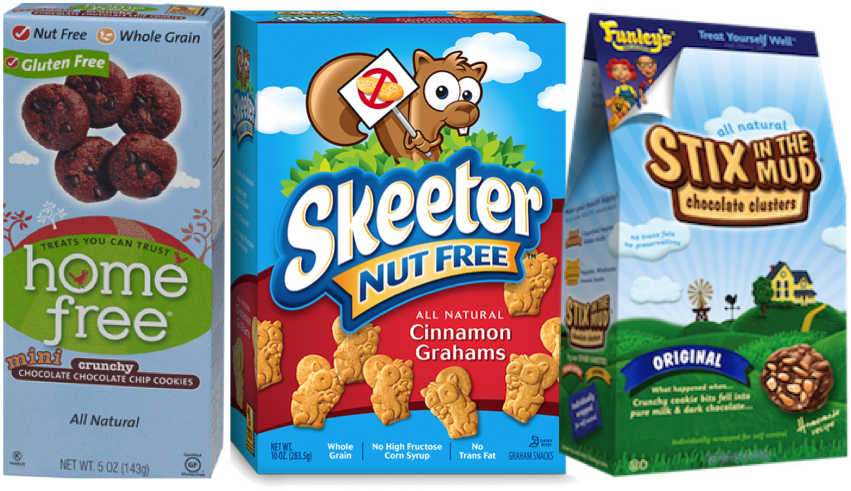
Home Free, Skeeter and Funley’s are on the market touting such mouth-watering claims as ‘Nut Free’, ‘School Compliant’ and ‘Gluten Free’ and other ‘free-from’ things.   Which is a shame, because beneath those claims they all tasted really good – a message that seemed somehow forced into 2nd place.

Cookies

Separately, organizations like Wholesome Tummies are offering alternative programs providing ‘fresh, nutritious and exciting foods’.

There were a lot of school nutritionists asking lots of questions.  And ultimately the market will decide.


OBSERVATION #4.  Liquor-flavored meat.

With these two manly ingredients, how could you lose? There were quite a few examples of meat flavored with some sort of macho alcohol. We’ve seen things like Jack Daniel’s barbecue sauce for years, but these examples had the flavor infused into the meat.

A few examples:
Family Brands has just introduced meat products infused with Ole Smoky White Lightnin’ Tennessee Moonshine. You can get pulled pork, sausage and other products flavored with with regular, apple pie or other moonshines. They taste great, but don’t overdo it – – you may get Dukes of Hazzard flashbacks.

OleSmoky

– Over at Zoe’s Meats, they’re offering Ghost Pepper Salami with tequila

– And my friends at Kronos Foods were sampling their brand-new Beer Can Chicken, which I can testify is better than anything I get from my smoker.  Perhaps one reason is that they use PBA (Premium Brown Ale), while I use PBR.

OBSERVATION #3.  Food Trucks Mainstreamed.

Food trucks have long been thought by some of as being on the funky fringe of foodservice, operating from recycled ice cream trucks. Well, this year served notice that food trucks are now driving right down the middle of the road.

FoodTruck

FoodTruckInt

Several companies offered custom foodservice trucks, built to spec and coming in at around $150,000. These are impressive, well-equipped, heavy duty vehicles specially built to bring the finest cuisines right to your doorstep.

At that point, whether you go for kimchi, po’ boy, pupusas or paletas is entirely up to you.


OBSERVATION #2 – RUNNER-UP:  Kallpod.  ‘What’, you say?

How many times have you had an otherwise great meal spoiled by:
– waiting for a refill on your drink
– waiting for your check
– otherwise having your server disappear into the ether never to be seen again

Well, this tech innovation gets super-high marks because it focuses on diner satisfaction.   What a concept.

The best analogy for Kallpod is the ‘Call Attendant’ button in an airplane – – only in this case it’s on your restaurant table and it’s wirelessly connected to a special Dick Tracy-like device that your server wears.

Kallpod

The concept is simple: you hit a button (refill, check please, etc) and your server gets a small vibration/shock and message like ‘check, table #8’. How great is that?  Awesome, although possibly less so if you’re a server, I suppose.

Reminds me a little of the Burger King Subservient Chicken that was compelled to respond to commands from strangers (shown in redemption video here):

http://adage.com/article/news/burger-king-s-subservient-chicken-video/292953/

So Kallpod offers something for everyone:

– Diners get quicker, better service and for a select few, the opportunity to indulge hidden sadistic tendencies
– Operators convert more drink requests, and can turn tables more quickly
– Servers get the opportunity to see their guests more, and for a select few, the opportunity to indulge hidden masochistic tendencies.

Kidding aside, this is a palm-to-forehead great idea, well executed.


And the winning #1 observation at this year’s NRA is:  SCHMACON!  

Yes, Schmacon. It’s not a trend or even a fad, it’s the sort of cosmic occurrence that we unfortunately see all too infrequently in our short time here on this mortal coil.

Schmacon2

My first minutes at NRA, at 9am, took me directly into the olfactory territory that the modest Schmacon booth was invisibly marking.

Schmacon is ‘smoked and cured glazed beef slices’ , but think of it as beef bacon, which by one account tastes like ‘crispy glazed pastrami’ (thanks Kevin Pang). By all accounts it is delicious, as demonstrated by the growing line for samples (of which I had two, for research purposes).

In addition, it is lower in calories, fat and sodium than traditional bacon.  A bit ironically, it is not pork but neither is it kosher.  But who are we to quibble about a technicality?

Schmacon is from Schmaltz Products in the Chicago area – a company with a funny name, but serious deli DNA.

Schmacon was a Food & Beverage 2014 award-winner.  I took home Schmacon literature and a scratch ‘n sniff button to remind me of my experience.  It’s mostly just for foodservice now, but you can taste it for yourself when it hits retail shelves later in the year.

———–

So that’s it for the Top 10.  I do have some Honorable Mentions directly below:

Ice Beer.  Basically a beer slurpee, complete with alcohol.

IceBeer


Nutella Poppers.  Like little chocolate beignets – awesome (and proof that carbs are alive and well)

Carbs!


Neat meat replacements.  Mixes made from nuts, beans, grains and other ingredients.  Really tasty with great texture.

Neat

Poppies Dough.  Terrific products (but I’d be lying if I didn’t say I had a little Seinfeld moment…)

Poppies


Outrage at New Corporate Average Calorie Count Mandate: What took so long?

Posted on

After over a year, the food industry has finally begun to voice frustration with the upcoming Corporate Average Calorie Count (CACC) requirements that were a little-noticed insertion in the recently implemented Affordable Care Act.

Like it or not, this law has been on the books for over a year – – why the sudden passive-aggressive reaction?

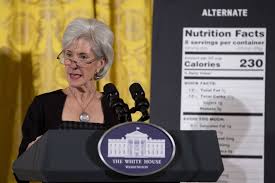
Like Big Auto’s Corporate Average Fuel Economy (CAFE) standards, CACC requires all US-based food and beverage manufacturers making over 20 products to average at or below 100 calories-per-serving for all processed products by 2019.   While CAFE uses a sales-weighted mean, CACC counts all products equally.  “We decided to use a simpler approach that everyone – consumers, manufacturers, retailers – – and Congress – – could understand”, said HHS Secretary Kathleen Sebelius (who knows a thing or two about the importance of simplicity). Sebelius-calories

Companies need to submit CACC plans by the end of 2014, with final compliance targeted by 2019.  Excluded are imported products, unprocessed foods, dairy, ‘ingredient’ foods like peanut butter or oil, alcoholic beverages and products sold through foodservice, vending and convenience channels (although vending machines are impacted by the same provision in ACA and have to post calorie counts by the end of 2014) .  Companies not meeting standards will face penalties of $1,000 per calorie above the target level, multiplied by each $1 million of revenue of that company. ACA-Vending

Food manufacturers are just now starting to realize the size of the challenge.  “CACC creates significant costs for manufacturers, a huge compliance burden, and most importantly, is likely to remove choice and impact taste for consumers,” said Lloyd Braun, CEO of Peterman Bakeries of Omaha, NE.  “If it’s difficult for a smaller producer like us, it could be almost impossible for the Krafts and Pepsis of the world”.

Indeed, meeting the standard will be tough.  We took a look at PepsiCo to see what they are facing.

According to its websites, PepsiCo sells 1327 products across its Pepsi, Frito-Lay and Quaker businesses (not counting Tropicana).  Its Corporate Average Calorie Count now stands at 118.2, with beverages actually close to the standard at 102.6, brought up by Frito-Lay at 137.9 and Quaker at 150.7 (click on chart).

PepsiCo-Calories

To meet the 100 calorie corporate goal, PepsiCo will likely need a combination of reformulation, elimination of higher-calorie offerings, and addition of lower-calorie offerings.  This could mean fewer products like Grandma’s Cookies (210 calories), Quaker Breakfast Cookies (175) and Starbucks Frappuccino (290) and more like Rice Cakes (35), Matador Jerky (75) and lots more AMP Sugar-free Energy Drinks (15).  Happily, Quaker’s Quisp cereal checks in at an even 100 calories and thus seems safe.

As difficult as this current Pepsi Challenge is, they at least have the benefit of a large number of products (and frankly, a couple of large subsidiaries) to work with.  The CACC mandate could be terminal for those companies specializing in more indulgent fare, such as frozen pizza (285), fettucine alfredo (415) and Garrett’s Gingerbread CaramelCrisp Popcorn (300).

Still, the angst is real: A source inside PepsiCo explained: “We thought we had done our part by helping reduce Americans’ calorie intake by 6.4 trillion calories as part of the 2010 Healthy Weight Commitment Foundation initiative – – we are now quite frustrated that the current Administration is piling on with these new requirements. So frankly, not much work has been done yet”.

Well, it’s time to stop whining and get to work.   ACA is not going away, and your country is depending on you.

Is soup good food? Hard to tell sometimes.

Next to perennial diet enemies fat and sugar, sodium has never gotten much respect — probably because overconsumption of sodium doesn’t lead to a spare tire or other jiggling parts.  But too much sodium does contribute to heart disease and high blood pressure, and sodium reduction is now hitting the mainstream.  How do we know this?  Because the lawyers have gotten involved.

The Campbell Soup Company was recently hit with a lawsuit claiming that some of its Healthy Request soups contain too much sodium, despite a ‘Heart-Check’ endorsement from the American Heart Association (seen mostly on Campbell’s website), implying that Campbell’s is in the tank with the AHA (read: payola).

AHA Heart Check Logo

AHA Heart Check Mark

This is a case where technically Campbell seems to meet the AHA criteria, but where the consumer perception of benefit is probably greater than reality.   Which means it cannot be a permanent solution.

The market will ultimately choose an approach that combines great taste, reasonable sodium levels, and some way to convey these benefits without implying a taste tradeoff.  Not easy, but it’s happened before (trans-fats) and as awareness of sodium dangers gain visibility, a tipping point is inevitable.

Campbell's Healthy Request Soups

Campbell’s Healthy Request Soups

A quick fact-check:

–       To get the Heart-Check seal, a product must contain (among other things) no more than 480 milligrams of sodium per serving.

  • Never mind that the AHA advocates just 1500 mg per day of sodium, and that it classifies ‘low sodium’ as 150 mg or less per serving.  It’s their seal and they can do what they want with it.

AHA Heart Check Nutritionals

–       A typical serving of Campbell Healthy Request soup has around 400 mg, which clearly fits the guideline.

Campbell HR ChickenNoodle Nutritionals

Case closed?

Well, yes and no – each can has between 2 and 2.5 servings.  And according to a recent survey, over 60% of consumers would eat a whole can at a sitting.  Meaning the real sodium intake of just one soup experience could be 800-1000mg or more.  Which wouldn’t seem to be too helpful in reducing the current American average intake of 3500mg/day to a commonly held target of 1500-2300mg.

–       So there’s a fair argument that advertising as ostensibly ‘Heart Healthy’ is misleading.

–       Considering that 75% or more of sodium intake is through processed foods, this sets an unhealthy precedent for using an association endorsement to market foods with healthy benefits.  Americans can’t effect enough change with the salt shaker – it’s largely up to manufacturers to supply solutions.

Campbell has had its own corporate struggle with sodium.  In 2010 it announced significant sodium reduction in many of its soups, only to reverse course in 2011 when sales declined.   As Campbell is a public company, and is in business to make profits, it has justification in responding to marketplace demand.

Consumers care about sodium intake, but they care about taste more.  So it seems that using sodium reduction as a mainstream messaging effort will be very challenging, as ‘reduced sodium’ translates for most people to ‘bland as cardboard’.

A more appropriate approach going forward might want to include the following steps:

1) Continued formulation to deliver reduced sodium with great taste.  There are some great new salt alternatives available that should make this possible.

2) Use a so-called ‘stealth’ approach to reduce sodium gradually, and enable consumers to adjust their palates’ expectations over time.   With less salt, over time, Americans might even be able to taste the delicate and sophisticated flavor nuances that exist in most processed foods. (the thyme!  the basil!  the hydrolyzed corn protein!)

3) Continue the use of benefit-focused claims (along the lines of ‘heart healthy’), as opposed to ‘less of’ formulation claims (e.g. ‘reduced sodium’) – this is one of the only ways to convey ‘good for you’ and ‘good tasting’ at the same time.

Long-term, whether carrying an endorsement or not, manufacturers will need to make sure that sodium reductions are real and truly help the consumer –  and that the product tastes great.

But as it becomes easier for consumers to check nutritionals while shopping, the bar will inevitably be raised for both manufacturers and associations seeking an endorsement relationship.

Relaunching Twinkies – – Attempting Marketing Alchemy?*

Posted on

*Alchemy: “A process by which paradoxical results are achieved or incompatible elements combined with no obvious rational explanation.”  Source:  The Internet

You may have heard that Twinkies are now available again.

NewTwinkies

New Twinkies Collector’s Edition Package

In the spirit of ‘don’t waste a good crisis’, post-bankruptcy, union-free Twinkies management is aggressively marketing the product at relaunch, including PR, a billboard in Times Square, social media, retail presence, and an increased shelf life to 45 days, from 26 previously. (yikes!)

However, they are attempting an extremely difficult balancing act: adjusting enough to develop a new franchise, while simultaneously not alienating the current customer base.  This is a tightrope walk at best; there may be actually no way to serve these two masters with one product.  Twinkies may be trapped in a box.

Pulling this off, based on what’s already been tried in the past, would be a huge success.

As everyone knows, with one ‘Twinky’ containing 150 junk calories and 2.5g of saturated fat (13% of the recommended daily intake), this iconic brand had become out of step with current food trends.  And that’s not to mention 30+ ingredients.

Twinkies ingredients

What’s a Twinkie really made of?

Twinkies had actually achieved some level of cult status for its indestructibility, celebrated in (among other things) a 2012 Super Bowl Chevy Silverado ad.

chevy-super-bowl-blog480

Surviving the Apocalypse – 2012 Chevy Super Bowl Ad

So with much fanfare Twinkies is now relaunching, but long-term growth will still depend on either getting current older consumers to buy more, or getting new younger consumers to buy.  Or some combination.  There’s no other way.  And therein lies the rub.

Is it possible to keep the core elements consistent enough to satisfy the loyalists, while at the same time changing enough to appeal to a new crop of consumers?  Difficult.  New Coke of course comes to mind, as does JC Penney.

Further, this was a product that was off the shelves for a year or so while competitive ersatz Twinkies (now there’s a concept) chased some of the unmet demand.  So it would appear that they have their work cut out for them.

Can they pull it off?  Some clues may come from the new owners (Metropolous brothers) from an interview in March 2013 (my interpretation):
– statement that the brand is bullet-proof (“cannot be killed“)
– confidence that core consumers have high loyalty and can be kept while new ones added (through viral and other guerrilla marketing)
– goal to leverage “younger hipster consumers”…who are “on the pulse of what’s trend-setting
– focus on merchandising and retail execution – with separate grocery and convenience strategies
– willingness to play with the core formula (e.g. the shelf-life extension)
– expectation that product innovation will help grow the business going forward
– statement about cost savings, not being “slowed down with analytics or bureaucracy

TwinkiesExtensions2

Twinkies Historical Line Extensions

I respect the ambition and energy of the new owners.  However, I will hold to my comment about 6 months ago:  despite the incredible publicity, it may be difficult to achieve much upside.).  There is nothing obvious in what we’ve seen so far to support a turnaround, and in fact there may be a few areas of concern:
– focusing on retail blocking and tackling is an excellent move and should yield good results – for the current product
brand awareness is not the same as brand elasticity.  And affection doesn’t necessarily translate to purchase.  Many of us fondly remember the Good Humor bars of our youth.  Do you have any in your freezer right now?
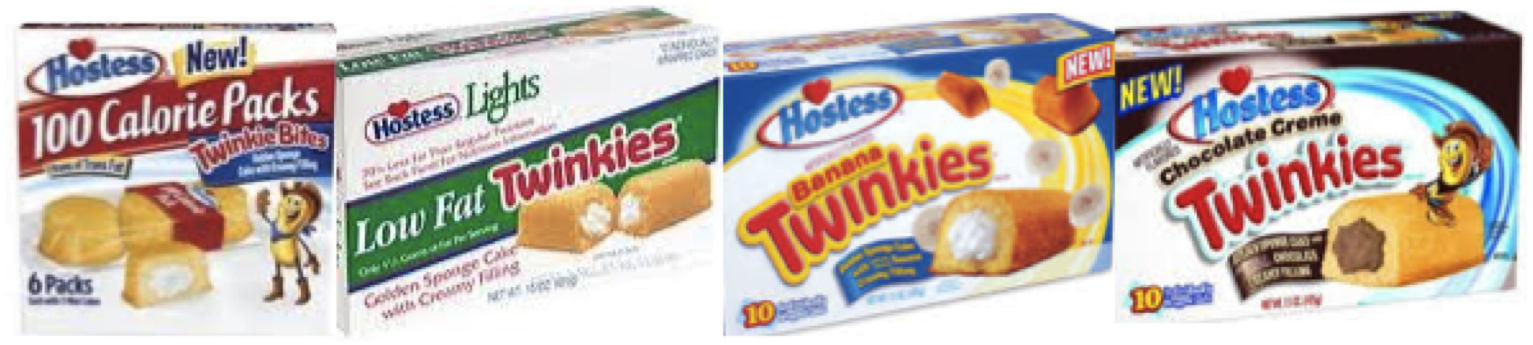
innovating an iconic product may not be that easy – – this is a product with just one proven form. Former management unsuccessfully introduced 100-calorie packs, low-fat, banana and chocolate creme versions.  So extending the Twinkies brand is not exactly an original idea.
willingness to change the original product – – they’re already smaller.  What’s next? Take away a man’s Polysorbate 60 and there could be hell to pay.

Net, we wish new management luck – – it would be great to have Twinkies always within arm’s reach.  But attempting to deliver on two strategies with a single product is a tall order.

Product Life Cycle Management: What do a cyclist, a horsewoman and NutraSweet have in common?

No, this is not a joke.  So what do they have in common?   Answer: a strategy that focused on optimizing profits in the moment.  At least one had a thought-out exit strategy.  Can you guess which one?

There is a lesson here about understanding your product’s practical lifespan.

Let’s examine the players.

The Cyclist — Lance Armstrong

By now we’re all very familiar with Lance’s story – – cancer survivor, fundraiser extraordinaire (almost $500 million), of course winner of 7 Tour de France titles, since vacated due to his now-confessed use of PEDs.  Ironically, prior to his cycling fame, Armstrong was a world-class teenage triathloner, and if he had remained clean it’s likely he would still have been world class in triathlon or cycling.  Of course, now we’ll never know.

Young Lance

The relevance?  Post-cancer (and by some accounts before), Armstrong decided that he would pursue world cycling dominance at all costs.  Success required use of PEDs, intimidation of colleagues, and repeated lying.  But during that time, it paid off handsomely — Armstrong was estimated to have earned $20-30 million annually during the roughly 10 years that he dominated, so perhaps $300 million, not counting the fame and celebrity.  His worth is currently estimated at $125 million.

Lance A Foundation

The exit strategy?  Whether Armstrong expected this ride to end well is unknown; increasingly it seems that he didn’t actually give much thought to his exit strategy and in fact just put his head down and worked to get the next title that he was seeking.  What is clear is that the gravy train has now developed into a bad case of road rash.  Including his volunteered restitutions and lost future endorsements, it’s estimated that he has lost $200 million of future earnings, and it is not clear what the nature of his future will be.  But he is still young, 41, and while he may have difficulty along the way, it’s possible he can re-establish public support.

So – he went all-in for success, and achieved it at the cost of longer-term viability.  A medium-length life cycle with a sharp drop-off.  Worth it?

The Horsewoman – Rita Crundwell

If you live in Illinois you know the story – – the long-time comptroller of little Dixon, IL (pop 15,000) was found to have embezzled over $53 million from the town over 22 years (!).  Crundwell continued this deception for years and stopped only when she was caught.  The ill-gotten gains were used to support a lavish equestrian lifestyle, including among other things an 88-acre estate and ranch, 3 additional homes, over 300 champion horses and a $2 million RV.   After her arrest, Crundwell faced certain loss of all of her possessions as well as as up to life in prison.  An excellent account is here.

Crundwell 1

The exit strategy?  In November 2012, rather than drag the state through a long and expensive trial, Crundwell pled guilty to embezzlement and wire fraud and faces up to 20 years in prison.  Sentencing is in February.  In this case, realizing that she successfully made hay while the sun shone, Crundwell has taken as close to the high road as is possible, and has gained some measure of respect for it.  But she’s still going to jail for a long time.  Worth it?

Crundwell 3

NutraSweet

NutraSweet, the brand name for the sweetener aspartame, was a much better tasting product than its predecessor saccharin, and supplied the missing link that enabled diet sodas to finally go mainstream, a huge profit machine for the soda makers.  Its introduction strategy was as innovative as its taste, and set the bar for future branded ingredient launches (such as Intel Inside).

At launch, NutraSweet was priced at a high multiple of saccharin, and required that customers put the then-unknown NutraSweet swirl logo on the front panel of their famous products.  In exchange, NutraSweet spent as much as $50 million annually to promote the brand, driving awareness and consumer demand for its customers’ products.  Customers, which included Coca-Cola and PepsiCo, had no choice but to agree to NutraSweet’s terms, but did so grudgingly.  In fact, NutraSweet purposely pursued a strategy that ensured at best a cool relationship with each of its major customers.  An excellent NY Times account can be found here.

diet pepsi

Why the unconventional take-no-prisoners approach, counter to the typical goal of generating customer loyalty for the long term?  Well, NutraSweet knew exactly what its sell-by date was:  December 1992, at which point the patent on the aspartame molecule would expire and lower-cost producers would enter the market.  (and in fact, this has happened – – at its peak NutraSweet sold for $150/lb; it is currently around $5/lb.).  There was no long term.  NutraSweet management, with essentially a one-product portfolio, decided that the aggressive pricing strategy maximized overall profits.  This seems to have been the right move – – NutraSweet was remarkably profitable during its lifespan, and the market has demonstrated that trying to retain customers post-patent at premium pricing would have been difficult at best.

The lesson?

Managing a product’s life cycle is about maximizing net present value of future profits.  This in part means understanding the expected premium that a product can command over its lifecycle, based on advantages vs competitive offerings, and managing pricing, promotion and product improvements to realize this premium. When a product can no longer produce an acceptable profit, it is time to sunset or adjust the strategy (reducing investment, etc).

Lance Armstrong certainly had an extremely powerful brand for a good number of years, and maximized profits over that time period.  However, he didn’t seem to envision any consequences of his maximization strategy and therefore has shortened his own marketability life cycle.  Said another way, he killed his own golden goose.

Rita Crundwell also maximized profits over a significant time period, and clearly did nothing to change things.  It is likely that she fully realized that when her marketability life cycle ended it would be irretrievably over, which led to her pleading guilty.

NutraSweet assessed its profitability life cycle very early, as part of its pricing/marketing strategy, and stuck to its strategy successfully.  And while the logo has essentially been retired, it stands as one of the more innovative, and profitable, chapters in marketing history.

Net, managers need to carefully assess how a product’s pricing power may shift during its lifecycle, and plan pricing and support appropriately to maximize profits.

Would you prefer pink slime or horsemeat with your burger?

Well, neither, actually, thank you.  If you’re talking about things that we’d rather not see in our food, you can add melamine to the mix.  All three caused quite a commotion when stories broke revealing their presence in the food supply.

In that respect they have similarities; in other ways they couldn’t be farther apart.  In all cases, the media played a key role.

First, a brief recap (if you’re up to speed, skip to the meat of this post below).

Melamine – – an organic compound, used to make familiar things like Formica, dinnerware, laminate flooring, and white boards.  Melamine also is toxic, and can falsely indicate high protein content in foods.  These characteristics came together with tragic consequences in 2007 and 2008, when Chinese-sourced infant formulas and pet foods that had had their protein counts ‘boosted’ with melamine led to six infant deaths and hundreds of thousands of injuries, as well as a lot of killed or harmed pets.

Melamine mom

Pink Slime – – known more commonly in the meat biz as Lean Finely Textured Beef (‘LFTB’), is ground-up low-grade meat byproducts that has had the fat removed, and was approved in 2001 for use as a filler at up to 25% of ground beef content.  In 2012 a scandal arose when it became known that as much as 70% of the ground beef sold in the US contained LFTB but was not required by the USDA to be identified on labels.  While not posing any health risk, public outcry focused on the fact that with no label disclosure consumers were not able to make informed decisions.

pink slime

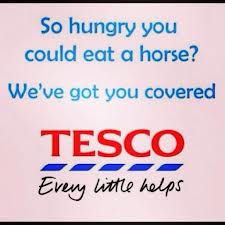
Horsemeat — just this week, An Irish meat processor recalled 10 million burgers from supermarkets across Ireland and Britain amid fears that they could contain horsemeat, a discovery that poses no danger to public health but threatens to harm Ireland’s important beef business.  While the concept of horsemeat is not particularly appetizing to a US culture that idolized Seabiscuit and Mr. Ed, apparently that’s not a universal feeling.  In fact, according to Food Manufacturing, “much of Europe happily consumes horsemeat as a delicacy.  Still, ‘The Irish are known for their respect of the horse, and they’re not used to eating horses,’ the French newspaper Le Figaro explained Wednesday to its readers.”

tescoscared horse

How are these three things similar?   Easy:  with all of them we were served a nasty surprise regarding our food, which is never going to go down smoothly.

How are these different?  Well, in a few ways.

1) Benefits/Dangers – – Melamine is toxic, period.  It provides no benefit in food other than to increase profits for the producer.  LFTB is clearly not harmful, although it has less protein than the beef it replaces.  On the other hand, it helps reduce beef’s fat content, which is good, and can help reduce retail prices of ground beef, a benefit generally appreciated by consumers.  Horsemeat is similar to LFTB in that it is not harmful, but in this case it seems to have been secretly added to ground beef solely in an effort to increase profits.

2) Outcome of the scandal – – Melamine – – boycotts of Chinese products worldwide, 21 convictions, including 19 long sentences and two death sentences in China.  On the plus side for consumers, it has led to longer-term enhancements in food supply chain testing and security.  LFTB – – as a result of the media frenzy, several beef processors went bankrupt, eliminating thousands of jobs and driving higher prices at the shelf.  Horsemeat — still unfolding.

melamine china

3) Role of the media — with melamine, the media was essential in uncovering the scandal and demanding quick action and accountability.  With LFTB, the media seemed less interested in pushing for the public good than in fanning hysteria (and circulation) using the irresistible ‘pink slime’ nickname.  Certainly without that name there would have been far less outrage.  With horsemeat, the media is somewhere in between – – apparently staying mostly objective and reporting the facts, so far.

slime headline

What is the meat of the matter here?  What are lessons for producers and retailers?

–> With the broad footprint of upstream suppliers and the highly dispersed market for downstream finished products, there can be no such thing as too much supply chain traceability and security, and with access to the right information, consumers will increasingly be willing to pay for safety.  Manufacturers and retailers have a potential danger in the event of an ingredient scare, but also an opportunity to use traceability and source of supply as differentiating advantages, by simplifying sourcing, and investing in supplier audits and shipment tracking automation.

food supply chain

–> Consumers will continue to demand transparency regarding what’s in their products.  Manufacturers and retailers will need to increasingly provide it to stay competitive.  To some extent this is not easy; research shows that consumers often have a knee-jerk reaction to the sound of an ingredient (e.g. ‘pink slime’) without bothering to know the facts.  But pink slime is a very obvious example; there are more subtle perception dangers even with very useful ingredients (propionic acid is naturally occurring and helps prevent bread mold; alpha tocopherol is just another name for Vitamin E; and ascorbyl palmitate is an antioxidant and nutrient; etc.).  Claims like GMO-free can provide a marketing benefit but can also generate significant added costs.  Country of Origin Labeling (COOL) is a great concept but can get murky depending on where a product is grown, processed or packed.  Net, providing transparency is a worthy goal but it is still very tricky and will require ongoing management.

ingredient line

–> Social media has helped create a situation where consumers act immediately on rumors and don’t want to wait for facts, which puts all producers at greater risk of a Pink Slime-type incident.  In some ways, this is a risk that is hard to mitigate.  The best advice would be twofold:  1) err on the side of greater disclosure of ingredients so the message can be proactively managed; and 2) in the event an ingredient issue surfaces, use the same social media to immediately acknowledge the problem, present the facts, and communicate what the company is doing about it.

twitter panic

–> The media must remember that with its power comes a responsibility to maintain objectivity, balance and context in reporting the news.  A pink slime-type episode, where sensationalism trumps perspective, can make for interesting copy, but can also have real consequences for real people.

wendys finger

Microsoft: Time to Surface?

Posted on

Mac Classic

First of all, I must note that I am a long-time Apple user – – starting in the 1980s with the Mac Classic, in the 1990s with a Quadra,  and continuing with roughly a $3000 purchase every 3 years when something died.  I figure that our family has bought close to 20 Apple products over the years, not including iPods – – but importantly, including a one-year old iPad. The appeal of Apple was no secret:  intuitive, sleek, inter-device compatibility, and increasingly, no worries about viruses, hackers, blue screen of death, etc.  The limitations of Apple were less compatibility with MS Windows software, which made it less popular with the typical office IT folks.

Mac Quadra

Now it seems Microsoft is (again) going all Apple on us, by announcing the introduction of their SURFACE product, sort of a combination of a pad and a notebook.  Following its history of not being a leader in the hardware arena, and specifically being an unsuccessful follower of Apple (Zune, anyone?) I must admit that the Surface has the possibility to break through.

New Microsoft SURFACE

Why?  Like Apple has done many times before, Microsoft has taken an existing innovation (there were lots of MP3 players before the iPod) and made it more usable.  The Surface tablet addresses probably the key downside of the iPad by simply adding a keyboard (on the reverse side of the now-ubiquitous cover panel).  In addition, the Surface products (there are 2 versions) will operate more like notebooks, with relatively full-function Windows desktops available.  Lack of a keyboard on my iPad, and inability to manipulate files have driven me to my (Apple) laptop more than I would like; these could be improvements that sort out the optimal capabilities array for this type of product and finally help Microsoft get its footing in the hardware arena.

Unless (until?), of course, Apple responds.  Will be interesting to see if Apple announces something before fall, when the Surface is scheduled to debut.  That could send MS back under water…