The future of shopping and loyalty is mobile – – we are continually reminded about this. Digital loyalty programs can leverage vast storehouses of data and sophisticated analytics, and can deliver individualized promotions at a time, place and shopping occasion that optimizes ROI.
So why the heck is there, sitting on my kitchen counter, a sheet for gluing small stamps received with each shopping trip at the local Jewel (Albertson’s)? (If enough stamps are collected, a piece of Cuisinart cookware can be ours!).
After all, this is an utterly low-tech, old media, one-size-fits-all loyalty promotion here in the digital age.
Ultimately the reasons for this low-tech promotion’s survival are related to its low-techness, and can be helpful to more tech-driven modern programs.
Hard to believe but this is essentially the same concept as S&H Green Stamps, which debuted over 100 years ago and were highly popular from the 1930s to the 1980s. You got stamps when you bought stuff, filled out books (typically 1200 stamps) and could then win prizes from a catalog. Stores that gave out these stamps used it as a competitive advantage.
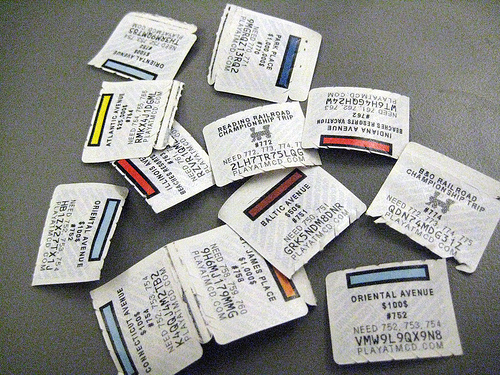
And this is not an isolated grocery type program – – McDonald’s famously runs its Monopoly program, where customers get game pieces on everything they buy, and can win big prizes if they collect the right stamps.
So what accounts for these games’ popularity?
1) Simplicity – no apps, no logging on or passwords, no points to track online, no devices at all. Just shop, stick, rinse and repeat. It’s likely that there is greater appeal among older users for some of these promotions, but that doesn’t explain the McDonald’s popularity.
2) Can visualize success – each new stamp makes progress tangible and encourages continued participation
3) User involvement – Unlike an automatic electronic promotion, manually applying the stamps actively involves the participant, much like adding the proverbial egg to the cake mix turned Mom into a baker – increasing personal commitment level.
4) Closed-ended – a finite promotion period, so no long-term commitment or long wait for a payoff
5) It’s fun! – there’s an excitement to participating in these promotions! It’s not just a mercenary exercise in repetitive purchases; there’s often an element of chance (and like gambling and golf, hope is what brings people back in the face of continued abject failure).
I’ve not seen any statistics about whether any of these promotions is more effective at driving shopper loyalty than any other. I know that stamp programs definitely impact our shopping habits at home.
In any case, it’s clear that digital/mobile is the future of loyalty programs, even if the transition will take some time.
But some of the factors that make these old-school promotions popular can help make future loyalty efforts more successful.
And until tech can replicate all of the above factors, it’s likely we’ll be shopping, sticking and winning, well into the future.
Trying to neatly summarize this sort of confab without a experience as an e-commerce operator is sort of like assuming you can translate Portuguese based on having watched the World Cup. The show was large, chaotic and alien – sort of like walking into 100 Star Wars bars simultaneously.
So while I have decent e-retailing experience, I will not attempt to make sense of all of this.
But I do have some observations.
E-Commerce is based on a few simple objectives, not too different from the marketing funnel used for any other product marketing, but with different terminology:
– gain the right customers’ attention (‘engagement’, ‘click thru’, ‘open rate’)
– encourage purchase (‘conversion’)
– efficiently delivering (‘fulfillment’, ‘final mile’)
– establish a relationship (‘customer experience’)
– encourage repeat purchase (‘loyalty’, ‘retention’)
– encourage WOM, referrals (‘evangelism’)
– etc.
Simple, no? I mean, we all shop online, how difficult could it be?
Well, let’s illustrate some of the complexities using a typical grocery store as the template. Imagine running this store.
This is a store where:
– the store itself serves the entire world — yet it needs to be built to serve the right volume of customers profitably
– finding the store requires a guide — yet the description that will lead to your store changes every 6 months
– your most loyal customers can be lost if a competitor offers to carry the groceries to the car for free
– one of your big vendors (i.e. ISP) can have a bad day and you are unable to open, with no control
– competitors can pop up virtually next door – instantly – and go away just as fast
– about 4 in 10 customers fill up their carts and then exit the store, leaving the cart in the aisle
– a person with bad intent could lock the doors of your store – from thousands of miles away
– your loyal shoppers are barraged with promotional messages from stores right next door – and around the world
– your competitors’ customers don’t necessarily live nearby – – but you still have to find them
– some of your competitors sell products to an enormous store that’s in every market, and which sells them cheaper (hint: starts with an ‘A’)
– and all of this is changing at light speed — Yikes!
On the other hand, all is not lost. Imagine if your store could:
– remind customers when important events are, and even suggest items to buy for the occasion
– send customers totally personalized communications, including catalogs – – as often as you want, for almost nothing
– make recommendations to your customers about what they might love, based on what they’ve already bought
– send customers not just promotions, but at the exact time that you know they typically buy, and the deals that they respond to
– enable your customers to tell all their friends about your great store – – instantly, when they’re most excited
– follow up every single purchase to make sure everything is ok
– dress your store up for the holidays or another event – – instantly
– change what your store offers based on what your customers are buying elsewhere
– enable customers to order merely by touching the picture in the ad
This is the magic of e-tailing. The ability to reach and influence is remarkable, and the rules are constantly changing.
Here are a few companies whose products looked interesting:
Ship 2 My ID – – from their website: “Ship2MyID is a social commerce enabler that will allow users to buy items online and send them to others without needing to know the receiver’s physical address. Both the sender and the receiver’s physical addresses are kept hidden from each other, and the receiver has to accept the shipment, ensuring security.” Got it? You give them your email or social media ID, they help someone ship something to you without their knowing your address. yes, me too.
OrderGroove – encourages all-important loyalty by enabling subscription ordering (i.e. they figure out when you run out of vitamins, diapers, dog treats, whatever, and facilitate having the manufacturer send to you.)
Bitpay – Still don’t understand bitcoins? Doesn’t matter. With these guys, your store can still accept them.
From their site: “Instant conversion, no transaction fee, and bank deposits in US Dollars, Euros, GBP, CAD and more. We take the bitcoin exchange rate risk, your customers get the best rate on the market, and you get a payment you can count on, every time.”
Sounds pretty low-risk to me.
FeedVisor – Algorithmic Repricing for Amazon Sellers! I will admit – – not 100% sure what these guys do. Maybe not even 50%. There was a crowd of intimidating techies crowded around the booth so I just gave them wide berth and moved on.
The IRCE show is one trade event that is actually worth attending every year, because you know that in a year everything will be completely different.
This is the time of year where instead of being productive, people put together lists.
So here’s my look back at 10 events in 2013 that provided (purposely or not) great learning.
2013 Lesson 1: Measure Twice, Cut Once. Make that: Measure three times. Healthcare.gov rollout
(honorable mention for Chicagoans: Ventra public transit card rollout).
– So many lessons here. It’s the lesson that keeps on giving. Reminder: even if your brand isn’t one-sixth of the national economy you probably still want to test a new e-commerce site. Test, test and then test again.
2013 Lesson 2: A brand CAN do a 180 in a Single Day Miley Cyrus
– And in this case it took about 5 minutes. The recipe: take one tweens’ idol named Hannah Montana. Remove most clothes, liberally add makeup, a big foam finger and nationally televised awards show; mix aggressively using the body and add a large dash of idiot grin. Voila! You’ve now transformed from Hannah Montana into what looks like the love child of Gene Simmons and Dita Von Teese, without the charm.
The winner: probably Miley and her handlers, but hard to know yet. The clear losers: Millions of formerly innocent Hannah fans. Also, the general cultural level in the US.
So yes, it is possible to completely change your brand’s image in a day. But it might involve twerking.
2013 Lesson 3: There is such a thing as too much transparency Lululemon
– Due to quality control snafus, Lululemon’s yoga pants delivered a little more than was supposed to meet the eye. The media, always a model of sober restraint when it comes to high-minded topics like see-through clothing, did its best to spin this story as salaciously as possible. Ultimately it went viral, resulting in loss of gobs of market value, as well as Lulu’s top management. At least they kept their sense of humor about it. (actually, there is a real lesson here: at the end of the day it’s about the product – and you can never take your eye off the ball).
2013 Lesson 4: The early bird still catches the worm – – if he tweets about it. Oreo cookies
– We now live in an era that enables, and requires, real-time marketing. As has been reviewed ad nauseam (guilty!), Oreo slam-dunked it with a timely tweet during the Super Bowl blackout. Meanwhile, given the opportunity of Marco Rubio’s magic cotton-mouth TV moment, the Poland Spring ad team not only didn’t stick the dive, they missed the pool entirely.
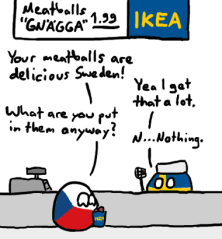
2013 Lesson 5: When life gives you lemons, make lemonade. When your meatball supplier tries to slip you some horsemeat, clean house IMMEDIATELY. IKEA
– When IKEA learned that some of its famous meatballs (150 million annually!) might contain traces of horsemeat, it immediately got rid of all meatballs in inventory, whether suspect or not. Cost of write-off? Probably pretty high. Benefit to reputation by immediately taking action? Priceless. Sales of meatballs since then? UP.
2013 Lesson 6: Hint: ‘Fail Fast’ is really just a euphemism for Test and Learn. It doesn’t mean your goal is actually to fail fast. JC Penney
– Here is a retailer that tried to do a 180 without twerking. Or more importantly, without considering that its customers preferred periodic discounts. Boom.
Easier to adapt to customer preferences than to try to force them to adapt to you.
2013 Lesson 7: There is No Such Thing as Bad PR (at least for Jeff Bezos) Amazon
– Amazon’s eerie delivery drones cleverly debuted on ’60 Minutes’ the day before Cyber Monday. Never mind that if you give it about 5 seconds’ thought, the barriers are significant (snow? wind? power lines? privacy issues? teen boys with slingshots?) – what it really shows is that in addition to any product you can think of, Amazon’s mission apparently also includes delivering PR to all homes.
2013 Lesson 8: If you go for the ‘wink-wink, joke’s on me’ approach, and people don’t get it, then ‘wink-wink, the joke’s on you’. Honda/Michael Bolton Holiday campaign
– If you didn’t see them, these spots feature the man of the strained tenor and shorn mullet singing soulful holiday-esque tunes from atop a Honda, next to a Honda, in a Honda showroom, behind a piano, behind a guitar, all to the indecipherable reactions of surprised, baffled, younger presumed car shoppers. It’s difficult to tell what the point is. The obvious assumption is that this is a quid pro quo: the 60-year old Bolton (perfect for a younger target!) has a new album that needs promoting (true) and Honda needs some breakthrough quality in the holiday car ad environment that generally features obnoxiously gift-wrapped luxury cars (true again).
But what’s Bolton doing up there on that car? Apparently, according to Adweek, this campaign is ‘poking fun at itself with melodramatic guitar solos and idiotic lyrical gems like “This special time of year, it’s filled with joy and cheer, for me and you and you and you, too’.” Well, I know something about misplaced melodrama and idiot lyrics and I didn’t catch it. If there’s a wink in there somewhere, it’s subtle enough as to be invisible.
So we’re left with a spot with bland cars, being promoted by bland music – – a perfect match, but I suspect probably not what they were going for.
The American public as a rule doesn’t respond well to ‘subtle.’ Witness, if you will, Ron Burgundy for Dodge – – a more effective celebrity hookup.
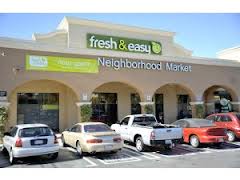
2013 Lesson 9: When in Rome, do as the Romans do. When trying to break into Southern California, and your name contains the word ‘Fresh’, don’t pre-wrap the fruits and vegetables. Tesco Fresh & Easy
– This one already has a coda. Big UK retailer Tesco created its Fresh & Easy chain in late 2007 to penetrate the Western US market with a fresh new smaller format store, famously after significant consumer research. The experiment failed when consumers didn’t respond well to new formats, new food presentation, and in some cases, truly foreign concepts. Ultimately F&E was sold to Yucaipa, which has added “competitive pricing, improved hours, fresher foods and assisted checkout” according to management. Everything, it appears, has been changed except the name.
– The obvious lesson – – listen to your customers (see Lesson 6).
2013 Lesson 10: You can say Social Media and B2B Marketing in the same sentence Maersk Shipping
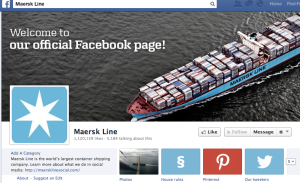
– Maybe it’s the exotic locations where its ships are shown. Or maybe it’s just the fact that deep down we’re all little kids and are awed by really cool big boats. Whatever the appeal, big freight shipper Maersk found a way to go from zero to one million+ in Facebook likes in about a year (good Forbes article here). Of course, no one places container orders on a Facebook page, but for very little cost (repurposing archival company photos) this enhances the Maersk brand, distances it a bit from its competitors, and likely provides meaningful recruiting and morale benefits.
Probably the big lesson for 2013 has been that while many old conventions are being challenged (e.g. static campaigns, role of social media), the key marketing fundamentals are still alive and well: understanding your customers and their needs is the surest way to success (or at least avoiding being in next year’s write-up).
When I first heard that Restoration Hardware was delivering 7 lb. reflections of its founder, I feared that science had finally mastered cloning and was sending us all little Gary Friedman (‘Chairman Emeritus‘) babies. Turns out it’s even worse.
It seems that Restoration Hardware, which owes its success to the retro look, is also committed to retro marketing.
RH Spring 2013 catalogs
Chairman Emeritus Gary Friedman
Last week in my mail I received the latest RH catalog – make that catalogs with an ‘s’ –no, scratch that – -make it ‘Source Books’ – all 7 lbs and 1600 pages of it. It is huge, glossy, painfully self-conscious, and utterly uncalled for. Comprising 5 separate parts (‘Interiors’, ‘Outdoor & Garden’, ‘Objects of Curiosity’, ‘Tableware’, and ‘Small Spaces’), it prominently features the heroic, studiously casual, Ralph Lauren-style visage as well as philosophical meanderings of the founder, Mr. Friedman. It also features a sober collection of furniture marketers, as well as such fashion-forward innovations as deconstructed furniture. Yes. You can now have this for your home.
RH Design Team
Deconstructed chair
You can find some other worthy commentary in the MorningNewsBeat blog. And the philosophy of Mr. Friedman in the inside cover pages (“uh, do you mind if I, um, quote myself?”) is worth a quick look.
Now, to be fair, I’ve bought things at RH before (although I can’t remember the last time), and among the weirdness they do have some very nice stuff, although it always seemed overpriced. But I can’t figure out why they would invest anywhere from $3 to $18 (depending on who you ask) to send this bulky material to my house. I didn’t ask for this crap! How does this ever pay back the millions invested? New users?
Beyond the RH website, the catalog itself is available online as an iPad/iPhone app, which seems more consistent with how people shop. And sending this enormous bulk of paper, in addition to being highly wasteful, now requires effort on the part of environmentally-conscious recipients – to execute recycling properly. Mine went to the bin right after the photo shoot.
More likely, it is a true ego reflection of the founder – – and reveals his most basic underlying philosophy: size matters. In a final unintended irony, an almost whispered disclaimer on an insert commends itself on sending this catalog ‘twice a year rather than monthly’, and encourages consumers to ‘participate in the recycling programs in their communities’. No kidding.
What sort of a charmed life is one living when Chef Robert Irvine factors into it twice in a single month? I had the pleasure of walking the floor at the National Restaurant Association show in Chicago this week, and was treated to a delightful array of sights, smells, tastes, huge portions of protein, and in the case of Chef Irvine, sounds!
Overall, while there were no gangbuster introductions, the show seemed to achieve a cosmic balance of the healthy (e.g. gluten-free), the indulgent (pastry galore), the novel (spinach balls) and the old-school standbys.
Here’s a sampler from this roving do-it-yourself Lazy Susan:
1) MO’ MEAT! An unlimited assault of meat. Australian Wagyu beef (unbelievable!), Ditka’s chicken sausage (should real men eat it?), bangers from Jolly Posh, jamon iberico de bellota, plain old hot dogs, and the list goes on. A veritable on-the-fly charcuterie. Ron Swanson’s vision of heaven. Perhaps the only product equally welcomed at either NRA show.
2) Celebrity! The boundary between cooking as craft and cooking as entertainment has been erased forever. Anthony Bourdain, a few of Food Network’s A Team (Aarón Sanchez, Robert Irvine, Alexandra Guarnaschelli – and that was just the day I was there), and many others. They attracted long lines, and in the case of the showcase demo area, made a lot of noise (yes, that’s Chef Irvine wearing a tight black short-sleeved shirt for a change).
3) Rising international influence. The international representation of exhibitors was exceeded only by the internationality of the attendees. Not just many countries, but lots of delicious cross-fertilization of ingredients and techniques. More proof of the unstoppable globalization of foods and flavors. Peru debuted at NRA this year.
4) Salmon – oak or maple smoked, flavored, salty, delicious – – and in unlimited supply. Like the brunch table at that swanky Bar Mitzvah you heard about but weren’t invited to. Maybe it’s been there all along, but I was astounded at all the options this year.
5) Tchotchkes – Flo bobble-heads (from Progressive Insurance), t-shirts, cozies, pens, etc. I was lucky to be on the floor close to the show’s end, and scored a nice bottle of Magueye Sweet Sap – – an old-but-new, tasty alternative sweetener. You heard it here first.
6) Umami – OK, there are 5 flavors now, just like there are 8 planets. Forget what you learned as a kid. It’s here, it’s savory, and it means great taste. A whole area was devoted to just umami.
7) Greek Yogurt – – it’s alive! And not just in plastic containers any more. Not only were Greek yogurt-based dessert options shown that more closely resembled ice cream sundaes, there was also Greek yogurt cheesecake, mac and cheese, and more. Hmm…starts out as a healthy option, now loaded with sugar and other stuff. We’ve seen this before: energy bars, muffins, etc.
7) Technology – from the large booths of companies like NEC and IBM, to small software entrepreneurs, at times the NRA looked more like a technology convention. Whether hi-tech signage, online menu management software, or nutritional scoring, technology seems almost as important as the food in enabling operators to compete profitably. Judging by a lot of sameness in some of the standard food offerings, perhaps it’s already passed food in importance…
9) Alternative ordering/delivery – GrubHub/Seamless, MobileTummy and others were pitching all manner of new ways to hook people up with food. Order online, order by mobile, have it delivered, have it ready – – another case where technology is enabling options that are designed to match the way people live.
10) Focus on kids’ health – consistent with NRA’s own Kids Live Well program, there were quite a few exhibitors focusing on not only healthier fare that kids might actually eat, but techniques to evaluate nutritional content and make good choices as foodservice operators, as well as consumer-friendly apps to make it easier to find a restaurant with kid-friendly offerings.
OK, that headline is a bit harsh. But so is the world of retailing – – no matter how high-concept and inspired a new retailing idea is, if it doesn’t integrate the core consumer in the development process, there could be trouble. We will respectfully dance on a few graves and illustrate with 3 cases.
Case 1: JCPenney. By now we all know that Ron Johnson flew a bit too close to the sun, banking on his reputation and the obvious hubris gained during his successful run at Apple. He applied the Apple Store model (where the stars were ultimately the products) to JCPenney, with an immediate switch to an everyday pricing approach (since reversed), and store remodels including branded mini-boutiques. All, famously, without testing. The result: a disastrous $4 billion sales slide, imploding stock price, his ouster and most recently JCP looking to the capital markets to secure another $1 billion in operating cash. Ouch.
—> Diagnosis: Less brilliant, more tone-deaf. The plan counted on consumers to see things Ron’s way: “Hey! JCP now offers reliable low pricing all the time, so you can trust us!” The catch: consumers apparently liked the way they already shopped – -they were used to buying on deal, and there was not much merchandise at JCP that couldn’t be bought elsewhere. And elsewhere is apparently where consumers went.
Case 2: Tesco’s Fresh & Easy Neighborhood Markets. British supermarket giant Tesco announced it will shutter and take a $1.5 billion write-down on its F&E chain, after cumulative losses exceeding $1 billion and 5 years after noisily entering the California market. Fresh & Easy, which famously touted its in-depth consumer research, opened smaller format (10,000 sq. ft) stores and promised “convenience, fresh produce and tasty prepared foods” (LA Times).
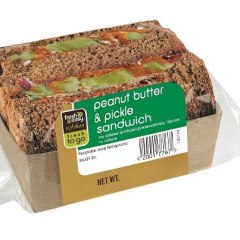
—>Diagnosis: They didn’t walk the talk. Rather than truly adapting to Americans’ shopping habits, Tesco essentially imported its own model and assumed that customers would do the adapting. A few examples of British norms that didn’t make it here: pre-wrapped produce (heavy on the watercress!) and pre-packaged sandwiches (but no fresh deli), fewer familiar branded products in favor of higher-priced private label, and a policy against couponing.
According to respected researcher The Hartman Group: “We believed then, and said it repeatedly in the following years, that Tesco had an innate desire — an arrogance if you will — to do things their way rather than make adjustments that catered to the needs and expectations of American shoppers. Despite Tesco’s vaunted success in the European marketplace, the resulting retail experience in Fresh & Easy was artificial, sterile and increasingly without a relevant proposition.” (bold added)
Case 3: Webvan. The mother of all examples of misjudging the consumer. Founded in the late 1990s by Louis Borders (of bookstore fame), Webvan was an online grocery retailer offering delivery within a 30-minute window. Funded by Silicon Valley venture capital, Webvan hired away the president of Andersen Consulting (now Accenture) and was heavily capitalized ($1 billion for warehouse infrastructure, plus vans, computers, etc.) By 2001 Webvan was bankrupt (although subsequently bought by Amazon, where it exists in a much smaller form).
—> Diagnosis: Webvan management and investors incorrectly assumed that consumers would immediately adapt to their genius. Grocery buying is very personal, an ingrained habit, and expecting large numbers of people to abruptly abandon what they’ve been doing for years was naive at best. In the heady days of the dot-com bubble #1, funding was fast, and it was big (Borders himself said “It’s $10 billion or zero“. He was right). So the inclination was go big or go home, leading to huge advance spending, astronomical traffic expectations, and a spectacular flameout when consumers didn’t sign up as the financial pro formas had assumed. By one estimation, Webvan would have had to sign up two-thirds of the tech-savvy households in the San Francisco area. This is probably one of the best examples of misjudging (or conveniently ignoring) consumer input, breathing one’s own exhaust, as well as the adage ‘Easy come, easy go’. A short, fun post-mortem can be found here.
 So why the heck is there, sitting on my kitchen counter, a sheet for gluing small stamps received with each shopping trip at the local Jewel (Albertson’s)? (If enough stamps are collected, a piece of Cuisinart cookware can be ours!).



























 The Armchair MBA