Author Archives: davetuchler

GEICO Advertising: It’ll take a lot less than 15 minutes to read this post…

I’ve been thinking about GEICO lately.  Not because I’m shopping for insurance, but because GEICO doesn’t give me any choice – – its advertising is in my face (and ears) constantly.

Which got me thinking:  Marketing 101 says that there should be creative consistency in advertising, lest the message (and brand) become diluted or confused.  But I can name at least a handful of concurrent campaigns (not counting infinite executions) for GEICO being used today.  I bet you can, too.

–       GEICO gecko – inescapable, multiple cross-media executions Geico gecko

–       Happier Than (guys playing guitar/mandolin) – (“How happy are GEICO customers? – – happier than Eddie Money running a travel agency”, etc)

Geico Eddie Money

–       Caveman (“so easy a caveman could do it”)Geico caveman

–       Rhetorical (“Was Abe Lincoln honest?”  Mary T. L.: “does this dress make my backside look big…”) (personal favorite)

Geico Abe Lincoln

–       Maxwell the Pig

Geico pig

–       And more.  There’s even a Wikipedia entry dedicated to GEICO advertising

Geico eyesGeico Peter GravesGeico Serling

So what gives?  Lots of quite different executions trying to sell basically the same product. Wouldn’t putting all weight behind one creative campaign (with freedom for infinite versions) make more sense?  Well, 2 main reasons:

1)    While the creative changes, the USP/ message is highly consistent.   All roads lead to Rome, and all GEICO ads lead to “15 minutes could save you 15% or more on insurance.”  They may be talking about a car, home, motorcycle, RV or whatever, but in the end the message is the same.  And that’s what counts.  While there might be a mixed read on what consumers recall creatively, I bet message recall (‘cheaper insurance’ or similar) would be very consistent.

2)    At some point any advertising can reach a saturation/burnout stage, and familiarity, even with the most inventive creative, will breed contempt.  So changing up the rotation, with the sort of weight GEICO deploys, works to its advantage.  In addition, consistent use of humor (generally done well) lends a lightness to the proceedings that make the spots more tolerable.

– McDonald’s has a similar variety of campaigns, but they support different strategies (meal dayparts, seasonal favorites, dollar menu, new products, etc.).

– Big Auto uses similar weight/variety, but unfortunately much of the focus is on price and only a few have message consistency that endures over time (‘Ultimate Driving Machine’).

The only questionable tactic is recently identifying GEICO by its original name, Government Employees Insurance Co.  Considering Congress’s abysmal approval rating (12%), one wonders what the expected gain would be.

Moral of the story:  in advertising as in humans, up to a certain point weight is necessary; beyond that point one must be cautious.

On the other hand, I still haven’t invested in that 15-minute phone call…
Why I don’t discuss politics on Facebook

Well, why would I?

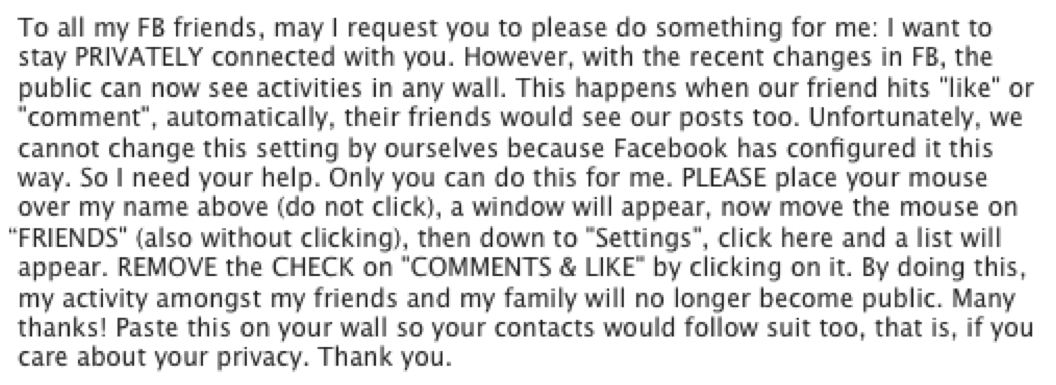
Recently started getting this request from friends on Facebook to make comments private.

Image

You may have also noticed stories like this about friends (and relatives!) unfriending each other because of something that was posted that chafed their backside (most likely involving politics).  I’ve seen posts recently from friends that made me think a lot less of them, and frankly encouraged me to stay away from them.

We’ve reached a point where we can broadcast pretty much indiscriminately, but haven’t seemed to figure out that this also requires a comparable amount of discretion.  In the days where we knew where our messages were going, we also realized that any consequences would affect us directly, so we acted accordingly.  If I insult your wife, I get a punch in the nose.  Social media has created the ability to spew behind the protection of a computer screen with no apparent immediate personal danger – – so people often assume no accountability.  But these people fail to realize that the implications have taken a different shape, and that consequences now shift well beyond ourselves.  Because of the ability to also share on a mass scale, the potential impact of any message rises exponentially.  In some cases it can introduce negatives that didn’t need to be there – – and as we’ve recently seen, social media provides a platform for any nutjob to express their personal far-out positions, but whose rants become convenient cover for other extremists’ real, violent agendas.

Image

So why don’t I share political views on Facebook?  Well, what’s the point?

– I probably already know who you’re going to vote for (and vice versa) – and in most cases I really don’t care, so there’s no need for any more reminders

– I’m not going to change anyone’s mind

– Something that seems funny to me can be truly offensive to someone else.  The amount of juvenile and insulting commentary posted by supposedly educated people is staggering.

– I don’t even usually have original content – – attaching someone else’s rant does not show how clever I am (usually quite the opposite)

– I have some dear friends who have different points of view – – sometimes really dramatically different.  But I’d like to keep them as friends.  If and when it feels appropriate to discuss politics or religion or this season’s hem lengths, I’ll take it on with them personally.  Where they know where I stand, where I speak for myself, and where what I say considers the audience and the potential consequences.

As for puppies and sports and catching up with friends and lots of other things, I’m still all-in.

These popular sports don’t belong in the Olympics

OK, we’ve seen Andy Murray and Serena Williams win singles – great, exciting, pip pip, etc. But tennis shouldn’t be in the Olympics (and the same goes for golf, which is regrettably planned to be introduced as an Olympic sport in Rio in 2016).
WHY do I make this cranky and probably unpopular statement?

Simple: the Olympics is where the world sees who is the best athlete in each individual sport, where there aren’t generally well-publicized events otherwise. (quick: do you remember the last time world champions were decided in Women’s 8s?). These are athletes who are almost all amateurs, making remarkable sacrifices to be able to prove their mettle to the world (and themselves) on a grand stage.

Well, tennis happens to have a schedule of major tournaments that are conducted among the world’s best players 4 TIMES EVERY YEAR!  French Open, US Open, Australian Open..and we just finished Wimbledon, for crying out loud! So why do we need yet another tournament that will only steal television coverage from those athletes who are more deserving of this quadrennial spotlight?  Additionally, these pro tennis players already have more fame and fortune than most humans – – perhaps being deprived of the honor of representing the US is the price they have to pay.  On the other hand, maybe the US competitors could start by doing better in the Davis Cup!  ‘Golden Slam’?  Spare me.

Ditto for Golf.  We just don’t need it in the Olympics. Let’s start by doing a little better in the Ryder Cup, eh chaps?

And in the ‘is this a joke’ category, NFL Commissioner Roger Goodell has apparently started lobbying for ‘US-style football’ to be included in future Olympics.  He claims there are 64 countries already playing the sport, which is some sort of requirement.  Well, I’ll agree that Texas and a few other states could be considered countries, but mostly – –  ARE YOU KIDDING ME?

Microsoft: Time to Surface?

Posted on

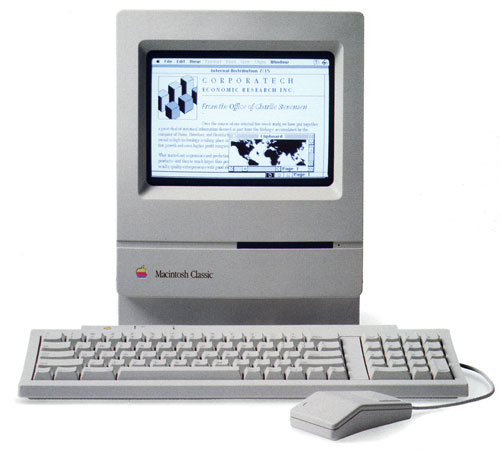
Mac Classic

First of all, I must note that I am a long-time Apple user – – starting in the 1980s with the Mac Classic, in the 1990s with a Quadra,  and continuing with roughly a $3000 purchase every 3 years when something died.  I figure that our family has bought close to 20 Apple products over the years, not including iPods – – but importantly, including a one-year old iPad. The appeal of Apple was no secret:  intuitive, sleek, inter-device compatibility, and increasingly, no worries about viruses, hackers, blue screen of death, etc.  The limitations of Apple were less compatibility with MS Windows software, which made it less popular with the typical office IT folks.

Mac Quadra

Now it seems Microsoft is (again) going all Apple on us, by announcing the introduction of their SURFACE product, sort of a combination of a pad and a notebook.  Following its history of not being a leader in the hardware arena, and specifically being an unsuccessful follower of Apple (Zune, anyone?) I must admit that the Surface has the possibility to break through.

New Microsoft SURFACE

Why?  Like Apple has done many times before, Microsoft has taken an existing innovation (there were lots of MP3 players before the iPod) and made it more usable.  The Surface tablet addresses probably the key downside of the iPad by simply adding a keyboard (on the reverse side of the now-ubiquitous cover panel).  In addition, the Surface products (there are 2 versions) will operate more like notebooks, with relatively full-function Windows desktops available.  Lack of a keyboard on my iPad, and inability to manipulate files have driven me to my (Apple) laptop more than I would like; these could be improvements that sort out the optimal capabilities array for this type of product and finally help Microsoft get its footing in the hardware arena.

Unless (until?), of course, Apple responds.  Will be interesting to see if Apple announces something before fall, when the Surface is scheduled to debut.  That could send MS back under water…

Bloomberg’s Soft Drink Edict: New York State of Mind

Posted on

I’m not in favor of Orwellian control of things like drink sizes.

HOWEVER, what seems to have been lost in the recent NYC brouhaha is that there is something huge in the idea of managing down drink sizes (and food portions overall):

1) we all know that humans have essentially zero self-control, and like puppies, will continue to consume whatever is put in front of them until it is gone – – so somehow influencing options makes sense from a behavioral perspective
2) a recent study put Americans’ caloric intake from beverages at around 24% of total caloric intake, yet people to a great extent don’t think about drinks when counting calories – – it’s thought of as sort of a free play.
3) there are roughly 350 calories and about 88 grams of sugar in a single 32 oz cola drink — which chips away quite a bit toward daily recommended intake of 2000-2500 calories and exceeds the recommended daily intake of around 50g sugar (depending on where you source your info).
4) When you consider that a lot of these drinks will be consumed with food, and that restaurant food portions are very often too big and unhealthy, it starts to get scary.

No less an authority than British boy band One Direction (please don’t ask), when asked about the biggest difference between the States and the UK, their immediate response was not the weather, not the girls, not the cars, not the great dental environment – – it was FOOD PORTIONS.    (see 16:47 to about 17:15)

So, I understand Mayor Bloomberg’s objectives, but government mandate can’t be the answer (impractical, unfair; people can apparently easily work around gun laws, so gaming the soda restrictions might just be doable).

If there could be some market-driven way for consumers to somehow be trained to be satisfied with non-excessive portion sizes (food and drink), there could be forward progress.  I wish I had an answer.  But as we’re so trained to equate ‘good value’ with ‘big meal’, getting our arms around this problem will be a tall order (puns intended).

Scotts vs. Pennington: Grass Stains

Posted on

It’s springtime in the US, and the sounds of birds chirping and squirrels chattering are being drowned out by Scotts and Pennington going after each other like Itchy and Scratchy.  For peat’s sake, what’s going on here?

For starters, seems there’s a violation of that age-old marketing axiom:  don’t legitimize your smaller competitor!  (I mean, would Mitt have belittled Ron Paul?  Do the Kardashians need to compare themselves to Snooki?)

Scotts Company – the 800 lb gorilla.  If you can fog a mirror you have heard and/or seen a lot of a Scotsman named ‘Scott’ of Scotts doing a pitch for TurfBuilder grass seed in a slightly cartoony but mostly agreeable faux-brogue.  This is prime time for the enormous lawn care industry and Scotts brought their A Game with breakthrough advertising with a simple message and catchy mnemonic.  And who doesn’t know Scotts?  They are the 800 lb gorilla in lawn care.  All they really need to do is remind you of the need, the name, and where to buy.

The scrappy upstart. So what happens?  A much lesser known (perhaps until now) competitor named Pennington Seed Company and Scotts have apparently gotten sufficiently in each others’ grills with competitive claims that there has been a spate of back-and-forth lawsuits in the last few years.  Unlike most categories where Scotts dominates, Pennington actually claims share leadership in their specialty, seed.  And in an effort to directly tweak their nemesis, Pennington currently is running copy claiming that Scotts seed products contain filler.

You said their name was Pennington?’  Amazingly, Scotts has responded by running spots mentioning Pennington by name with ‘Scott’ also saying on radio he’s got ‘a bee in his britches’ about the claim Pennington is making regarding seeds.

One can just imagine how ticked off Scotts management must have been to approve the spots (likely over the agency’s guidance), and maybe it feels good, but this can’t be a good move.  By contesting Pennington’s position in a portion of the business, seed, Scotts has now validated Pennington as a broader lawn care company, making it easier for them to increase their offerings beyond seed.

“I’d like to acknowledge my competitor, who is way behind in the polls”.  Everyone who would have previously looked past Pennington on the shelf now has some level of name recognition and credibility-by-association, so this can do nothing but help Pennington when clearly Scotts’ objective was the opposite.

Separately, over the last year Scott has launched more detailed explanatory videos on YouTube, documenting exactly what is in a bag of Scott seed.  Because this is likely to be viewed only by people who are already involved in the category, contrary to their broadcast marketing efforts, this seems like a very smart move.

Will be interesting to see how this plays out – – a lot of green is at stake.

Mondelēz Musings

First off, say you’re an international media powerhouse and there’s a hot branding story to be written — who you gonna call?  Well, if you’re the Wall Street Journal, it would be the fortuitously and impossibly named Julie Jargon, of course (check for yourself).

– On to the issue of Kraft’s new name – Mondelēz:  Despite the public yelping and nattering, beyond the many snarky-but-funny commentaries out there already (Mon-de-Leeza Rice, Da Vinci’s Monde-Leza), whether you like it or not, this name is unlikely to have a significant business impact one way or the other.  Corporate names (particularly where individual products are differently named) are generally inwardly focused; as Robert Passikoff of Brand Keys observed, consumers buy products, not companies.  Investors, on the other hand, do buy companies, in whole or in part.  So they are probably the most relevant audience – -and their decisions are based on financial performance, not nomenclature.

– If you’re in the business of developing a new corporate name, it is a bit like a chocolate candy with a small rock inside – -looks like a tasty fun project but quickly becomes very difficult to chew – especially for a global company.  Not only do you need to find a heretofore-unused name (because otherwise it’s not protectable or proprietary), it has to be usable internationally (and by usable I mean it minimally can’t insult cultures/religions or otherwise incite any sort of web-fuelled blowback).  Additionally, there needs to be global trademark clearance, availability of URLs, etc.  With luck, it can even conjure some sort of general imagery – – good-tasting food, global, etc. – -but that’s really not the primary consideration.  It’s about finding something that works.  Other industries that need a ready supply of new names, a prime example being the pharma business, have out of necessity chucked some of these criteria, which results in new drug names resembling past foes of Captain Kirk as he manned the bridge staring at that large before-its-time flat-screen TV:  including new entrants Jakafi, Egrifta, Erwinaze and Forfivo (according to Gregory Karp of the Chicago Tribune).  Mmmm!

But the most difficult aspect of naming is that new and unfamiliar names are rarely going to be immediately loved, or even liked.  As humans, we like the familiar, we assign emotional connections to brands and it’s generally not possible to drive instant familiarity and positive connections with an intangible corporate entity – – if anything, this would evolve over time.  It’s very hard to get a realistic assessment of how new names will play out in the long run through research, regardless of how many are polled – – in the immediate setting, there’s not a lot at stake with a positive or negative reaction, and people can’t project a familiarity-driven feeling into the future.  Think about some of the new names that have been hatched recently:  Verizon (not bad), Accenture (mostly harmless), BearingPoint (reminds me of BreakingPoint), Altria (neutral).  None of these really impacted the company’s fortunes one way or the other.  The most practical evaluation of a new name, thus, becomes: does the CEO like it?  This depends a lot on how it strikes this particular person – – with the obligatory ‘supporting research’ in tow.  Fair?  Optimized?  Probably not.

– On the other hand, there are some subjective repercussions of Mondelēz that can’t be ignored.  In this case, I can’t help but think that Mondelēz is an actual person. And not just any person, a male person.  And not just any male person, but someone who might be a cross between Juan Valdez of coffee fame, and the Dos Equis Most Interesting Man in the World.  So there is definitely (at least for me) a Latin male image that was probably not the primary goal of the creative brief.  Don’t know if it’s ‘mon’ that is similar to ‘man’, or the long e (ē) macron symbol that looks like a Spanish enye (ñ). In any case, male and Latin is fine, but it perhaps loses some appeal to more than 50% of the world’s citizens, and a much greater share of the world’s shoppers.   Or maybe it somehow conjures a single-named entertainer (like Gallagher, Yanni, Fabio, etc).  Like an earworm, you can persuade me all you want but that’s now the image I’m carrying around.  (You know, one never gets a second chance to make a first impression).

– Net, this corporate naming business is difficult, but in the end, large budgets, repeated exposure and time will dull the first impressions and generate familiarity and possibly positive impressions over time.  And since consumers don’t really connect corporations to uniquely-named products, it’s not a life-or-death decision (product branding is a different story).  So my prediction: Mondelēz will, over time, become part of the landscape and we’ll move on to different and more important issues.  Just don’t get me started about AbbVie…or Russian slang…